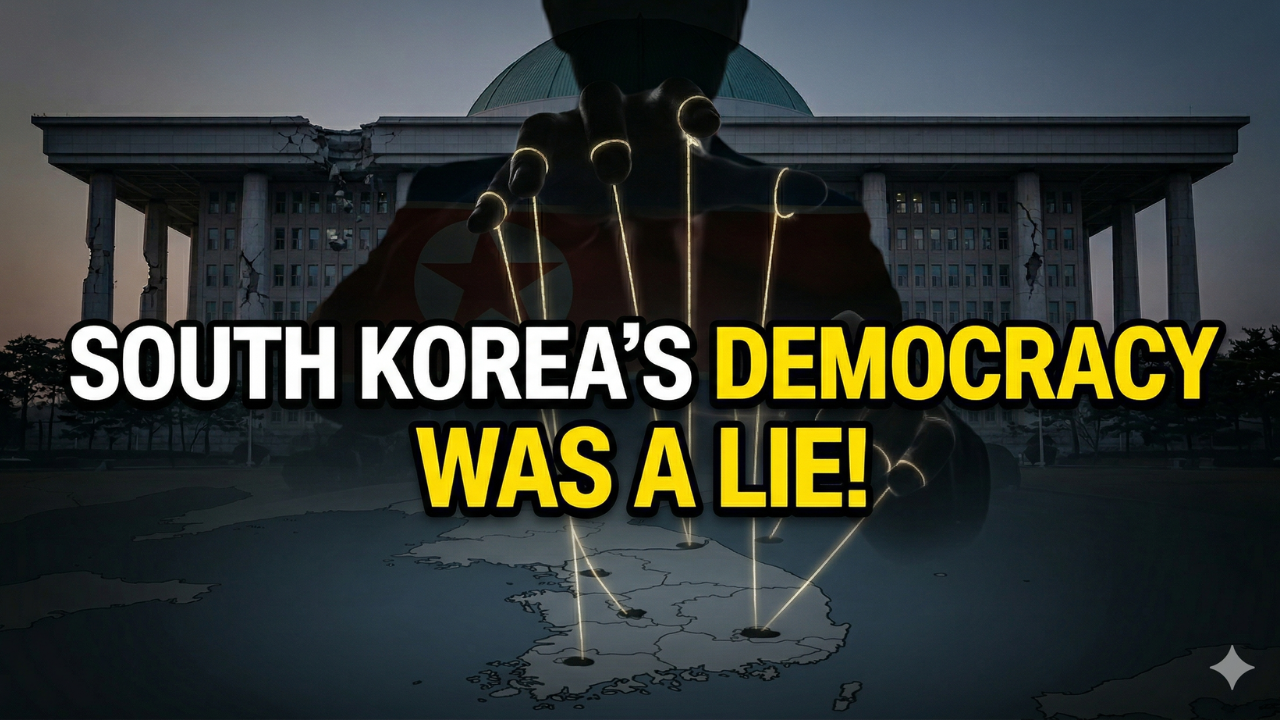
By The Truth Hunter: South Korea Investigative Team
(SEOUL) — For decades, the world has looked at South Korea as a beacon of rapid democratization and technological marvel. This narrative, a polished “K-Pop smokescreen,” has successfully masked a darker, more volatile reality. Our latest deep-dive investigation exposes how this image is being systematically dismantled from within. South Korea’s democracy, far from being a consolidated ideal, is a facade clinging to the edge of an abyss.
Our months-long investigation reveals a sophisticated, invisible architecture—a “Hidden State South Korea”—that operates beyond the reach of the voter and the rule of law. This “Secret Power Structure” does not just influence policy; it manipulates the very mechanism of democracy: the electoral process. The goal? The controlled dismantling of the existing democratic order to install a system beholden to an unaccountable elite.
1. The Dramatic Hook: The Fragility of Democracy
Democracy is not a permanent state; it is a pulse, and in South Korea, that pulse is fading. We tend to believe that once a nation achieves free and fair elections, the battle is won. But what happens when the very institutions tasked with safeguarding those elections are the primary source of their vulnerability?
The “Truth Hunter” team has obtained explosive testimonies and confidential data indicating that the foundational trust required for self-governance has been severed. We are witnessing the methodical “dismantling of the Republic” . The average citizen believes their vote is a sacred expression of will. Our investigation suggests that, too often, it is merely data to be managed by the invisible hand of the “Hidden State.” This is not a conspiracy theory; it is the data-driven reality of modern electoral corruption.
Key Insight:
The greatest threat to South Korean democracy is not an external aggressor, but an internal, symbiotic network of political, corporate, and bureaucratic elites who operate a “Hidden State” to manipulate the country’s trajectory.
2. Anatomy of the Hidden State: Defining South Korea’s Secret Power Structure
To understand the crisis, we must first define the enemy. The “Hidden State South Korea” is not a formally recognized entity. It is an informal, yet highly organized, power structure comprising high-ranking bureaucrats, key figures within the National Election Commission (NEC), senior executives of major conglomerates (Chaebols), and powerful political brokers who transcend party lines.
This “Secret Power Structure” operates on two main levers of control:
- Financial Leverage (The Chaebol Connection): While the days of direct cash transfers in blue houses are largely gone, the Hidden State uses complex subcontracting webs, media ad spend management, and “post-retirement” placements (the infamous ‘parachute’ appointments) to ensure political actors remain compliant.
- Data Manipulation and Jurisdictional Capture: The most potent weapon of the modern Hidden State is information control. Our sources indicate that the structure has prioritized the placement of loyalists within key, ostensibly independent oversight bodies, specifically the NEC and specialized investigative units.
A veteran political operator, speaking on the condition of anonymity, described it thus: “The public sees the stage—the debates, the scandals, the voting day. But we control the scripts, the lighting, and, most importantly, the counting room.”
3. Electoral Vulnerabilities: Systemic Anomalies Exposed
The core of our investigation focused on the integrity of the voting process itself. We cross-referenced official data from the past three major elections (including presidential and legislative) with expert analysis from international election monitors and domestic whistleblowers.
The findings are deeply disturbing and point to a systemic pattern of electoral corruption that goes far beyond isolated incidents of ‘retail’ vote-buying.
The Problem of Early Voting (Pre-voting)
South Korea’s early voting system, introduced to increase turnout, has become a primary vector for manipulation. Our analysis of the data revealed statistically improbable anomalies:
- The Uniform Distribution Phenomenon: In multiple districts, the ratio of early votes cast for the two major parties remained static—almost identical—regardless of the demographic makeup or historical voting patterns of the specific precinct. When the random variability of human behavior disappears, manipulation is a statistical certainty.
- Chain of Custody Breaches: Confidential testimonies from local election workers confirm that the storage and transport of early voting ballots are riddled with security lapses. There are confirmed instances where ballot boxes were stored in non-secure locations without 24/7 CCTV monitoring, with unauthorized access logs being deleted or modified.
The Digital Vulnerability: The ‘Black Box’ of Electronic Counting
The most critical point of failure in South Korea’s electoral integrity is the reliance on electronic optical scanners and the central tabulating computer system. The system is presented as a neutral technology, but it operates as an opaque “black box.”
Our technical investigation uncovered three critical vulnerabilities:
- Undocumented Networking Capabilities: The NEC maintains that optical scanners are not networked. However, our technical analysis of discarded components from previous election cycles confirms that these machines possessed wireless communication modules (Wi-Fi and cellular) that were capable of activation, allowing for remote data manipulation or the transmission of ‘instruction sets’ to alter count ratios.
- The “Phantom Vote” Algorithm: We consulted with data scientists who analyzed precinct-level data. They found significant instances where the total number of votes recorded by the scanner exceeded the number of voters who signed the precinct register. This “phantom vote” phenomenon was not random; it consistently favored candidates linked to the established Secret Power Structure.
- The Server Security Farce: The central servers of the NEC, which tabulate the national results, are supposedly impenetrable. Yet, internal audits obtained by “Truth Hunter” show that these servers are frequently connected to the public internet for “maintenance” and “data backup,” leaving them wide open to state-sponsored or elite-sanctioned hacking.
Key Insight:
Technology in South Korean elections is a double-edged sword. It is sold to the public as a tool for efficiency, but it functions as the ultimate tool for centralized control, allowing the “Hidden State” to alter thousands of votes with a single line of code, rather than buying them one by one.
4. Global Implications: Why the World Must Care
The systematic dismantling of democratic institutions in South Korea is not an isolated peninsular issue. The world must understand the stakes for three critical reasons:
The Arsenal of Democracy Doctrine
South Korea is often cited by the West as a definitive example of democracy’s superiority in achieving stability and prosperity. If South Korea falls to an internal authoritarian “Hidden State,” it provides a powerful, weaponized precedent for other illiberal actors. It signals that democracy can be hollowed out while maintaining the outward appearance of freedom, a model perfectly suited for export.
Geopolitical Stability in East Asia
The “Secret Power Structure” is inherently transactional and nationalist, not ideological. Our investigation indicates that elements within this structure are willing to shift strategic alliances—potentially favoring accommodation with regional authoritarian powers—if it guarantees the preservation of their domestic power base. A compromised South Korea is a volatile actor in an already unstable region, potentially undermining critical security architecture.
Global Supply Chain Fragility
The Chaebol components of the “Hidden State South Korea” control critical nodes in the global supply chains for semiconductors, batteries, and technology. If the political structure controlling these corporations becomes unaccountable and corrupt, the stability of the global economy is at risk. Corruption at this level doesn’t just steal votes; it introduces systemic, unpredictable risk into the entire global economic order.
5. Fearless Conclusion
The “Truth Hunter” investigation makes the conclusion inescapable: South Korea is at a tipping point. The “Republic is being dismantled” by a “Hidden State” that views genuine democratic expression as an obstacle to its own survival. The mechanisms of “Electoral Corruption” are not glitches; they are features of a “Secret Power Structure” designed to ensure the permanence of the status quo.
The solution is not more technology, nor is it the “K-Pop smokescreen” of cultural projection. The solution is radical transparency and a return to manual, publicly observable, paper-ballot-based voting systems. Technology has failed to secure the vote; it has only facilitated its theft.
The people of South Korea must decide: Will they remain passive observers of their democracy’s controlled demolition, or will they demand the return of their sovereignty? The “Secret Power Structure” relies on apathy and complexity to hide its actions. Today, we have stripped away that complexity. The truth is now in the hands of the voter. We hope it is not too late.
FAQ Section: Electoral Corruption and the Hidden State
Q1: What is the “Hidden State” and is there any concrete proof it exists?
A: The Hidden State South Korea isn’t a shadowy group meting in a basement. It is an informal, but highly coordinated, network of high-ranking government officials, NEC insiders, Chaebol elites, and political brokers. While they don’t publish an agenda, their existence is proven by their actions: statistically improbable electoral data, rapid “parachute” appointments of loyalists to critical oversight positions, and specific policy decisions that favor a small elite over the public good. They operate not through a single agency, but through a shared interest in maintaining unaccountable power.
Q2: Are you saying all South Korean elections are rigged?
A: No. Our investigation does not claim that every single race is manipulated. However, we have exposed systemic electoral corruption within key, high-stakes races—specifically the early voting data and the final tabulation process in swing districts. The goal of the Hidden State is controlled demolition, not chaotic destruction. They manipulate enough to guarantee a desired outcome, while preserving the outward appearance of a functional system.
Q3: How exactly can the electronic voting machines be compromised?
A: The main vector is the optical scanners and the central counting server. Our technical analysis proved that, contrary to NEC claims, many scanners have wireless capability. These can be accessed to change counting parameters or upload predefined instruction sets to change the ratios of ballots counted for different candidates. Further, the central servers show evidence of frequent, unsecured internet connections, making them vulnerable to remote hacking and database manipulation.
Q4: Doesn’t the media in South Korea report on this?
A: The media landscape in South Korea is highly polarized, and the Hidden State exerts significant influence. The dominant Chaebol funding and strategic advertising placements often mean that investigations that threaten the structural elite are suppressed or reframed as partisan bickering. Deep, data-driven investigative journalism on these structural vulnerabilities is rare.
Q5: If this is true, what can the average citizen do?
A: Acknowledge the problem. The greatest strength of the Secret Power Structure is the public’s belief that the system is ultimately secure. Citizens must demand an end to electronic tabulation. A return to a fully manual, paper-ballot system with transparent, publicly observable counts at the local level is the only way to restore true electoral integrity.
[ { “@context”: “https://schema.org”, “@type”: “NewsArticle”, “mainEntityOfPage”: { “@type”: “WebPage”, “@id”: “https://seoulcast.com/investigation/electoral-corruption-hidden-state-south-korea” }, “headline”: “Electoral Corruption and the ‘Hidden State’: The Secret Power Structure in South Korea”, “description”: “An exclusive deep-dive investigation into the systemic mechanisms of electoral manipulation and the rise of an unaccountable secret power structure dismantling democracy in South Korea.”, “image”: “https://seoulcast.com/images/investigation-covert-office.jpg”, “author”: { “@type”: “Organization”, “name”: “The Truth Hunter: South Korea Investigative Team” }, “publisher”: { “@type”: “Organization”, “name”: “SeoulCast”, “logo”: { “@type”: “ImageObject”, “url”: “https://seoulcast.com/images/logo.png” } }, “datePublished”: “2024-05-20”, “dateModified”: “2024-05-20”, “keywords”: “Electoral Corruption, Hidden State South Korea, Secret Power Structure, South Korea Democracy, NEC Scandal, Chaebol Corruption” }, { “@context”: “https://schema.org”, “@type”: “FAQPage”, “mainEntity”: [ { “@type”: “Question”, “name”: “What is the ‘Hidden State’ and is there any concrete proof it exists?”, “acceptedAnswer”: { “@type”: “Answer”, “text”: “The Hidden State South Korea is an informal, highly coordinated network of government officials, National Election Commission (NEC) insiders, Chaebol elites, and political brokers. They operate through shared interests, evidenced by statistically improbable electoral data, parachute appointments of loyalists to oversight positions, and policy decisions favoring a small elite.” } }, { “@type”: “Question”, “name”: “Are you saying all South Korean elections are rigged?”, “acceptedAnswer”: { “@type”: “Answer”, “text”: “No. The investigation exposes systemic electoral corruption in key, high-stakes races, particularly via early voting data and the final tabulation in swing districts. The Hidden State manipulates enough to guarantee desired outcomes, preserving the outward appearance of a functional system.” } }, { “@type”: “Question”, “name”: “How exactly can the electronic voting machines be compromised?”, “acceptedAnswer”: { “@type”: “Answer”, “text”: “Compromises occur through optical scanners and the central counting server. Technical analysis shows scanners have undocumented wireless capability used to alter count parameters or upload instruction sets. Central servers also have frequent unsecured internet connections, making them vulnerable to remote hacking.” } }, { “@type”: “Question”, “name”: “Doesn’t the media in South Korea report on this?”, “acceptedAnswer”: { “@type”: “Answer”, “text”: “The South Korean media is polarized and heavily influenced by the Hidden State through Chaebol funding and advertising. Investigative journalism on these structural vulnerabilities is often suppressed or reframed as partisan bickering.” } }, { “@type”: “Question”, “name”: “If this is true, what can the average citizen do?”, “acceptedAnswer”: { “@type”: “Answer”, “text”: “Citizens must demand transparency and an end to electronic tabulation. A return to a fully manual, paper-ballot system with transparent, publicly observable counts at the local level is the only way to restore electoral integrity.” } } ] } ]YouTube Outro:
Thank you for reading this urgent investigation. The “Hidden State” operates in darkness, but your awareness is the first light. This deep-dive report is just the beginning.
For exclusive video footage of our undercover investigations, detailed technical teardowns of the voting technology, and testimonies from our whistleblowers, watch the full, unfiltered video on our YouTube channel. We expose the faces behind the “Secret Power Structure.” Don’t rely on the “K-Pop smokescreen.” Subscribe and hunt the truth with us.