Building an online business often feels like a loud, extroverted game. The gurus tell you to jump on Reels, launch a YouTube channel, and “go live” daily. For introverts, this advice ranges from draining to terrifying. But here’s the quiet truth: the digital economy is shifting toward authenticity and depth, not just noise. You can absolutely build a thriving, profitable online business—one that generates passive income while you stay in your cozy pajamas—without ever showing your face or hopping on a single video call. Living in California, I’ve seen firsthand how many quiet entrepreneurs are leveraging these exact strategies to build massive wealth from the comfort of their homes.
You may think I’m an extrovert just by reading my words, but I am most certainly one. I started my secret blog back in 2018 without showing my full name or my face for the first year. It was my quiet space, my cozy business. And guess what? I was still able to get over 1 million page views and build an email list of 4,000 subscribers, allowing me to start earning real passive income. That was in 2018. Today, the landscape is even more favorable. There are countless more opportunities that don’t require you to be “on.”
This is my jam. My name is Mia, and I am an introverted online business coach for cozy entrepreneurs who want to start and grow their online businesses in a quiet way—in a “soft marketing” kind of way, without the “bro marketing” terms or the constant pressure of short-form video. Here are seven distinct, passive income ideas tailored specifically for introverts who want results, not performance.
1. Creating and Selling Digital Products on Etsy
Digital products are the ultimate passive income vehicle. You create the asset once, and it can be sold thousands of times, generating income while you sleep (or read, or meditate). The range of what counts as a “digital product” is vast, making it easy to find a niche that fits your quiet strengths. We are talking about printables, digital planners, complex spreadsheet templates, journals, ebooks, and more.
The Low-Ticket Strategy for Proven Income
My first-ever digital product was an ebook called “Dream Morning.” I will never forget where I was when I made my first sale. I was at the gym—which is funny, because I never actually go to the gym—walking on the treadmill. Yes, walking on the treadmill, checking my email as we all do when we are on treadmills. Someone had bought my ebook. Holly was her name. Wherever you are, Holly, I’m grateful to you. You proved to me that I could do this. I could make money online and create a cozy online business.
If you enjoy writing but are intimidated by creating a full-blown course, start simple. A planner, a workbook, or a guided guide. Take one of your high-performing blog posts or a successful freebie and turn it into a full ebook that solves a specific problem. Price it at a low ticket (like $7) to begin with. This low barrier to entry is crucial. It proves to you, an introvert, that someone will pay for your quiet expertise. From there, you can build momentum toward more complex products, including written courses or higher-ticket offers. You don’t need an Etsy or a Shopify; you can simply collect payments through a landing page connected to a simple checkout like PayPal. The entry cost is near zero.
2. Affiliate Marketing with a Clear Strategy
I feel like people sleep on affiliate marketing. A lot of people just throw up a couple of links on their website, call it a day, and wonder why they aren’t seeing massive returns. There’s no tracking, no strategy, no back-end funnel. But this is where introverts—known for our love of strategic planning and thoughtful writing—can truly excel. Affiliate marketing is you promoting someone else’s service, course, tool, or product and receiving a percentage of the sale in return. Typically, this is anywhere from 5 to 50% commission.
Leveraging the Strategy of Quiet Promotion
Instead of casting a wide net, double down on a few resources that you use yourself, trust deeply, and know your audience would find helpful. Sign up for their affiliate program and get your unique link. Start promoting, but with intention. Don’t just pepper links; integrate them into powerful content. Create deep, analytical “versus” review articles (which introverts excel at writing). Build an automatic email marketing funnel that sells your chosen affiliate products to your list. I also recommend creating a dedicated “Resources” page on your blog so your audience can easily find exactly what you use. This authentic, soft-sell approach is high-converting and completely video-free.
3. Selling Templates and Systemizing Your Workflows
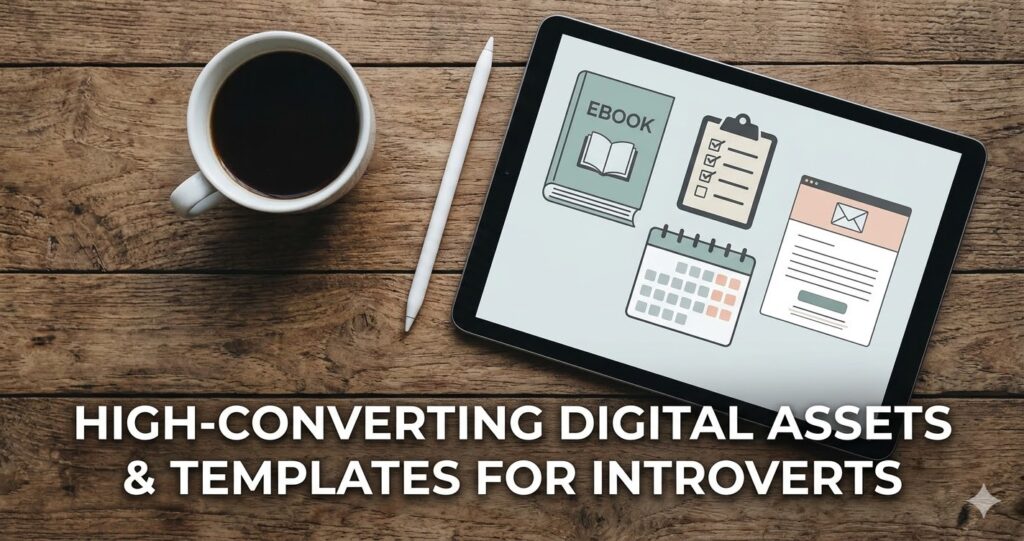
If you have a business, you have systems. Everything you do that is helpful to your audience—or that saves you time—can be productized and sold as a template. I have done this in my cozy shop, offering everything from email templates to ClickUp templates, from brand refresh templates to Notion templates. The core concept is simple: take things you already do, formalize them, and sell them as a low-ticket digital product.
The Introvert Advantage: Perceived High Value
Here is why introverts are perfectly suited for this: people are nosy. They want to know exactly how you do what you do. They want to see your specific workflow, your structure, your organization. High perceived value comes from saving your customers time and energy by providing them with a done-for-you framework. If you use a tool like Notion or ClickUp to manage your life, your content, or your business, chances are your audience would be thrilled to pay you for a duplicate of that exact template. This is an easy yes for your audience and generates high passive income without complex product creation or extensive marketing.
4. Selling on Print on Demand (POD) Platforms
If you are a visual person, have design skills, or just have artistic sensibilities, print on demand (POD) is an exceptional business model for introverts. This is all very passive, and I want to be careful using that word because nothing is ever completely passive, but once you have set up your shop, it’s pretty much hands-off. You can sell mugs, journals, t-shirts, and other merch with your unique brand design, a clever quote, or a quote that makes sense for your audience.
No Inventory, No Face Required
This is actually something that I plan on doing myself. I’ve talked about creating cozy merch for you guys for a while, and maybe someday soon, I will. This business model is attractive because you need zero inventory. You create the design, upload it to a POD platform (like Printful or Printify), and integrate it with your shop (like Etsy or your own website). The POD platform handles the printing, packaging, and shipping when a sale is made. All you need to focus on is the design and the low-maintenance optimization of your shop’s listings. It’s entirely face-free and highly scalable.
5. Written Online Courses without Video
I feel like a lot of people don’t think they can do this, but you can do this. Yes, you don’t need to be on video, or even record your voice, or show your face to create a massive, value-packed online course. They can be strictly written based. Doesn’t that sound like a cozy way to run an online course?
Text-Based Courses as a Powerful Tool
I am saying this because I have bought several online courses that were in Kajabi or Teachable, and they were entirely text-based. No video, no audio. It was value-packed, got me the results I needed, and was exactly what I was looking for. You go through the lessons one by one, there are workbooks and PDFs involved, but zero video. You can create written online courses like that. You can also create hybrid courses like I usually do: slides and my voice, but no video of myself. A lot of my courses are strictly slides with me just recording over them. That’s it. You don’t have to sit in front of the camera to have a value-stuffed online course.
6. Selling Audios and Creating Private Podcasts
If writing isn’t your main jam, but you are not comfortable on video, creating and selling audios is an excellent avenue. You can create guided meditations, affirmations, calming audio tracks, or even an audio-based online course (like a private podcast subscription) that you sell to your audience. This is completely face-free, can be recorded from the comfort of your home, and offers massive value without ever showing your full presence on camera.
Soft Marketing for a Calm Audience
Let’s say you are in the self-care space. Creating affirmations or guided meditations is a high-demand, quiet, and calming way to build an online business. Selling an audio-only course provides flexibility for your audience (they can listen on their commute, while they exercise) and allows you to avoid the visual demands of video. The tech required is simple (a decent microphone, basic editing software) and offers a great entry point for introverts with strong vocal presence or specialized expertise.
7. Selling Stock Photos and Digital Art
This idea is the perfect culmination of the quiet online business. No face, no video, just pure artistic creation. If you are good at taking photos (maybe on your iPhone, maybe a DSLR), you can sell your photos as stock photos. Sign up for platforms like Unsplash or any other stock photo website and sell them, or sell them through your own website or as bundle packs. Tada!
Creative Freedom with No Face Required
But it’s not just photos. If you are artsy in any way, you can create digital art or actual art and sell that. Print on demand can even be a subset of this where your art is printed on canvases or other home goods. This is a very powerful passive income idea for introverts who have some creativity or artsy skills and want to monetize them authentically online without having to do the video calls, the constant video creation, or jumping on Reels. You can still make money online, start a cozy online business, even as a shy introvert who doesn’t want to show their face. And that is completely fine.
💡 Frequently Asked Questions (FAQ)
Q1: How can I build trust and connection with an audience if I am 100% faceless?
A1: Faceless brands don’t lack connection; they shift the connection from the person to the value. You do this through powerful, high-quality content—deep analytical articles, actionable emails, unique and practical digital products. Show up with specialized expertise, a unique soft-marketing perspective, and strong writing that resonates with your ideal quiet audience.
Q2: Which of these 7 ideas is the best starting point for a brand new introverted entrepreneur with zero experience?
A2: Selling digital products on Etsy (like printables or a simple planner) is the most beginner-friendly starting point. The financial barrier to entry is extremely low (can be near-zero), it allows you to test your ideas quickly without video, and provides immediate proof-of-concept when you make that first quiet sale.
Q3: In the new era of AI, do faceless brands still hold value and have longevity?
A3: Absolutely. In fact, AI makes authentic, value-driven, and truly human (even if faceless) content more valuable. While AI can churn out basic content, it cannot easily replicate unique strategic thinking, curated high-value templates, specialized technical knowledge, or the deeply personal, nuanced review content that introverts naturally produce. Focus on authenticity and specialized value.