There is a particular kind of silence that only small bloggers know. It is the silence of an affiliate dashboard that reads $0.00 for the ninth straight week, while somewhere on the internet a guru with two million monthly visitors posts a screenshot of a five-figure month.
I know that silence well. Living in San Jose, in the long shadow of Silicon Valley, I am surrounded by people who talk about “scale” the way other people talk about the weather. Venture capitalists at the coffee shop on Santana Row discuss user bases in the tens of millions. Meanwhile, my own tech blog was pulling a few thousand visitors a month, and every “best affiliate programs” list I read seemed written for someone else entirely.
Here is the uncomfortable truth those lists rarely admit: most affiliate advice is built for traffic you do not have yet. It recommends programs with tiny percentages that only make sense at massive volume, or programs that quietly close your account if you do not hit sales quotas fast enough. For a small tech blog, choosing the wrong program is not just a missed opportunity. It is months of effort pointed at the wrong target.
So this guide to the best affiliate programs for small tech blogs takes a different angle. Instead of asking “Which programs pay the most?” it asks a sharper question: Which programs actually pay a blog that gets 500 to 5,000 visitors a month? That means looking at commission size per sale, cookie length, payout thresholds, approval friction, and whether a single conversion can move the needle. Let’s dig in.
Key Takeaways
- Small blogs win with high payout per conversion, not high volume. One $200 sale beats a hundred $0.40 commissions.
- Long cookie windows (60 to 120 days) give slow-deciding tech readers time to come back and buy.
- Recurring commissions turn a handful of referrals into income that stacks month after month.
- Low or reachable payout thresholds matter more than headline percentages when you are just starting.
- Intent beats traffic: a “best X for Y” post with 300 visits can outearn a viral listicle with 30,000.

Why Low Traffic Is Not the Dealbreaker You Think It Is
Think of affiliate income as a simple equation with three levers: visitors × conversion rate × payout per conversion. Big publishers pull the first lever because they can. Small publishers have to pull the other two harder, and the good news is that those two levers are far more responsive than most people realize.
The math of a small blog, made concrete
Imagine two blogs. Blog A gets 50,000 visitors a month, mostly from viral “top 10 gadgets” lists, and promotes a retail program that pays a few percent on a $40 accessory. Blog B gets 2,000 visitors a month, mostly from searches like “best SEO tool for a new WordPress site,” and promotes a software program that pays a flat bounty of around $200 per sale.
- Blog A: 50,000 visitors × 1% click-to-buy × roughly $1.20 per sale ≈ $600 a month, but only after building a massive audience.
- Blog B: 2,000 visitors × 0.25% buy rate × $200 per sale ≈ $1,000 a month, from a fraction of the traffic.
These are illustrative numbers, not promises. Real conversion rates swing widely by niche, article quality, and audience. But the shape of the math is real, and it is the single most important idea in this article: when your traffic is small, every visitor has to be worth more.
Search intent is your secret weapon
A reader who types “what is a VPN” is curious. A reader who types “NordVPN vs Surfshark for streaming” has a credit card within arm’s reach. Small tech blogs cannot outrank Wired or The Verge for broad, curious keywords, but they absolutely can rank for narrow, buyer-intent phrases that larger outlets ignore because the search volume looks too small to bother with.
That is the gap you live in. A query with 150 searches a month sounds tiny until you realize that the people typing it are ready to decide. Rank for twenty of those queries and you have built a quiet, durable sales funnel that does not depend on going viral.
Trust scales down better than it scales up
There is another hidden advantage of being small. When a reader lands on a personal tech blog and sees screenshots of a real dashboard, a candid list of what annoyed you about a tool, and a voice that sounds like a person rather than a content farm, they trust the recommendation more. Large review sites often feel like catalogs. A small blog can feel like advice from a friend who happens to know the topic. That trust translates directly into conversion rate, the second lever in our equation.
How We Picked These 7 Programs
Every program on this list had to survive a specific filter designed for small publishers. Glamorous brand names were not enough. Each one needed to make sense for a site that might generate only a handful of sales per month in its first year.
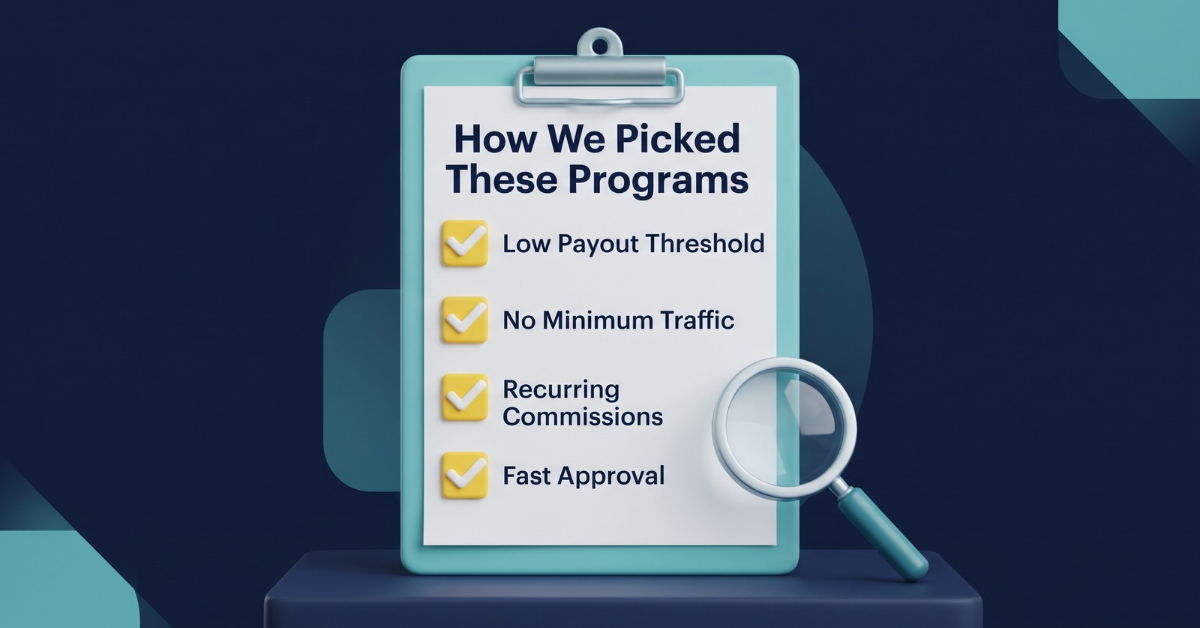
- Meaningful payout per conversion. We favored programs where one sale is worth at least $10 to $50, and ideally far more. Pennies per click do not build a business at 2,000 visitors a month.
- No published minimum traffic requirement. Some programs quietly reject sites under a certain size. Everything here is open to smaller publishers, though approval is never guaranteed.
- Cookie windows that fit tech buying behavior. People research software and hosting for days or weeks. A 24-hour cookie punishes that behavior; a 60 to 120 day cookie rewards it.
- Reachable payout thresholds. A $50 or $100 minimum is achievable in a few sales. Thresholds that take a year to reach drain motivation.
- Recurring or repeat-purchase potential. Bonus points for programs that keep paying when a customer renews or buys again.
- Natural fit with tech content. The product had to be something a tech blogger can honestly use, test, and write about in depth.
One-Time vs. Recurring: Understanding How the Money Flows
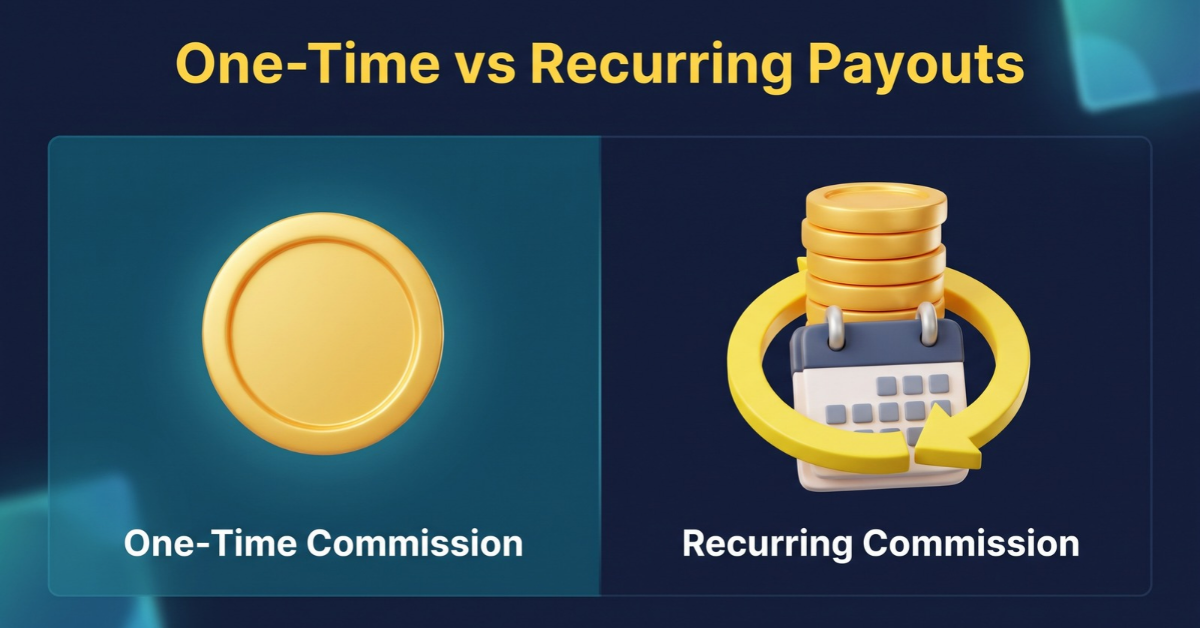
Before we meet the seven programs, it helps to understand the two main ways affiliate programs pay. This distinction will shape which programs you prioritize, because the “best” program depends heavily on whether you want quick wins or slow-building income.
One-time commissions (CPA and bounties)
A one-time commission, often called CPA (cost per acquisition) or a bounty, pays you once when a referred customer completes an action, usually a first purchase. Think of it as a finder’s fee. The advantage is speed and size: a single conversion can be worth $50, $100, or even $300 depending on the program. The disadvantage is that the relationship ends there. When the customer renews next year, you see nothing.
Recurring commissions
A recurring commission pays you a percentage of every payment the customer makes, for a set period or for as long as they stay subscribed. Individually, these payments look small. Collectively, they behave like a snowball rolling downhill. Refer three customers a month to a $30-per-month tool at a 30% recurring rate, and by the end of year one you may be collecting on roughly three dozen active subscriptions at once, assuming most of them stick around.
Analyst’s note: The smartest small-blog portfolios mix both models. One-time bounties provide early proof that your content converts and keep motivation alive. Recurring programs quietly build a revenue base that compounds while you sleep. Treat the first as your paycheck and the second as your pension.
Sponsored Resource
New to Building Income Online?
If the whole idea of turning a blog into an online business still feels abstract, this e-business starter resource walks through the fundamentals of digital income in plain language.
Explore the E-Business Guide →The 7 Best Affiliate Programs for Small Tech Blogs
The list below is ordered by how friendly each program is to a brand-new or low-traffic tech blog, not by raw earning potential. The early entries are easier to convert with modest traffic; the later entries carry bigger upside or come with a catch worth understanding before you commit.
1. Fiverr Affiliates: The Program That Pays You for Solving Readers’ Problems
Cookie: 30 days
Best for: Tutorials, “how to fix” posts, and any article where readers might prefer to hire help
Every tech blog has a dirty secret: a meaningful slice of readers do not actually want to do the thing your tutorial explains. They want it done. They read your 2,500-word guide to migrating a WordPress site, feel their stomach drop at step four, and start looking for a professional. Fiverr Affiliates lets you get paid for that moment of honest overwhelm.
According to Fiverr’s own affiliate blog, the program offers two main commission plans. The CPA plan pays a dynamic fixed commission per first-time buyer that ranges from about $15 up to $150, with Fiverr Pro services sitting at the top of that range. The Hybrid plan pays a $10 commission on a first-time buyer’s first order plus a 10% share of what they spend over the following 12 months. Fiverr has also noted that it takes a 20% cut of each purchase, so that 10% revenue share represents a generous slice of its own margin.
Why it works for small blogs: Fiverr is a household name, which lowers the trust barrier. Readers do not need to be convinced that Fiverr exists or is legitimate; they only need to be shown the right gig category at the right moment. A single referral that lands in a high-value category can pay more than an entire month of display ads on a small site.
Content ideas that convert:
- A “Do it yourself or hire it out?” box at the end of every technical tutorial
- “How much does it cost to hire a WordPress developer in 2026?” pricing explainers
- Case-study posts where you actually hired a freelancer and documented the result
Watch out for: Commissions only trigger for first-time buyers. If your audience is full of experienced Fiverr users, your conversion rate will be lower than you expect. Industry reviews also report a $100 payout minimum, so plan for it to take a few sales before your first payment arrives.
Want to see what professional help actually costs for your next tech project?
Browse Freelancers on Fiverr →2. Kit (Formerly ConvertKit): A Full Year of 50% on Every Referral
Network: PartnerStack
Best for: Blogging tutorials, newsletter guides, creator-economy content
If Fiverr is the program that pays for your reader’s frustration, Kit is the program that pays for their ambition. Every tech blogger eventually writes about building an email list, and Kit is one of the most respected email platforms for independent creators. Its affiliate program is unusually generous: Kit’s official partner page advertises 50% commission for 12 months, with an additional 10% to 20% recurring revenue beyond the first year once you earn a performance tier.
Run the numbers on a single referral. If a reader signs up for a paid plan in the $30 to $40 per month range, half of everything they pay in year one flows back to you. That is potentially $180 to $240 from one person, spread across twelve monthly payments. Refer two or three people a month and the stacking effect becomes very real by the end of the year.
Why it works for small blogs: Your audience likely overlaps heavily with Kit’s ideal customer. People who read small tech blogs are often aspiring bloggers, YouTubers, or side hustlers themselves. You are not selling to strangers; you are selling to your own peers. And because Kit has a free tier, readers can start without risk, which lowers resistance at the moment of the click.
Content ideas that convert:
- “How I set up my first email newsletter in one afternoon” walkthroughs
- Head-to-head comparisons like Kit vs. MailerLite vs. Beehiiv for small creators
- Automation tutorials showing a welcome sequence you actually use
Watch out for: The long-term recurring layer only kicks in once you reach a status tier, which requires referring a minimum number of paying customers per year. Treat the first-year 50% as the real offer and any lifetime recurring income as a bonus you grow into.
3. Hostinger: The Beginner-Friendly Hosting Bounty
Cookie: 30 days
Payout minimum: $100 via PayPal ($500 via bank transfer), paid after the 30-day refund window
Best for: “How to start a blog” guides and beginner WordPress content
Web hosting has funded more independent blogs than almost any other affiliate category, and for good reason. Every new website needs a home, and the decision often happens right inside a beginner tutorial. Hostinger has become one of the most visible budget-friendly hosts, and its affiliate program is built for exactly the kind of content small tech blogs naturally produce.
Hostinger’s own published guide lists a 40% commission rate with a 30-day cookie on hosting plans. Its support documentation states a $100 minimum payout for PayPal and $500 for bank transfer, and notes that commissions are only paid after the 30-day money-back guarantee period has passed. Several independent reviewers report that the rate can climb with volume, though you should not count on that in your first months.
Why it works for small blogs: The buyer journey is short and logical. Someone searches “how to start a tech blog,” finds your step-by-step guide, reaches the “choose your hosting” step, and clicks. Because Hostinger’s entry plans are inexpensive, the reader’s risk feels small, which helps conversion. Longer plan terms produce larger upfront purchases, which means larger commissions per sale.
Content ideas that convert:
- A genuinely complete “Start a WordPress blog in 2026” tutorial with your own screenshots
- Speed test posts comparing load times across budget hosts
- “Cheapest way to host a portfolio site” guides for students and freelancers
Watch out for: Commissions are one-time, so hosting income only grows if you keep publishing and ranking new content. The program also prohibits tactics like bidding on Hostinger’s brand name in paid search and self-referrals, so stick to honest content marketing.
4. NordVPN: Big-Brand Trust With Renewal Income
Cookie: 30 days
Best for: Privacy guides, travel tech, streaming, and remote-work content
VPNs occupy a rare sweet spot in tech affiliate marketing: they are useful to almost everyone, they are easy to explain, and people buy them in response to specific, searchable problems. Traveling abroad and want to access your home streaming library? Working from a coffee shop on public Wi-Fi? Worried about your internet provider tracking your browsing? Each of these is a search query, and each is an opportunity.
NordVPN’s commission structure varies by plan length. Affiliate directories and reviews commonly describe new-sale commissions around 40%, with some sources citing up to 100% on one-month plans, and roughly 30% on renewals of subscriptions you originally referred. Registering for the program also opens access to other Nord Security products such as NordPass. Because rates differ by network, region, and plan, verify the exact terms you are offered after approval.
Why it works for small blogs: Brand recognition does the heavy lifting. You do not need to persuade readers that NordVPN is trustworthy; years of mainstream advertising have already done that. Your job is simply to show them the right use case. The renewal commission is the hidden gem: a customer who signs up for a multi-year plan through your link can pay you again when that plan renews.
Content ideas that convert:
- “Is public Wi-Fi safe? What I do at airports and coffee shops”
- Travel tech checklists for international trips
- Honest speed tests showing how much a VPN slows your connection
Watch out for: The VPN niche is fiercely competitive at the top of search results. Do not try to rank for “best VPN.” Instead, target narrow, situational queries where big review sites have thin coverage.
Browsing on public Wi-Fi or traveling soon? This is the VPN I keep coming back to.
Check NordVPN’s Current Deal →5. SE Ranking: Recurring SEO Commissions With a Long Cookie
Cookie: 120 days
Payout minimum: $50
Best for: SEO tutorials, keyword research guides, blog growth content
Here is a program that rewards patience twice over. SE Ranking is an all-in-one SEO platform that positions itself as a more affordable alternative to the big-name suites. Industry reviews consistently report a 30% recurring commission, a generous 120-day cookie window, and a $50 payout threshold, a combination that is unusually kind to small publishers.
That 120-day cookie deserves special attention. SEO tools are considered purchases. A reader might sign up for a free trial today, poke around for a few weeks, and only commit to a paid plan two months later. With a short cookie, you would lose credit for that sale. With 120 days, you are still in the picture.
Why it works for small blogs: If you are writing about how you grew your own blog, you are already writing SEO content. Showing readers the actual tool you use to find low-competition keywords is natural, credible, and directly tied to their goals. The $50 threshold means your first payout can arrive after only a few referrals.
Content ideas that convert:
- “How I find keywords a new blog can actually rank for”
- Budget-focused comparisons of SEO tools for solo bloggers
- Monthly rank-tracking reports on your own site, showing real progress
Watch out for: Because the product is cheaper than premium competitors, each commission is smaller in absolute dollars. The value comes from recurring payments accumulating over time, so this is a long-game program.
6. Semrush: The High-Ticket Bounty Worth Building Toward
Cookie: 120 days, last-click attribution
Network: Impact
Best for: Advanced SEO, competitive analysis, and marketing strategy content
If SE Ranking is the steady salary, Semrush is the signing bonus. Semrush is one of the best-known digital marketing suites in the world, and its affiliate program pays flat bounties that can make a single sale feel like a small victory parade. Recent breakdowns of the program show commissions that vary by product, from about $50 for some toolkits up to $300 for the top tier, plus $10 for each free trial activation, all with a 120-day cookie.
That $10 trial bounty is the quiet hero for small blogs. You do not have to convince a reader to pay for a premium subscription to earn something. You only have to convince them to try it. That dramatically lowers the commitment barrier and gives you early, motivating proof that your content is working.
Why it works for small blogs: One conversion matters. A single full sale can be worth more than a month of ad revenue on a site with a few thousand visitors. Prominent bloggers have publicly reported earning hundreds of thousands of dollars from this program over the years, and while that is not a realistic benchmark for a new site, it shows how much the program can scale as you grow.
Content ideas that convert:
- “How I analyzed a competitor’s traffic in 15 minutes” case studies
- Free trial walkthroughs that show readers exactly what to explore first
- Semrush vs. SE Ranking comparisons for different budgets
Watch out for: Semrush is a premium-priced tool, and many beginner readers will balk at the monthly cost. Pair it with a cheaper alternative in comparison content so every reader has a sensible option. The program also restricts certain site types, such as coupon sites.
7. Amazon Associates: The Starter Program, With a Ticking Clock
Cookie: 24 hours (items added to cart during that session count if purchased within 89 days)
Key rule: Three qualifying sales within your first 180 days, or the application is closed
Best for: Gadget roundups, desk setup posts, and hardware reviews
No list of tech affiliate programs would be honest without Amazon, and no honest discussion of Amazon would skip the catch. Amazon Associates is the program nearly everyone tries first because the store sells everything and readers already trust it. If you review a mechanical keyboard, a USB-C hub, or a webcam, Amazon is often the most convenient place for your reader to buy it.
Here is the catch. Amazon only reviews your application once you have driven at least three qualifying sales within your first 180 days, and your own personal orders do not count. Miss that window and the application is withdrawn. The cookie is also short: a standard session lasts 24 hours, although items added to the cart during that session still count if the order is completed within 89 days.
Why it still earns a spot: Amazon’s real superpower is the “basket effect.” A reader who clicks your link for a $30 keyboard and then buys a $400 monitor in the same session can earn you a commission on the entire order, based on each product’s category rate. For gear-focused tech blogs, those incidental purchases add up.
How to survive the 180-day clock:
- Do not apply on day one. Publish five to ten genuine product posts first.
- Wait until at least two or three of those posts receive steady search traffic.
- Then apply, add your links and disclosures, and give yourself the full window.
Watch out for: Commission percentages on many electronics categories are modest, so Amazon rarely becomes the primary earner for a small software-focused tech blog. Treat it as a supporting player for hardware content, not your main strategy.
Sponsored Resource
Writing Seven Reviews Sounds Exhausting?
An AI copywriting assistant can help you draft outlines, product comparison tables, and email copy faster, so you spend your energy on testing and personal insight, which is the part readers actually trust.
Try the AI Writing Tool →Quick Comparison: All 7 Programs at a Glance
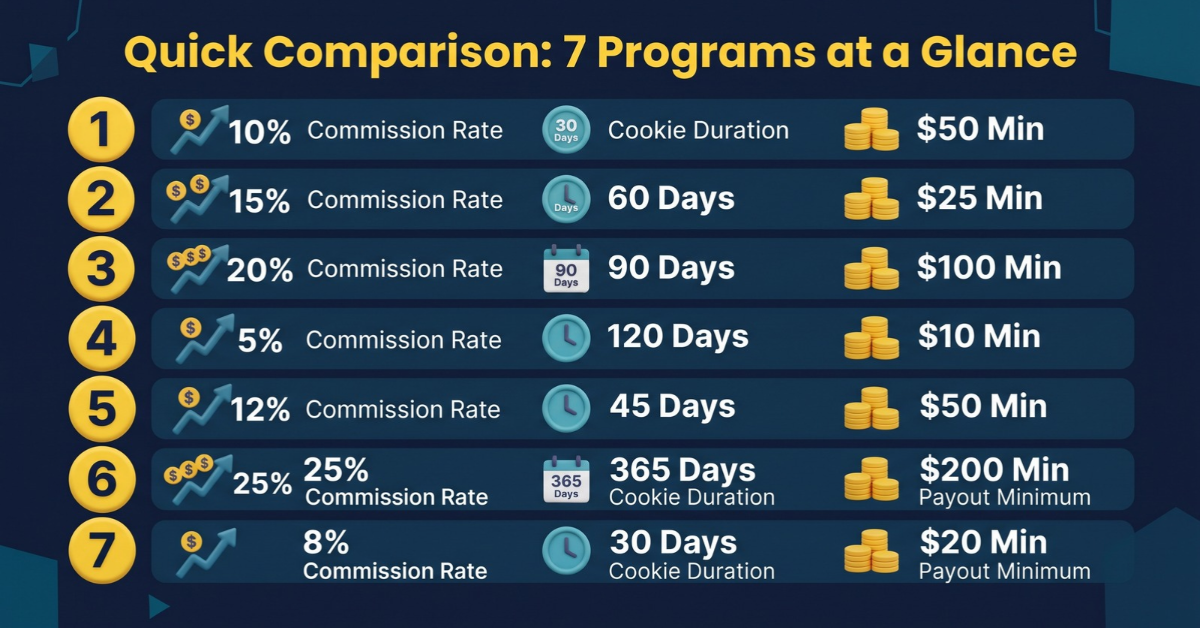
Numbers make decisions easier. Here is a side-by-side snapshot of the seven affiliate programs for small tech blogs, based on publicly reported terms as of October 2026. Treat it as a starting map, not a contract; always confirm rates inside each program after approval.
| Program | Commission | Type | Cookie | Small-Blog Fit |
|---|---|---|---|---|
| Fiverr | $15–$150 CPA, or $10 + 10% for 12 months | One-time / Hybrid | 30 days | Excellent |
| Kit | 50% for 12 months (+10–20% at tiers) | Recurring | Check terms | Excellent |
| Hostinger | ~40% of initial purchase | One-time | 30 days | Very good |
| NordVPN | ~40% new (up to 100% monthly), ~30% renewals | One-time + Renewal | 30 days | Very good |
| SE Ranking | 30% | Recurring | 120 days | Good |
| Semrush | $50–$300 per sale + $10 per trial | One-time | 120 days | Good (high upside) |
| Amazon Associates | Varies by category | One-time | 24 hours | Fair (180-day rule) |
Which program should you start with?
When choosing affiliate programs for small tech blogs, focus beats variety. If you only have time to join two programs this month, match them to the content you already publish:
- You write beginner tutorials: Start with Hostinger and Fiverr.
- You write about blogging and growth: Start with Kit and SE Ranking.
- You write about privacy, travel, or remote work: Start with NordVPN and Fiverr.
- You write about marketing strategy: Start with Semrush and Kit.
- You review physical gadgets: Start with Amazon, but only after your content is already pulling traffic.
Where to Place Affiliate Links So They Actually Get Clicked
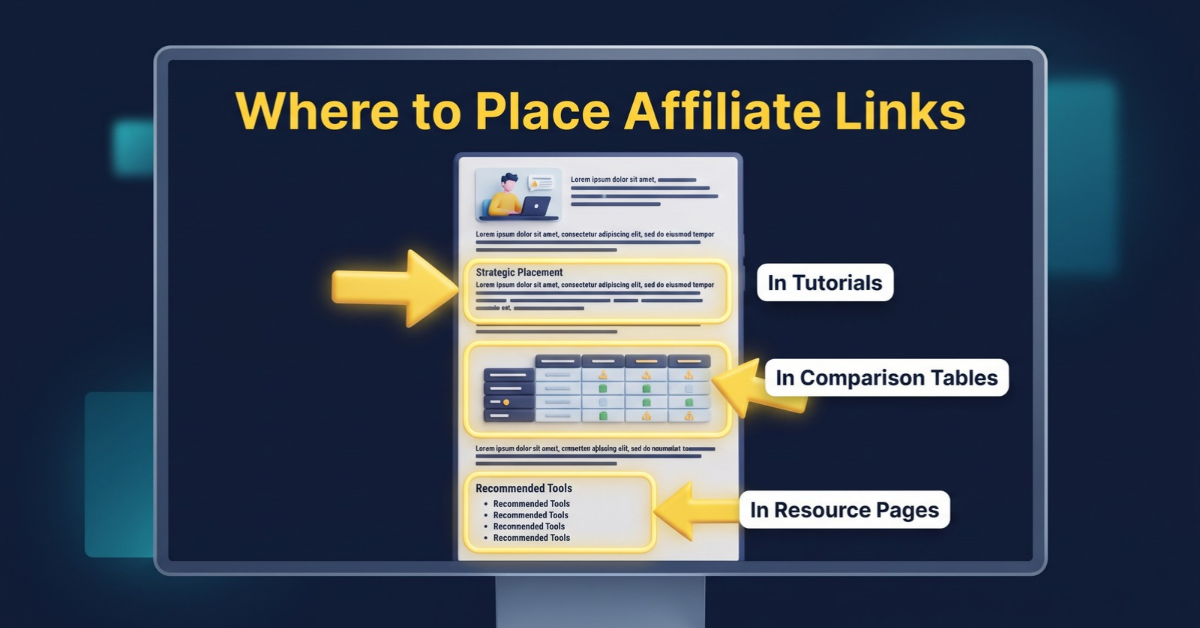
Joining the right program is only half the battle. A brilliant affiliate link buried in a forgotten sidebar earns exactly as much as no link at all. Placement is where small blogs quietly multiply their results without needing a single extra visitor.
1. Inside tutorials, at the exact moment of need
The highest-converting link is the one that appears precisely when the reader needs the product to complete the next step. In a “start a blog” tutorial, the hosting link belongs at the step where you choose a host, not in the introduction. In an email list tutorial, the Kit link belongs at the step where you create your first form. Context turns a link from an advertisement into a tool.
2. Inside comparison tables
Comparison tables are magnets for readers in decision mode. They scroll, they scan, and they click. A clean table with a clear “Check price” or “Try free” button in each row consistently outperforms links scattered through paragraphs. Keep tables honest: include a weakness for every product, including the ones you recommend most.
3. On a dedicated resource page
Create a single page titled something like “Tools I Use to Run This Blog” and link to it from your main navigation. Returning readers who trust you will visit it again and again. Each entry should include one or two sentences about why you use the tool and who it is best for. This page often becomes one of the highest-earning pages on small sites because it collects your most loyal visitors.
4. In your email newsletter, sparingly
Your newsletter subscribers are your warmest audience. A short, personal note saying “I just switched to this tool, and here is what changed” can outperform an entire month of blog traffic. The key word is sparingly. One thoughtful recommendation a month builds trust; one in every email erodes it.
5. Across your other channels
If you also run a YouTube channel, a Pinterest account, or a small online store, connect them. A YouTube tutorial can point to the full written guide on your blog, where the affiliate links and comparison tables live. A Pinterest pin of your comparison chart can drive search-intent traffic for months. A small tech blog does not need more traffic from one source; it needs several modest streams flowing into the same well-built pages.
Sponsored Resource
Turn Social Media Into a Traffic Source
If your blog posts deserve more readers, this social media marketing resource covers practical ways to bring followers from social platforms back to the pages where your affiliate links live.
Learn Social Media Marketing →A 90-Day Game Plan for Your First Affiliate Dollars
Strategy without a schedule is just a wish. Here is a realistic 90-day plan built for a blogger with a day job, limited time, and a site that currently gets a few thousand visitors a month or less.
Days 1–30: Foundation
- Pick two programs from this list that match the content you already have.
- Apply, and while you wait for approval, add a clear affiliate disclosure template to your site.
- Audit your top ten posts by traffic. Find natural places where a recommendation genuinely helps the reader.
- Build your “Tools I Use” resource page.
Days 31–60: Buyer-intent content
- Publish one comparison post (for example, “Tool A vs. Tool B for small bloggers”).
- Publish one “how I use” post with your own screenshots and honest results.
- Publish one problem-solution post targeting a narrow, specific query.
- Repurpose each post into a short video or a pin to seed additional traffic.
Days 61–90: Measure and double down
- Check each program’s dashboard for clicks, not just sales. Clicks show which pages have intent.
- Update the posts with the most clicks: sharpen the comparison table, add a clearer call to action.
- Write one more post in the topic cluster that is already converting.
- Only then consider adding a third program.
The principle behind this plan is focus. Most small bloggers join fifteen programs, sprinkle links everywhere, and earn nothing from any of them. Two programs, deeply integrated into excellent content, will almost always outperform fifteen programs scattered thinly.
Six Mistakes That Quietly Kill Affiliate Income
1. Skipping the disclosure
In the United States, the Federal Trade Commission expects clear and conspicuous disclosure of material connections, which includes affiliate relationships. Put a plain-language disclosure near the top of every post that contains affiliate links, not hidden in the footer. Beyond legal compliance, transparency builds the trust that drives conversions.
2. Recommending products you have never used
Readers can smell secondhand reviews. Even a free trial and a few screenshots of your own account dramatically improve credibility. If you cannot test a product, say so, and explain what you based your opinion on.
3. Chasing the highest commission instead of the best fit
A $300 bounty means nothing if your readers are beginners who will never pay for a premium tool. A $15 commission on something they genuinely need will earn more. Always start with the audience, then choose the program.
4. Breaking program rules
Many programs prohibit bidding on their brand names in search ads, promoting unapproved coupon codes, or buying through your own link. Violations can mean forfeited commissions or a closed account. Read the terms once, carefully, before you start.
5. Letting content go stale
Prices change, features change, and commission structures change. An outdated comparison post loses rankings and trust at the same time. Put your top affiliate posts on a quarterly review calendar.
6. Giving up before the compounding starts
Search traffic takes months to mature, and recurring commissions take months to stack. The most common reason small blogs never earn affiliate income is not bad programs or low traffic. It is quitting in month four, just before the curve bends upward.
Starting a blog later in life? Affiliate marketing is not just for twenty-something tech workers. Plenty of retirees and career-changers are building thoughtful niche sites. If that is you, our friends at Senior Journey Blog share practical guidance for navigating new chapters with confidence.
Final Thoughts: Small Blog, Real Payouts
That silent dashboard I mentioned at the beginning did not stay silent forever. It changed not when my traffic exploded, but when I stopped writing for everyone and started writing for the specific reader who was one decision away from buying. That shift, from volume to intent, is available to every small tech blogger today.
The seven affiliate programs for small tech blogs in this guide were chosen because they respect that reality. Fiverr pays you for readers who would rather hire help. Kit rewards you for a full year on every referral. Hostinger and NordVPN convert the trust of big brands into meaningful one-time and renewal commissions. SE Ranking and Semrush pay you for the long, thoughtful buying cycles of SEO tools. And Amazon, with its ticking clock, supports your gadget content once your foundation is in place.
You do not need a million visitors. You need the right two programs, a handful of honest buyer-intent articles, and the patience to let them compound.

Your Move This Week
Pick one program from this list that fits the content you already publish. Apply today. Then update your single best-performing post with one honest, well-placed recommendation. That is how the first commission happens.
💡 Frequently Asked Questions (FAQ)
Q. Can a blog with under 1,000 monthly visitors really earn affiliate income?
Yes, if the traffic has buying intent and the program pays well per conversion. A single sale through a bounty-style program like Semrush, which pays roughly $50 to $300 per sale depending on the product, can outearn months of display ads. The key is targeting narrow, buyer-intent searches such as comparisons and “best tool for a specific task” queries rather than broad informational topics.
Q. Should small blogs choose one-time or recurring commission programs?
Ideally both. One-time bounties such as Hostinger or Fiverr’s CPA plan deliver faster, larger individual payouts that prove your content converts. Recurring programs such as Kit, which pays 50% for the first 12 months, or SE Ranking’s 30% recurring commission, build a base of income that stacks over time. A mix gives you early momentum and long-term stability.
Q. Why is Amazon Associates risky for a brand-new tech blog?
Amazon requires at least three qualifying sales within the first 180 days before it reviews your application, and personal orders do not count. Its standard cookie also lasts only 24 hours. New blogs without established traffic can easily miss that window, so it is smarter to build product content first and apply only once several posts already attract steady search visitors.
🌿 Weekly wellness, health & beauty insights — straight to your inbox
Free subscription · Cancel anytime