Recurring Affiliate Programs for Tech Bloggers: The Complete 2026 Guide to Building Compounding Income
Last updated: September 2026 | 14-minute read

Every tech blogger remembers the first time an affiliate check arrives. It feels like validation. It feels like proof that the hours spent writing tutorials, comparing tools, and answering reader questions in the comments section were worth it. But then the second month comes, and the check is smaller, because the audience that clicked in month one already bought what they needed. If you have felt that specific kind of disappointment, this guide was written for you.
Living in California, I’ve watched an entire generation of independent tech writers build six-figure blogs, only to see their income evaporate the moment Google changed an algorithm or a single affiliate program cut its payout rate. The bloggers who survived, and the ones who are still thriving in 2026, share one trait: they stopped chasing one-time commissions and started building portfolios of recurring affiliate income instead.
This is not a listicle of “50 affiliate programs to join today.” It is a strategic framework, backed by real US market data and case studies, for understanding why recurring commissions are the single most important lever a tech blogger can pull in 2026, which categories of programs actually deliver on that promise, and how to build a promotional system that compounds month over month instead of resetting to zero every 30 days.
According to industry estimates from the Performance Marketing Association, US-based affiliate marketing spend crossed $13 billion in 2024 and continues to grow at a double-digit annual rate, driven overwhelmingly by subscription-based software and services rather than one-time physical goods. That shift matters enormously for anyone writing about technology, because it means the fastest-growing slice of the affiliate economy is exactly the slice that pays you again and again, month after month, if you position your content correctly.
Over the next several thousand words, we’ll walk through the mechanics of recurring commissions, the specific categories of software and services that consistently reward tech bloggers, a real-world case study showing how the math plays out over 18 months, the mistakes that quietly sabotage otherwise good affiliate strategies, and the exact promotional habits that separate bloggers earning a few hundred dollars a month from those earning several thousand. By the end, you should have a concrete plan you can implement this week, not just a list of ideas to bookmark and forget. Understanding recurring affiliate programs for tech bloggers is the single skill that separates a hobby blog from a real business.
1. What Are Recurring Affiliate Programs, Really?
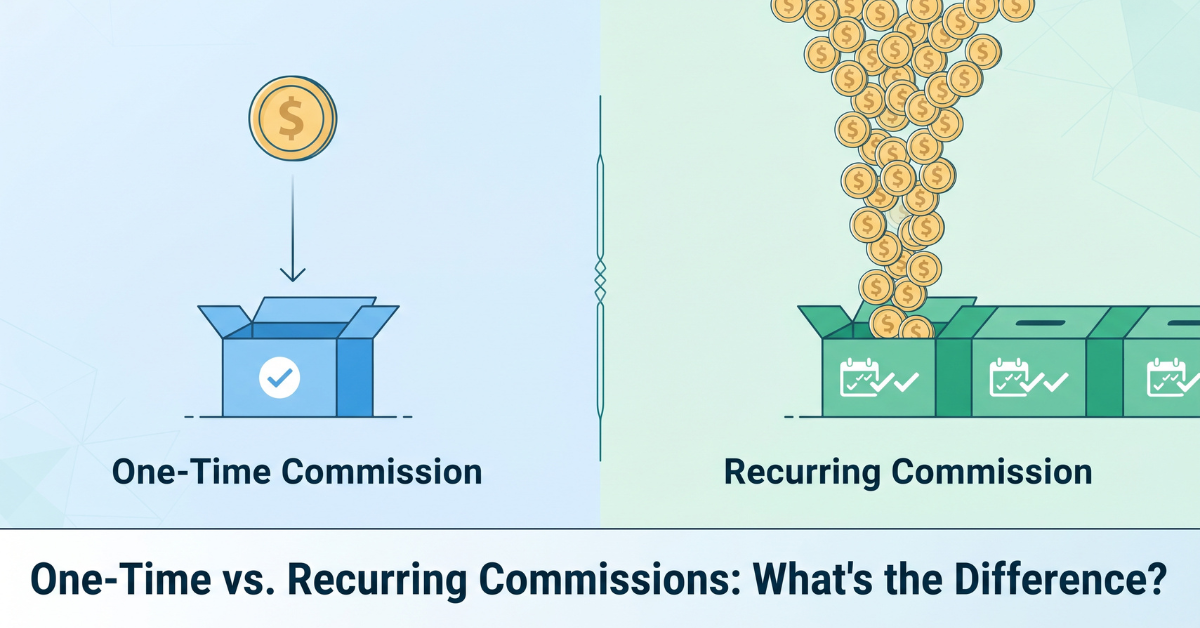
A recurring affiliate program pays you every time your referred customer renews their subscription or continues their service, not just on the day they first sign up. The distinction sounds simple, but the financial implications are enormous once you run the numbers over a 12-month horizon.
1.1 The One-Time Commission Model
In a traditional, one-time model, you write a review, a reader clicks your link, they purchase, and you get paid a single commission. That’s it. The relationship between your content and your income ends there. If you referred 100 customers to a $50 product with a 20% commission, you earned $1,000 — once. To earn that again next month, you need 100 brand-new customers.
1.2 The Recurring Commission Model
In a recurring model, that same referred customer keeps paying their monthly or annual subscription fee, and you keep earning a percentage of that renewal — often for the entire lifetime of their subscription. This is the exact mechanism that powers SaaS companies, VPN services, hosting providers, and email marketing platforms.
Consider this simplified comparison based on typical US market commission structures:
- One-time affiliate sale: $50 product, 20% commission = $10 paid once, ever.
- Recurring affiliate sale: $20/month subscription, 30% recurring commission = $6/month, for as long as the customer stays subscribed. Over 24 months (a realistic average retention period for SaaS tools), that single referral is worth $144 — 14 times more than the one-time equivalent.
This is why a blogger who refers only 20 new customers per month to recurring programs can, within 18 months, be earning more from their existing referral base than a blogger who refers 200 new customers per month to one-time programs. The math compounds in your favor, and it compounds silently, in the background, while you sleep.
1.3 Understanding Customer Lifetime Value (CLV) as an Affiliate
Most bloggers evaluate an affiliate program by asking a single, incomplete question: “What’s the commission rate?” A far more useful question is: “What is the expected Customer Lifetime Value of a referral through this program?” CLV, in this context, is calculated as the average monthly commission multiplied by the average number of months a referred customer remains subscribed before canceling.
Two programs with identical headline commission rates can have wildly different CLVs depending on the underlying product’s “stickiness.” A password manager or VPN, for example, tends to have very high retention because canceling means actively removing a security layer the user has grown dependent on. A trendy productivity app with a lower switching cost might have a commission rate that looks attractive on paper but churns out half its subscribers within 90 days.
Before joining any recurring program, ask the affiliate manager directly for average retention data, or search for independent churn statistics for that product category. Programs that are confident in their retention numbers will usually share them, because strong retention data is itself a selling point to recruit affiliates.
1.4 Hybrid Models: Recurring Plus Upfront Bonus
A growing number of software companies now offer hybrid commission structures: a modest upfront bonus payment when the customer first signs up, combined with a smaller ongoing recurring percentage for as long as the subscription continues. These hybrid programs are worth prioritizing when available, because they smooth out your cash flow in the early months of a promotional campaign while you wait for the recurring base to build up, without sacrificing the long-term compounding benefit.
Quick Tip: If a website mentions “outsourcing” your web development workload to skilled freelancers as a cost-competitive alternative to agencies, that referral model can also work in your favor. Services like the one I personally use for client and personal site builds — this outsourcing marketplace — let you recommend a genuinely useful resource to your audience while earning a commission on completed projects. It is not classic “recurring” revenue in the subscription sense, but repeat client usage over time creates a similar compounding effect.
2. Why Recurring Commissions Build Long-Term, Compounding Income
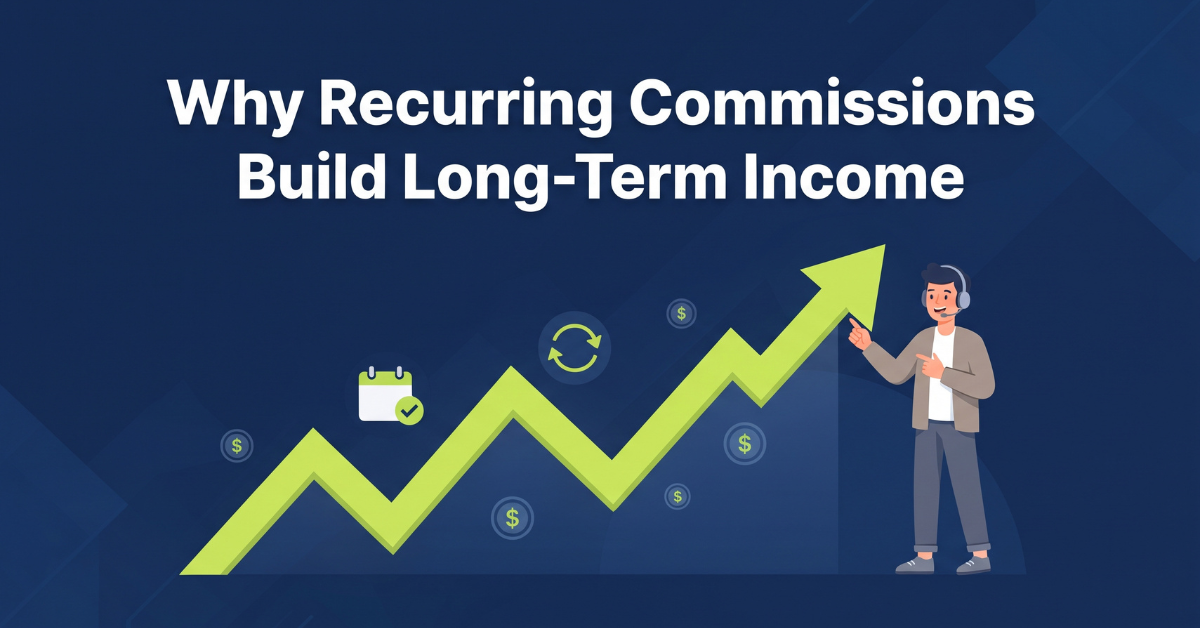
There’s a reason venture capital firms in Silicon Valley obsess over “monthly recurring revenue” (MRR) as the single most important metric for a SaaS company’s health. The same principle applies directly to your blog’s affiliate income, just from the referrer’s side of the ledger instead of the seller’s.
2.1 The Stacking Effect
Every new referral you generate this month doesn’t replace last month’s referrals — it stacks on top of them. Assume you refer 15 new customers per month to a recurring VPN affiliate program paying $8/month per active subscriber, with an average customer lifetime of 20 months before cancellation.
- Month 1: 15 active referrals × $8 = $120/month
- Month 6: ~85 active referrals (accounting for some churn) × $8 = $680/month
- Month 12: ~150 active referrals × $8 = $1,200/month
- Month 24: ~230 active referrals × $8 = $1,840/month
Notice that you did not increase your traffic or your writing output between month 1 and month 24 in this simplified model — you simply kept doing the same consistent work, and the income compounded because the underlying commission structure rewarded retention, not just acquisition.
2.2 Protection Against Traffic Volatility
Google’s core algorithm updates in 2024 and 2025 wiped out significant organic traffic for thousands of independent blogs, particularly in the “best of” and comparison review niches. Bloggers relying entirely on one-time commissions saw their income crash in direct proportion to their traffic loss. Bloggers with a base of recurring subscribers already locked in continued collecting commissions for months, even during a traffic slump, because those existing subscriptions kept renewing regardless of that month’s new visitor count.
2.3 It Rewards Evergreen Content
A three-year-old blog post reviewing a VPN service can still generate new sign-ups today, and each of those sign-ups becomes a recurring line item in your monthly income for as long as they stay subscribed. This means your archive of older content becomes an appreciating asset rather than a depreciating one — the opposite of what happens with one-time-commission content, which tends to lose relevance and clickthrough value as prices and product versions change.
2.4 A More Predictable Business Model for Serious Bloggers
Once your blog reaches a stage where you are treating it as a real business rather than a hobby, predictability becomes as valuable as raw income. Lenders, potential business partners, and even your own budgeting decisions all benefit from a revenue base that behaves more like a subscription business than a series of one-off sales. Several tech bloggers I’ve corresponded with over the years describe the shift to recurring-heavy revenue as the moment their blog “stopped feeling like gambling and started feeling like a business.”
This predictability also changes how you plan content. Instead of scrambling every month to find the next trending product to review before a competitor does, you can plan a content calendar around deepening your coverage of a smaller number of recurring-friendly categories, producing more thorough, higher-quality material because you’re not spreading your attention across dozens of unrelated one-time offers.
3. The Best Categories of Recurring Affiliate Programs for Tech Bloggers
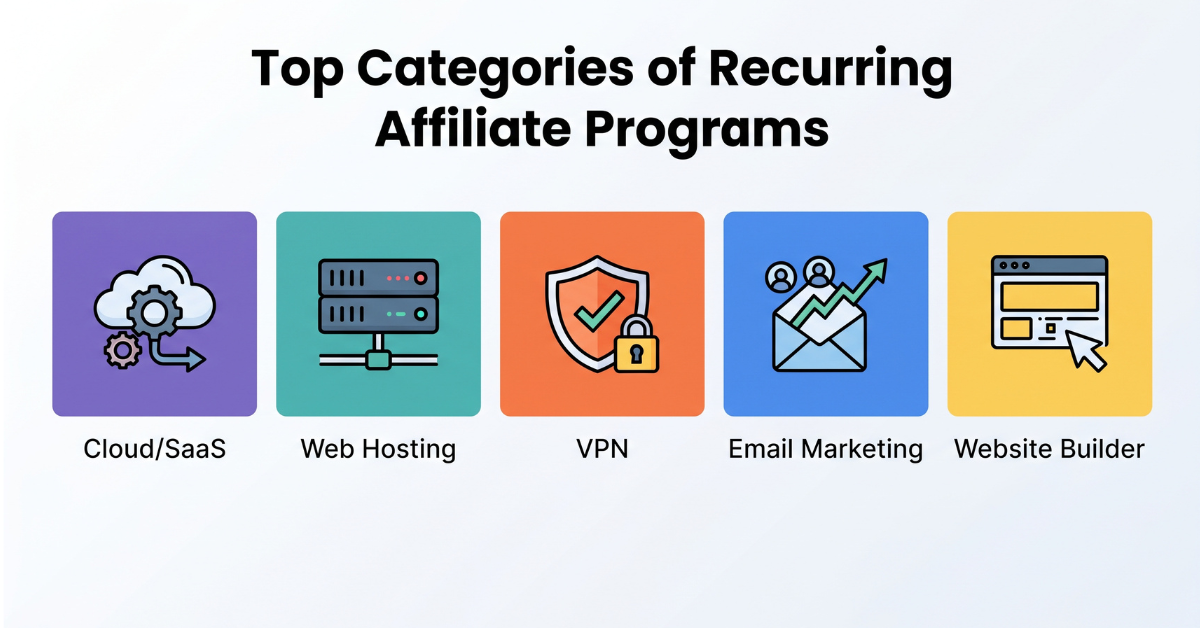
Not every recurring program is created equal. Some categories have commission structures, retention rates, and audience fit that make them dramatically more valuable to a tech-focused audience than others. Here are the five categories that consistently perform best based on US affiliate marketing data.
3.1 VPN and Privacy Software
Privacy tools remain one of the strongest-converting categories for tech audiences, and it is not close. With rising concerns about data breaches, workplace surveillance, and public Wi-Fi security, VPN subscriptions have become nearly as standard as antivirus software was a decade ago. Commission rates in this category typically range from 25% to 40% of the subscription price, and because most VPN providers use annual billing by default, a single referral often generates a meaningful commission every 12 months without any additional effort from you.
Reader Favorite: If online privacy and secure browsing matter to your audience — and for a tech-savvy readership, it almost always does — this is the VPN service I personally rely on for protecting my own devices while writing and researching. It is one of the easiest recurring programs to promote authentically because the product genuinely solves a problem nearly every internet user has.
Beyond the base commission structure, VPN programs are also notable for how well they perform across seasonal spikes. Search interest for VPN services in the US consistently rises around major streaming platform content releases, tax season (when identity theft concerns spike), and back-to-school periods as students set up secure connections for remote coursework. A tech blogger who times fresh VPN content around these predictable seasonal windows can capture disproportionate referral volume relative to the rest of the year, then let the recurring commission structure carry that seasonal spike forward for many months afterward.
3.2 Web Hosting and Domain Services
Hosting affiliate programs have historically been dominated by large, one-time bounty payouts. However, an increasing number of hosting providers, particularly those targeting the WordPress and small-business ecosystem, have shifted toward recurring lifetime revenue-share models to compete for high-quality affiliate traffic. These programs are a natural fit for any tech blogger who writes tutorials, “how to start a blog” guides, or website comparison content.
One nuance worth understanding: hosting affiliate terms vary enormously not just between companies but between plan tiers within the same company. A referral to an entry-level shared hosting plan might pay a modest one-time bounty, while a referral to a managed WordPress or business-tier plan from the same provider might include an ongoing recurring component. Always read the fine print at the plan-tier level, not just the headline program description, since marketing pages for hosting affiliate programs are notorious for leading with their best-case, highest-tier numbers.
3.3 Email Marketing and Automation Platforms
Email marketing tools are a favorite among affiliate marketers for a simple reason: the buyer profile is almost always a business owner, creator, or marketer, which means the customer’s willingness to pay for a subscription-based tool is already established. Recurring commissions in this category commonly sit between 20% and 30% of the monthly plan cost, for the lifetime of the referred account.
This category also rewards depth over breadth. A single detailed comparison of email marketing platforms tailored to a specific niche, for example, email tools for e-commerce stores versus tools for online course creators, will typically convert far better than a generic “best email marketing software” article competing against hundreds of similar broad comparisons. Niching down within the category is often the fastest path to ranking well and converting a business-minded audience already primed to spend on their marketing stack.
3.4 Website Builders and No-Code Platforms
As small businesses and solo entrepreneurs continue moving away from custom-coded sites, no-code website builders have exploded in popularity across the US market. Many of these platforms now offer recurring commission structures precisely because retention (not one-time acquisition) is their core business metric, and they want affiliates who are incentivized to send customers who will stay long-term rather than churn out after the first billing cycle.
3.5 Cloud Storage, SEO Tools, and Productivity SaaS
SEO software, cloud storage subscriptions, and productivity suites round out the fifth major category. These tools tend to have the highest customer lifetime value of any category on this list, because professional users rarely cancel a tool once it becomes embedded in their daily workflow. A single well-placed referral to a professional SEO suite can generate recurring commissions for years.
What makes this category particularly attractive is the “workflow lock-in” effect. Once an agency or freelancer builds their client reporting process, keyword tracking, or file-sharing habits around a specific SaaS tool, switching costs (retraining, data migration, disrupted workflows) become high enough that even a price increase rarely triggers cancellation. For an affiliate, that translates directly into unusually long average subscription lifespans compared to consumer-facing apps.
3.6 Comparing the Categories Side by Side
When deciding where to focus first, it helps to compare these five categories across three dimensions: typical commission percentage, average customer retention, and content difficulty (how much expertise is required to write convincingly about the category).
- VPN/Privacy: High commission (25-40%), strong retention (18-24 months average), low content difficulty — most readers already understand why privacy matters, so less education is needed before conversion.
- Web Hosting: Moderate-to-high commission (varies widely by provider), moderate retention (12-18 months, since website owners occasionally switch hosts), moderate content difficulty.
- Email Marketing: Moderate commission (20-30%), strong retention (24+ months for established business users), higher content difficulty since it targets a more specialized business audience.
- Website Builders: Moderate commission, moderate retention, low-to-moderate content difficulty, strong fit for “how to start a website” evergreen content. This category benefits enormously from step-by-step tutorial content, since a reader who successfully follows your guide to launch their first site using your affiliate link has effectively already completed the “purchase decision” as a natural side effect of following your instructions, rather than being persuaded through a separate sales argument.
- SEO/Productivity SaaS: Moderate commission, highest retention of any category (professional workflow lock-in), highest content difficulty, since it usually requires genuine hands-on tool expertise to write convincingly.
A practical starting strategy for most tech bloggers is to anchor around one high-retention, low-difficulty category (VPN/privacy is usually the easiest entry point) while gradually building expertise-driven content in a second, higher-difficulty category like SEO or productivity software, where competition is thinner precisely because it demands more genuine knowledge to write about credibly.
Editor’s Note: Throughout this guide, you’ll also see references to tools I personally recommend across these categories, including an email marketing platform, a website builder, an SEO tool suite, and a cloud productivity suite. These are the exact categories discussed above, and each one represents a recurring-revenue opportunity worth exploring for your own content strategy.
4. How to Choose the Right Recurring Affiliate Program

Not every program that calls itself “recurring” delivers real long-term value. Before committing your content real estate to a partner, run it through this checklist.
4.1 Commission Structure and Duration
- Is the commission truly “lifetime,” or is it capped at 12 or 24 months?
- Is the percentage fixed, or does it decrease after the first renewal?
- Does the program pay on upgrades, or only on the original plan tier?
4.2 Cookie Duration and Attribution Window
Tech buyers rarely purchase software on the first visit. A cookie duration of 30 days or less can cost you commissions from readers who research for a week before subscribing. Look for programs offering 60-to-90-day cookie windows, or better, ones that use account-based attribution instead of cookies entirely, since cookie-based tracking has become less reliable following browser privacy changes.
4.3 Product-Audience Fit
The highest-converting recurring program in the world will underperform if it doesn’t match what your specific audience actually needs. A blog focused on cybersecurity should prioritize VPNs and password managers over website builders. A blog focused on freelance web development should prioritize hosting, outsourcing marketplaces, and productivity tools instead.
4.4 Payment Reliability and Minimum Thresholds
Check payout minimums and payment schedules before committing meaningful content real estate. A program with a $500 payout threshold and quarterly payments can trap small-to-mid-sized bloggers in a cycle of “unrealized” earnings that never actually arrive in a bank account.
4.5 Program Reputation and Affiliate Support
Search affiliate forums and Reddit communities like r/juststart and r/AffiliateMarketing before joining a program you haven’t personally used. Programs with dedicated affiliate managers who respond to questions within 24-48 hours tend to have healthier long-term relationships with their partners than those relying entirely on automated dashboards.
4.6 Red Flags That Should Make You Walk Away
- Vague or shifting commission terms: If a program’s terms of service allow the company to reduce your commission rate retroactively on existing referrals, treat that as a serious warning sign.
- No public affiliate terms page: Legitimate recurring programs almost always publish clear, accessible terms. Programs that only share terms after you apply, or that change them without notice, are far more likely to shortchange affiliates down the line.
- Excessive negative reviews from other affiliates: A quick search for “[program name] affiliate complaints” or “[program name] didn’t pay” can save you months of wasted promotional effort.
- Pressure to misrepresent the product: Any affiliate manager encouraging you to exaggerate features, hide pricing, or omit known limitations is asking you to damage your own long-term credibility for their short-term gain.
5. Case Study: Scaling From $200/Month to $4,800/Month in 18 Months
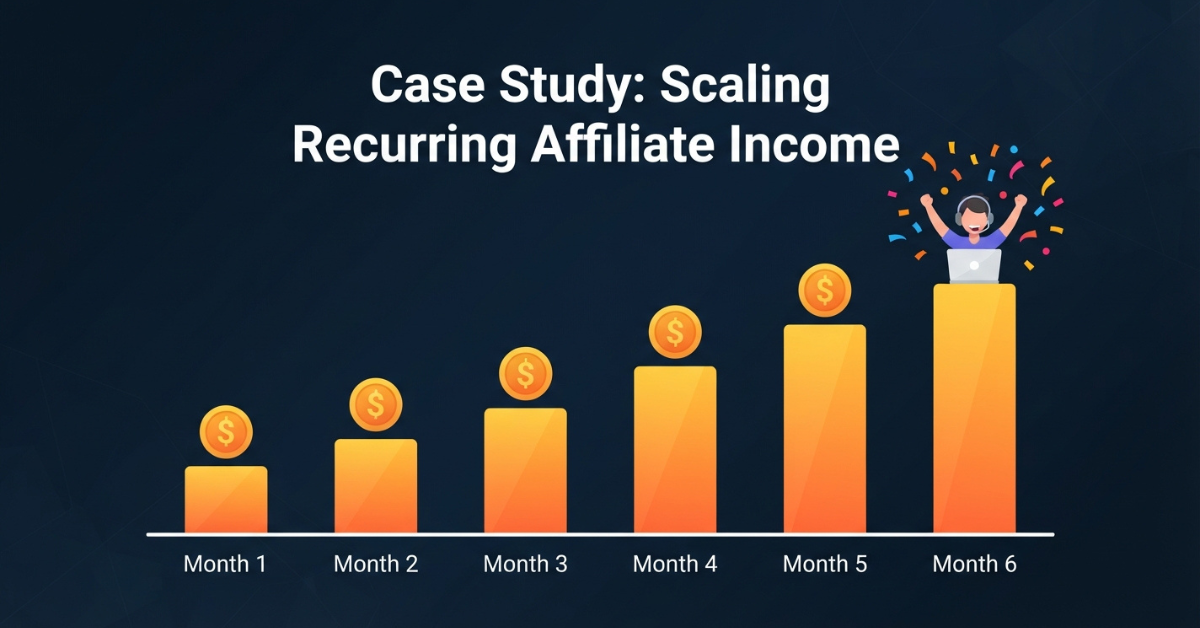
To make this concrete, let’s walk through a realistic, composite case study based on patterns common among US tech bloggers who transitioned from one-time to recurring commission strategies.
5.1 The Starting Point
A mid-sized tech blog with roughly 40,000 monthly organic visitors was earning approximately $200 per month from a mix of display ads and scattered one-time affiliate commissions. The blogger, frustrated by the income ceiling, restructured the content strategy around three recurring categories: VPN services, an email marketing platform, and a website builder.
5.2 Months 1-6: The Foundation Phase
The first six months focused on rewriting existing comparison and tutorial content to naturally incorporate the three recurring programs, along with publishing 12 new in-depth reviews. Monthly income grew slowly, from $200 to approximately $650, as the new referrals began accumulating and only a small percentage had churned out.
5.3 Months 7-12: The Compounding Phase
This is where the stacking effect described in Section 2 became visible. Even with content output staying roughly constant, income climbed from $650 to approximately $2,100 per month, driven almost entirely by the accumulated base of active subscribers still paying their monthly bills.
5.4 Months 13-18: Diversification and Scale
In the final phase, the blogger added a fourth recurring category (SEO tools) and began repurposing top-performing blog content into short-form video to drive additional traffic. By month 18, monthly recurring affiliate income reached approximately $4,800 — a 24x increase from the starting point, achieved primarily through retention economics rather than a proportional increase in traffic or workload.
5.5 What This Case Study Teaches Us
Three lessons stand out from this pattern. First, the early months always feel slower than expected, and the temptation to abandon the strategy is strongest right when the compounding is about to become visible. Second, the growth curve is not linear, it accelerates, which means judging the strategy’s success based on month 2 or 3 performance alone is statistically misleading. Third, adding a fourth category in month 13 rather than month 1 was a deliberate choice, allowing the blogger to master the content and promotional mechanics of the first three categories before spreading attention further.
6. Common Mistakes Tech Bloggers Make With Affiliate Programs
6.1 Chasing Commission Rate Over Retention Rate
A program offering 50% commission but with an average customer retention of only three months will earn you less over time than a program offering 25% commission with an average retention of two years. Always calculate estimated lifetime value, not just the headline commission percentage. A simple rule of thumb: multiply the monthly commission by the category’s typical retention window from Section 3.6, and compare that total across every program you’re considering before deciding where to invest your writing effort.
6.2 Over-Saturating a Single Page With Affiliate Links
Readers can tell when a page exists purely to funnel clicks. Cramming eight different affiliate links into a single 1,000-word post dilutes trust and typically reduces overall conversion rate compared to a focused post recommending two or three genuinely relevant tools.
6.3 Ignoring Disclosure Requirements
The Federal Trade Commission requires clear and conspicuous disclosure of affiliate relationships. Beyond the legal requirement, transparent disclosure (“I earn a commission if you sign up through this link, at no extra cost to you”) consistently builds more long-term reader trust than vague or hidden disclosures, which readers increasingly recognize and resent. Place the disclosure near the top of the article, in plain language, rather than buried in a footer that most readers will never scroll to see. Bloggers who treat disclosure as a trust-building feature rather than a legal chore often find that transparent, upfront honesty about the business model actually increases conversion rate, because readers respect the candor.
6.4 Letting Content Go Stale
Software pricing, features, and even company names change frequently. A three-year-old review recommending an outdated pricing tier or a discontinued plan will not only convert poorly, it can actively damage reader trust when they discover the information is wrong. Set a recurring content-audit reminder, as detailed in Section 11.2, so that stale content never sits unnoticed for more than one quarter.
6.5 Never Testing the Product Yourself
Readers can spot a review written from a press release or a competitor’s article from a mile away. The bloggers who earn the most from recurring programs are, almost without exception, the ones who actually use the products they recommend and can speak to real strengths and weaknesses. If a monthly subscription cost is a genuine barrier, many companies will provide a free or discounted account to established bloggers specifically for review purposes, so it is always worth asking the affiliate manager directly rather than assuming hands-on testing is out of reach.
6.6 Forgetting to Track and Reclaim Broken Links
Affiliate programs occasionally restructure their URLs during rebrands or platform migrations, silently breaking older links embedded in your archive. A broken affiliate link doesn’t just fail to convert, it actively frustrates a reader who was ready to buy. Running a quarterly link-checking audit across your top-performing older posts is one of the highest-leverage, lowest-effort maintenance tasks a recurring-income-focused blogger can do.
6.7 Treating All Traffic Sources as Equal
A visitor arriving from a highly specific, high-intent search query (“best VPN for remote workers 2026”) converts at a dramatically higher rate than a visitor arriving from a broad social media share of a general tech news roundup. Bloggers who fail to distinguish between these traffic types often misjudge which content is actually driving recurring revenue, wasting effort on the wrong distribution channels.
7. Best Practices for Promoting Recurring Affiliate Links

7.1 Build Comparison Content, Not Just Reviews
“X vs. Y” comparison posts consistently outperform single-product reviews in both search traffic and conversion rate, because they capture readers at the exact decision-making moment when they are ready to subscribe to something — they just need help choosing which one.
7.2 Use Multi-Channel Distribution
A blog post alone is no longer enough. The bloggers seeing the fastest growth in recurring affiliate income repurpose the same core content across YouTube tutorials, email newsletters, and short-form social clips, each pointing back to the same recurring program with slightly different framing for each platform’s audience intent.
7.3 Build an Email List Around the Recurring Offer
Because recurring commissions depend on long-term customer retention, staying in touch with your audience over time (through email) allows you to remind them of the tools they signed up for, reducing churn indirectly and increasing your own commission longevity.
7.4 Track Everything
Use UTM parameters and each program’s built-in dashboard to identify exactly which pages, platforms, and pieces of content are generating the most durable, low-churn referrals — then double down on creating more of that specific content type.
7.5 Diversify Across Four to Six Programs Maximum
Too few programs leaves you exposed to a single company’s policy change. Too many dilutes your credibility and content focus. Most successful tech bloggers settle into a core portfolio of four to six well-vetted recurring programs across two or three complementary categories.
7.6 Update Your Highest-Traffic Posts First
Rather than writing new content immediately, audit your analytics for the ten highest-traffic posts on your entire site and check whether any of them could naturally incorporate a recurring affiliate recommendation. Because these pages already have proven search visibility, updating them with a well-placed recurring link often produces faster results than publishing brand-new content that has to earn its own rankings from scratch.
7.7 Be Patient With the Compounding Curve
Perhaps the single hardest skill in recurring affiliate marketing isn’t a technical or writing skill at all, it’s the emotional discipline to keep investing consistent effort during the flat early months described in Section 5, trusting that the math of retention and stacking will eventually produce the acceleration it has produced for countless bloggers before you.
8. Real US Market Data and Industry Trends Shaping 2026
8.1 The Shift From Physical Goods to Subscription Software
Amazon Associates dominated the affiliate marketing conversation for over a decade, largely because of its enormous product catalog and brand trust. But commission rates for physical goods on Amazon have been repeatedly cut, in some cases to as low as 1-3% for entire categories, squeezing bloggers who built their entire business model around it. Meanwhile, SaaS and subscription-software affiliate commissions have held steady or increased, because software companies compete for high-quality affiliate traffic in a way that low-margin physical retailers simply cannot afford to.
8.2 Rising Consumer Trust in Independent Reviews
Survey data from US consumer research firms consistently shows that a majority of software buyers read at least one independent blog review or comparison article before subscribing to a paid tool, and that trust in independent bloggers has remained more stable than trust in traditional advertising or even influencer sponsorships, which readers increasingly view with skepticism. This trend favors tech bloggers who build genuine authority in a niche over time, rather than those chasing short-term viral traffic.
8.3 The Rise of AI Tools as a New Recurring Category
Since 2023, AI-powered software tools, from writing assistants to coding copilots to image generators, have emerged as one of the fastest-growing affiliate categories in the US market. Many of these companies, still in aggressive growth mode, offer unusually generous recurring commission structures to build affiliate distribution quickly. Tech bloggers who move early into thoughtful, hands-on AI tool coverage are positioned to capture outsized recurring commissions before the category matures and commission rates inevitably compress, the same pattern seen historically in hosting and VPN markets.
8.4 What This Means for Your 2026 Content Strategy
Taken together, these three trends point toward a clear strategic priority for 2026: reduce dependence on declining physical-goods commissions, build a durable core around the proven recurring categories in Section 3, and allocate a smaller, exploratory portion of your content calendar toward emerging categories like AI tools, where commission rates are currently generous but likely to compress as the market matures over the next two to three years.
9. Tax and Business Considerations for Affiliate Bloggers
9.1 Treat Recurring Income as Ongoing Business Revenue
In the United States, affiliate income, including recurring commissions, is generally treated as self-employment or business income and must be reported accordingly. Because recurring commissions arrive in smaller, more frequent payments across many programs, bookkeeping discipline becomes more important than it was under a one-time-commission model, where a handful of larger payments were easier to track manually.
9.2 Setting Aside for Quarterly Estimated Taxes
As recurring income grows and becomes more predictable, many US-based bloggers move to quarterly estimated tax payments rather than being caught off guard at annual filing time. A simple, disciplined approach is to set aside a fixed percentage of every affiliate payment received into a separate savings account earmarked strictly for taxes, adjusting that percentage based on guidance from a qualified tax professional familiar with self-employment income.
9.3 Consider Forming a Business Entity as Income Scales
Once monthly recurring affiliate income becomes a meaningful, stable part of your overall earnings, many bloggers consult an accountant about forming an LLC or S-Corp structure, both for liability protection and potential tax efficiency. This is not a decision to make lightly or without professional advice, but it’s worth raising proactively once your recurring base reaches a level where the administrative overhead is justified by the income involved.
9.4 Deductible Expenses Tied to Recurring Content Production
Building the kind of first-hand, tested content that Section 17 describes often requires purchasing the very subscriptions you review, hosting fees for your own site, screen recording software for tutorials, and even the domain and email tools you use to run your newsletter sequences. In the US, these costs are typically deductible business expenses when properly documented, which is another reason a dedicated bookkeeping system, even a simple spreadsheet, pays for itself well before your recurring income reaches a significant scale. Keep receipts and clearly separate personal subscriptions from those purchased specifically for content research and review purposes.
11. Building an Evergreen Content System Around Recurring Offers
11.1 The Content Pyramid Approach
A sustainable recurring affiliate strategy is built like a pyramid rather than a scattershot of unrelated posts. At the base sit broad, high-search-volume informational articles (“what is a VPN and do you need one?”) that capture readers early in their research journey. In the middle sit comparison and “best of” content (“top 5 VPNs for streaming in 2026”) that captures readers actively evaluating options. At the top sit deep, single-product review posts that capture readers who have already narrowed their choice and just need final reassurance before subscribing.
Each layer should internally link to the layers above and below it, guiding a reader who lands on a broad informational post naturally toward a comparison post, and from there toward the specific product review containing your recurring affiliate link. This structure not only improves conversion, it also strengthens your site’s topical authority in the eyes of search engines, since it demonstrates comprehensive coverage of a subject rather than a single isolated article. Over time, this pyramid becomes a self-reinforcing system: new informational posts feed new comparison posts, which feed new review posts, and each layer continues generating recurring referrals for years after the initial publication date, long after the writing effort itself has been fully paid off.
11.2 Refreshing Content on a Fixed Schedule
Set a recurring calendar reminder, quarterly at minimum, to revisit your top-performing recurring-affiliate posts. Update pricing figures, screenshot outdated interfaces, confirm the affiliate link and cookie duration are still accurate, and add any new competitor context that has emerged. Search engines increasingly reward demonstrably updated content with improved rankings, and updated content also converts better because it reflects current reality rather than a stale snapshot.
11.3 Repurposing One Article Into Five Content Formats
A single, well-researched comparison article can be repurposed into a YouTube walkthrough video, a condensed email newsletter feature, a short-form vertical video highlighting one surprising finding, a social carousel post summarizing the key differences, and an updated FAQ section addressing reader questions from the comments. Each repurposed format reaches a different segment of your audience and drives traffic back to the same underlying recurring affiliate offer, multiplying the return on your original research and writing investment.
12. Tools to Track and Optimize Recurring Affiliate Performance
12.1 Centralized Link Management
As your portfolio grows to four, five, or six recurring programs, managing raw affiliate URLs directly in your content becomes error-prone and hard to update. A link-cloaking and redirect plugin (common on WordPress) lets you route all outbound clicks through short, branded links on your own domain, which means updating a program’s URL after a rebrand takes one edit in one place instead of hunting through your entire archive.
12.2 Analytics Segmentation by Program and Post
Tag every outbound affiliate click with a unique identifier tied to both the specific program and the specific blog post it originated from. Over a few months, this data reveals which posts are quietly driving the most durable recurring revenue, information that is invisible if you only look at each affiliate program’s dashboard in isolation, since those dashboards rarely tell you which piece of your content deserves the credit.
12.3 Monthly Reconciliation Habit
Set aside 30 minutes at the start of each month to log into every affiliate dashboard in your portfolio and record active subscriber counts, not just that month’s payout total. Watching the active subscriber count trend over time is a much earlier warning signal of rising churn than watching the payout figure alone, since a payout can look stable for a month or two even as underlying churn quietly accelerates beneath the surface. A simple monthly log entry takes only a few minutes but, compounded over a year, gives you twelve data points that reveal trends invisible in any single month’s snapshot.
12.4 Setting Realistic Growth Benchmarks
Rather than fixating on an arbitrary income target, set benchmarks tied to active referral counts within each program, since that number is the true leading indicator of future recurring revenue. A reasonable benchmark for a growing tech blog might be adding 10 to 20 net-new active referrals per month, per core recurring program, after accounting for expected churn. Tracking this number consistently, rather than only the dollar figure, keeps your attention on the input you actually control (content and promotion quality) rather than the output, which naturally lags behind by several weeks or months. Revisit this benchmark every quarter and adjust it upward as your traffic and authority grow, so the target always reflects where your blog actually stands rather than a number set arbitrarily at the very beginning.
13. How to Negotiate Better Recurring Commission Terms
13.1 When You Have Leverage to Ask
Once you can point to a consistent monthly volume of referred customers over three to six months, you have real leverage to approach an affiliate manager directly and ask for improved terms, whether that means a higher percentage, an extended cookie window, or access to exclusive discount codes that improve your conversion rate. Most mid-sized software companies have budget flexibility for their top-performing affiliates that never appears on the public program page, precisely because retaining a proven, reliable source of high-quality referrals is often cheaper for them than acquiring the same customer volume through paid advertising.
13.2 What to Bring to the Conversation
Approach the negotiation with specific numbers: your monthly referral volume, your estimated conversion rate, and ideally a rough calculation of the total customer lifetime value you have already generated for the company. Affiliate managers respond far better to a data-backed request than a vague ask for “a better deal,” because it demonstrates you understand the relationship as a genuine business partnership rather than a one-sided favor.
13.3 Exclusive Deals as an Alternative to Higher Percentages
If a company is unwilling to raise your percentage, ask instead for an exclusive discount code or extended free trial for your readers. These offers often convert better than the standard public rate, indirectly increasing your total recurring commission volume even without a formal percentage increase, while also giving your audience a tangible reason to use your link specifically rather than searching for the product directly.
14. Affiliate Networks vs. Direct Partnerships: Where to Find Recurring Programs
14.1 Major Affiliate Networks Worth Checking First
Large networks such as Impact, PartnerStack, and CJ Affiliate host thousands of software and SaaS programs under one roof, many of them offering recurring commission structures. The advantage of starting here is consolidated reporting, a single payment threshold across multiple programs, and generally faster approval for new affiliates who don’t yet have an established track record with any single company. For a blogger just beginning to build a recurring-focused portfolio, starting with one or two well-known networks is usually a more efficient use of time than individually researching dozens of standalone company programs from scratch.
14.2 Direct, In-House Affiliate Programs
Many mid-sized and smaller SaaS companies run their own in-house affiliate programs rather than listing on a major network, often to avoid network fees. These direct programs sometimes offer more generous recurring terms precisely because the company keeps the full margin that would otherwise go to a network’s overhead, and because in-house affiliate managers have more flexibility to negotiate custom terms with high-performing partners, as discussed in Section 13.
14.3 How to Evaluate an Unfamiliar Network or Program
Before committing significant content real estate to a program you’ve never heard of, verify three things: the company has been operating for at least two years (reducing the risk of sudden shutdown), the program has visible, verifiable affiliates already promoting it (searchable via a quick web search of “[program name] affiliate review”), and the payment terms match the transparency standards outlined in Section 4. Programs that fail any of these three checks deserve extra scrutiny before you invest writing time into promoting them.
15. Aligning Your YouTube Channel and Email List With Blog Content
15.1 Why Cross-Channel Consistency Multiplies Recurring Revenue
Many tech bloggers today are not running a blog in isolation, they’re managing a blog, a YouTube channel, and an email list simultaneously, each reinforcing the others. When a YouTube video reviewing the same VPN service links back to a deeper written comparison on the blog, and that blog post is featured in a follow-up newsletter, you create three separate touchpoints reinforcing the same recurring offer to the same audience segment, dramatically increasing the odds that a hesitant viewer eventually converts. For a creator already managing a YouTube channel alongside a blog, this cross-channel reinforcement often requires no new content at all, simply better internal linking between formats you’re already producing, making it one of the highest-leverage, lowest-cost improvements available to an established multi-channel creator.
15.2 Using Video to Build Trust Before the Written Pitch
Video content, particularly screen-recorded product walkthroughs, builds a level of trust that written text alone struggles to match, because viewers can see the actual interface and your genuine, unscripted reaction to using the tool. Directing viewers from a YouTube video description to a more detailed blog post comparison, rather than putting the affiliate link only in the video description, gives readers a second, deeper touchpoint to research further before committing to a subscription.
15.3 Newsletter Sequences Built Around Recurring Offers
A simple, high-performing email sequence for recurring-affiliate promotion follows this pattern: an educational email explaining the general problem category (why privacy matters, why email deliverability matters), followed several days later by a comparison email evaluating two or three specific tools, followed by a final email addressing common objections and directly linking to your recommended option. This sequence mirrors the content pyramid described in Section 11, just compressed into an email format delivered directly to an audience that has already opted in to hear from you.
17. Building Long-Term Authority Signals Around Affiliate Content
17.1 Demonstrating First-Hand Experience
Search engines and readers alike increasingly favor content that demonstrates genuine, first-hand experience with a product rather than aggregated or paraphrased information from other sources. Original screenshots showing your actual account dashboard, specific performance numbers from your own usage, and candid notes about setup friction you personally encountered all signal authenticity that generic, templated reviews cannot replicate. Even a brief note about a limitation you encountered, a confusing settings menu, a slower-than-expected support response, does more to build reader trust than an unbroken string of praise, since readers instinctively recognize that no product is flawless and reward the reviewer who acknowledges that honestly.
17.2 Publishing an Update Log
Adding a brief, visible “last updated” note along with a short changelog at the top of your major recurring-affiliate posts, noting what changed since the last revision, signals ongoing editorial diligence to both readers and search engines. This habit costs only a few minutes per quarterly review cycle but meaningfully differentiates your content from competitors who publish once and never revisit their claims.
17.3 Citing Independent, Verifiable Data
Whenever possible, back up claims about a product’s market position, pricing history, or industry trends with citations to independent, verifiable sources rather than the vendor’s own marketing claims. This practice, combined with genuine personal testing, forms the backbone of the kind of durable content authority that continues attracting organic search traffic, and therefore recurring referrals, for years after publication.
18. Start Building Your Recurring Affiliate Income Today

The tech bloggers earning real, durable income in 2026 are not the ones who write the most posts or chase every trending product launch. They are the ones who understood, early, that recurring commission structures reward patience and consistency far more generously than one-time payouts ever could.
If you are just starting this transition, don’t try to overhaul your entire content library overnight. Pick one category from Section 3 that fits your audience best, whether that’s privacy tools, hosting, or productivity software, rewrite two or three of your highest-traffic existing posts to feature it authentically, and give it 90 days to compound before judging the results. The math in Section 2 works in your favor — you simply need to give it time.
Keep a simple spreadsheet tracking three numbers for each recurring program you join: the date you started promoting it, your cumulative active referral count, and your monthly commission total. Reviewing this spreadsheet every 30 days, rather than obsessing over daily dashboard checks, will give you the clearest possible picture of whether your strategy is compounding the way the case study in Section 5 suggests it should, and will help you decide with real data, rather than gut feeling, when it’s time to add a new category or double down on an existing one.
The tech blogging landscape will keep shifting, algorithms will keep changing, and new tools will keep launching. But the underlying economics of recurring commissions, retention-driven compounding, evergreen content value, and reduced traffic volatility, are structural advantages that don’t depend on any single platform staying the same. Build around that structure, and the specific tactics will keep working long after this particular guide needs its own quarterly update. Whichever category you choose to start with, the single most important action is simply starting: pick one post, rewrite it this week, and let the compounding math described throughout this comprehensive guide begin doing the real work that raw traffic and one-time commissions never could. Whichever category you choose to start with, mastering recurring affiliate programs for tech bloggers starts with the single most important action: simply starting.
Ready to put this into practice? Start with the privacy category by exploring this VPN affiliate program, or if outsourced web development fits your niche, take a look at this outsourcing marketplace as your first recurring-friendly partnership.
You Might Also Enjoy
If you’re building an income stream around content and lifestyle topics beyond tech blogging, our sister site SeoulCast covers the realities of building a creator life across Korea and the US — a useful read for anyone thinking about location-independent income the way recurring affiliate revenue enables. This guide to recurring affiliate programs for tech bloggers wouldn’t be complete without pointing you toward related resources like these for building a well-rounded, diversified creator income.
### Recommended Tags
recurring affiliate programs, tech blogging, passive income, affiliate marketing 2026, SaaS affiliate commissions
Key Takeaways
- Recurring commissions compound because every new referral stacks on top of your existing active subscriber base, rather than resetting each month like one-time commissions do.
- Evaluate programs by estimated Customer Lifetime Value (monthly commission × average retention), not just the headline commission percentage.
- VPN and privacy tools, hosting, email marketing platforms, website builders, and SEO/productivity SaaS are the five strongest categories for tech-focused audiences.
- A checklist covering commission duration, cookie window, audience fit, payment reliability, and program reputation should be applied before joining any new program.
- Common mistakes, chasing commission rate over retention, over-saturating pages with links, skipping disclosure, letting content go stale, and never testing products personally, quietly erode long-term recurring income.
- Multi-channel promotion across blog, YouTube, and email, combined with a disciplined quarterly content refresh schedule, meaningfully accelerates the compounding curve described in the case study.
- Once your referral volume is consistent, you have real leverage to negotiate improved commission terms or exclusive reader discounts directly with affiliate managers.
💡 Frequently Asked Questions (FAQ)
Q1: Is it realistic for a smaller blog with under 10,000 monthly visitors to build meaningful recurring affiliate income?
When it comes to recurring affiliate programs for tech bloggers, yes, it’s realistic even for smaller sites. The timeline is longer. Because recurring income compounds based on retained subscribers rather than raw traffic volume, a smaller, highly-targeted blog with strong reader trust can often out-earn a larger, generic blog over an 18-24 month period, provided the content consistently attracts an audience genuinely ready to pay for the recommended tools. In fact, smaller blogs sometimes have an advantage here, since a tightly focused niche audience tends to convert at a meaningfully higher rate than the more diluted, generic traffic that larger multi-topic blogs often attract.
Q2: How long does it typically take to see meaningful recurring commission income after switching strategies?
Based on the case study pattern in Section 5, most bloggers see a noticeable inflection point between months 6 and 9, once the accumulated base of active subscribers becomes large enough that monthly renewals meaningfully outweigh the natural churn rate. Expecting significant results before month 4 or 5 typically leads to premature abandonment of an otherwise sound strategy. This is precisely why keeping the simple tracking spreadsheet described earlier in this guide matters so much: it lets you distinguish between a strategy that is genuinely underperforming and one that is simply still in its slower, foundational compounding phase, a distinction that’s nearly impossible to make from memory or gut feeling alone.
Q3: Should a tech blogger prioritize joining more affiliate programs or optimizing existing recurring programs first?
Optimizing existing programs almost always produces a better return, particularly in the first 12 months. Improving the cookie window, placement, and content match for two or three existing recurring programs tends to generate more incremental income than spreading the same effort across ten different programs, most of which will receive too little promotional attention to gain traction. A useful heuristic is the “two-before-new” rule: before adding a fifth or sixth program to your portfolio, make sure your existing four programs each have at least one dedicated comparison post, one dedicated review post, and at least one piece of cross-channel promotion (video, email, or social) actively driving traffic to them. Only once that foundation is in place does adding a new program tend to produce a positive return rather than simply diluting your limited content and promotional bandwidth further.
🌿 Weekly wellness, health & beauty insights — straight to your inbox
Free subscription · Cancel anytime