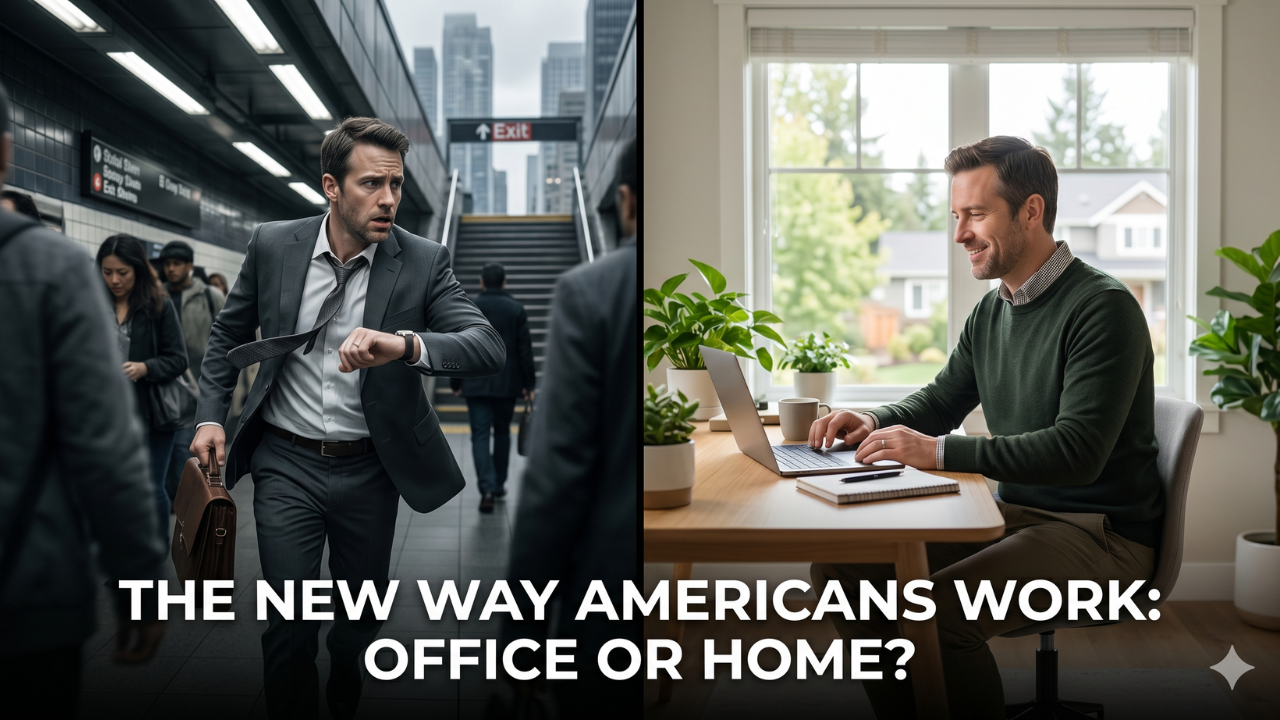
Work & Career · May 2026
Hybrid Work & the Commuting Radius Revolution: How Americans Are Redefining the 9-to-5
Remote work cracked open the door. Hybrid work just walked through it — and brought a moving truck.
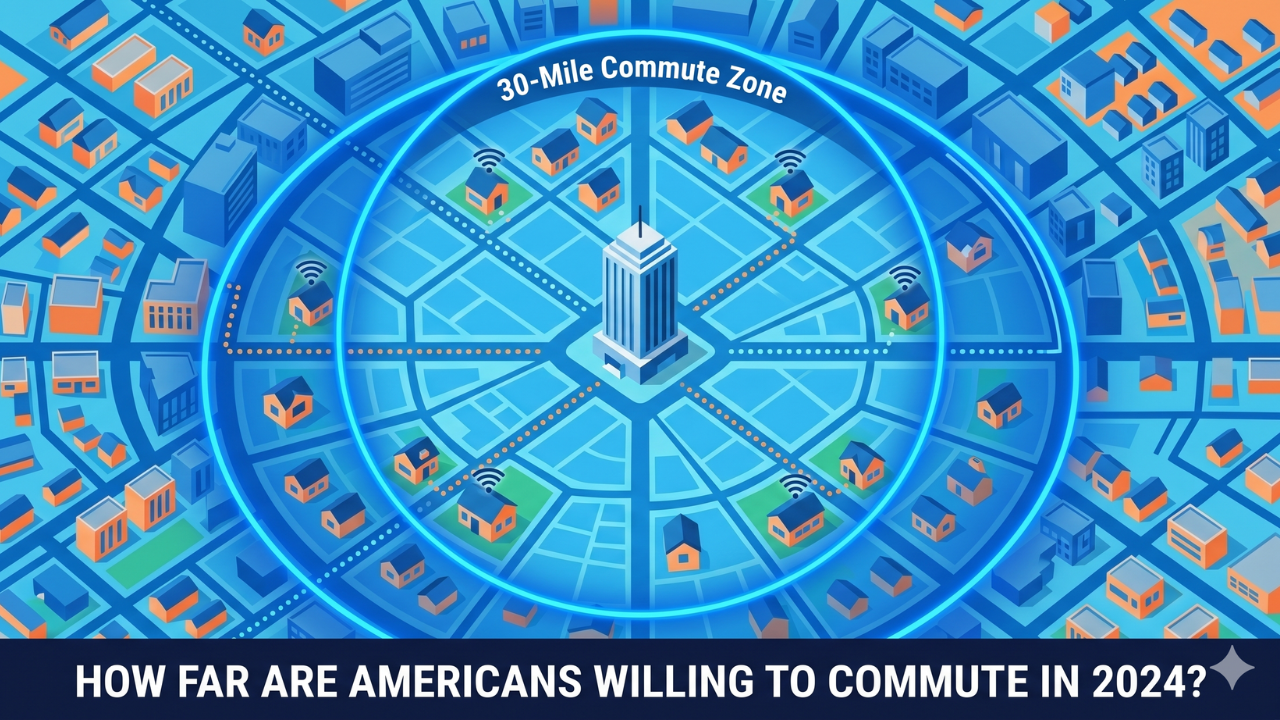
Living in California, I’ve watched entire neighborhoods transform over the past three years. Streets that once emptied at 7 a.m. — packed with professionals rushing to BART or the 101 — now hum quietly through lunch. Coffee shops that used to empty by 9 are full by 10. The commute, that sacred American ritual, has been renegotiated.
Across the United States, employers and workers are settling into what analysts now call the hybrid work era — a model that blends in-office presence with remote flexibility. But this isn’t just about where you open your laptop on a Tuesday. It’s reshaping housing markets, redefining what a “reasonable commute” means, and fundamentally changing what American workers demand from their employers.
If you’re still treating hybrid work as a temporary accommodation, you’re missing the story. This is structural. This is permanent. And it’s creating a massive ripple across every corner of American life.
What Exactly Is Hybrid Work — and Why Is It Dominating 2024?
Hybrid work refers to a work arrangement where employees split their time between a physical office and a remote location — most commonly, home. Unlike fully remote work (where employees never come in) or traditional on-site work (where they always do), hybrid occupies a flexible middle ground that has rapidly become the dominant model in the U.S. labor market.
According to a 2024 Gallup report, more than half of all remote-capable American workers are now in hybrid arrangements. The breakdown looks something like this:
- 53% of remote-capable workers are hybrid
- 27% are fully remote
- 20% are fully on-site
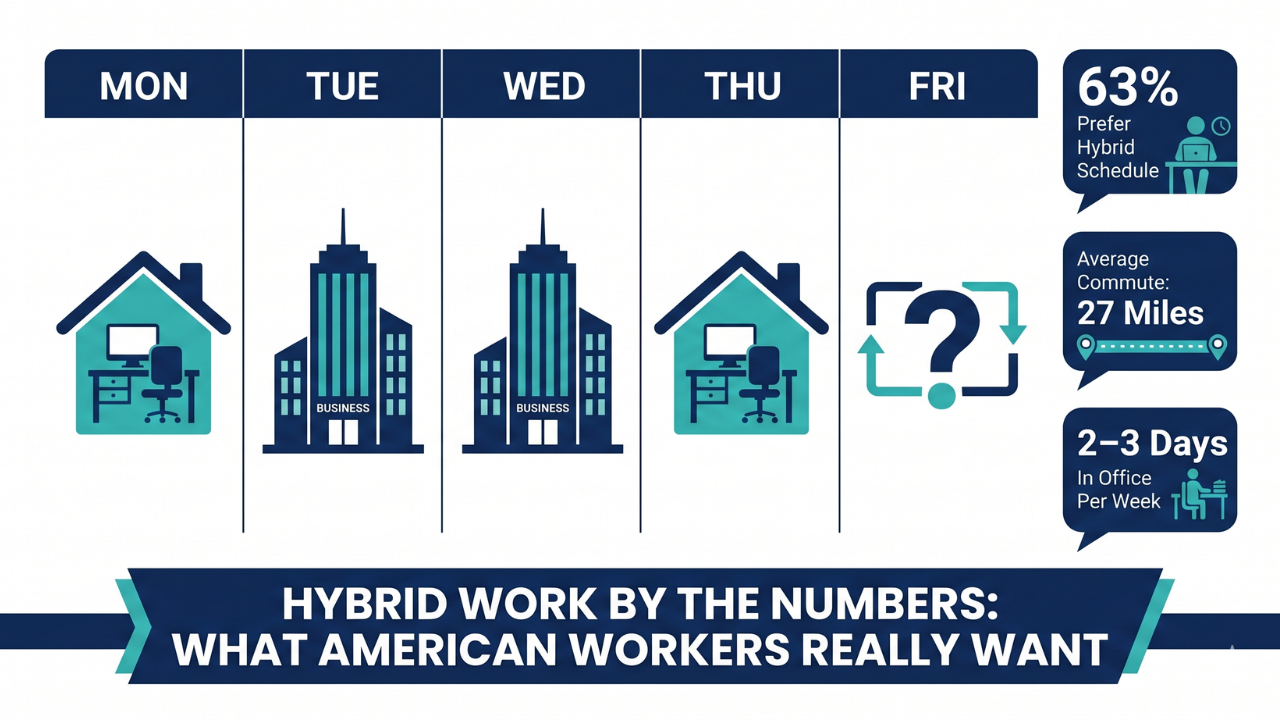
The most common pattern? Two to three days in the office per week — typically Tuesday, Wednesday, and Thursday — with Monday and Friday becoming de facto remote days. This creates a predictable rhythm that companies can plan around and workers can depend on.
The Commuting Radius Shift: Americans Are Moving Farther Away
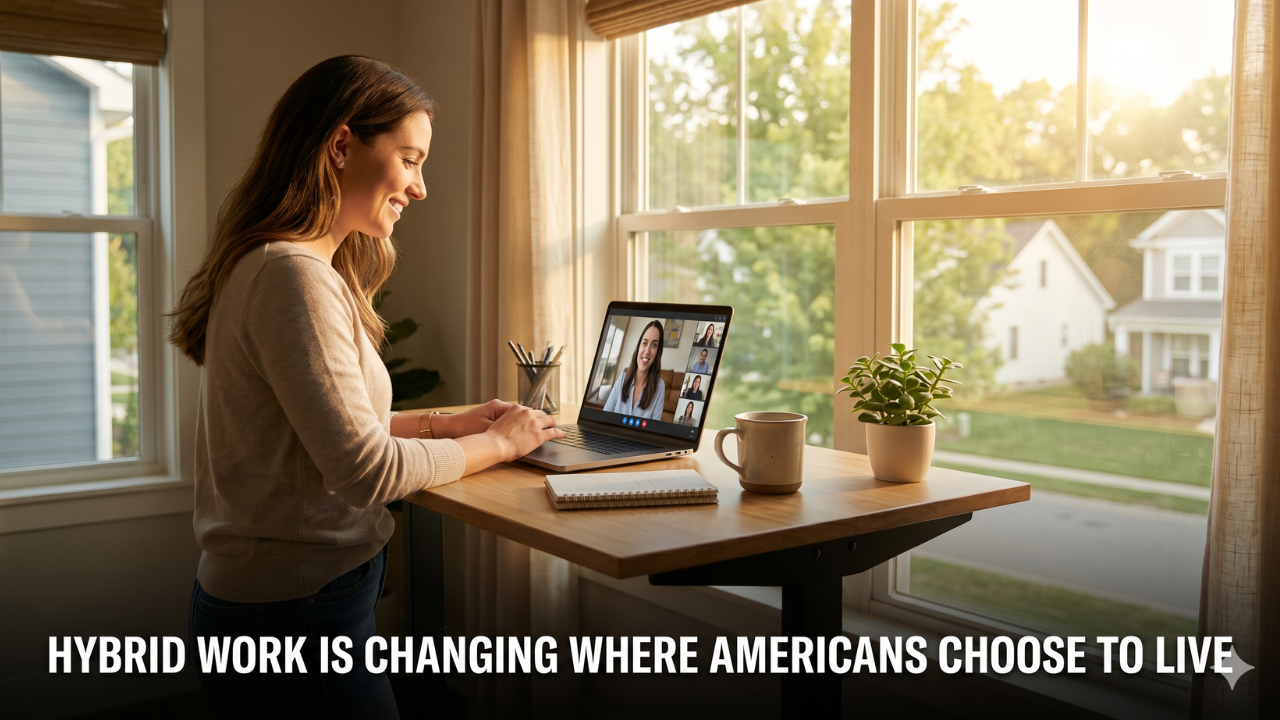
Here’s where it gets genuinely fascinating — and consequential. When workers only commute two or three days a week, a 45-minute drive each way suddenly becomes tolerable. Maybe even attractive, if it means living in a bigger house with a real backyard.
This is what economists are calling the “commuting radius expansion.” Prior to 2020, the average American worker lived about 27 miles from their workplace. Post-pandemic hybrid arrangements have pushed that number meaningfully outward, as workers accept longer distances in exchange for lower housing costs and more space.
Cities That Are Winning the Migration
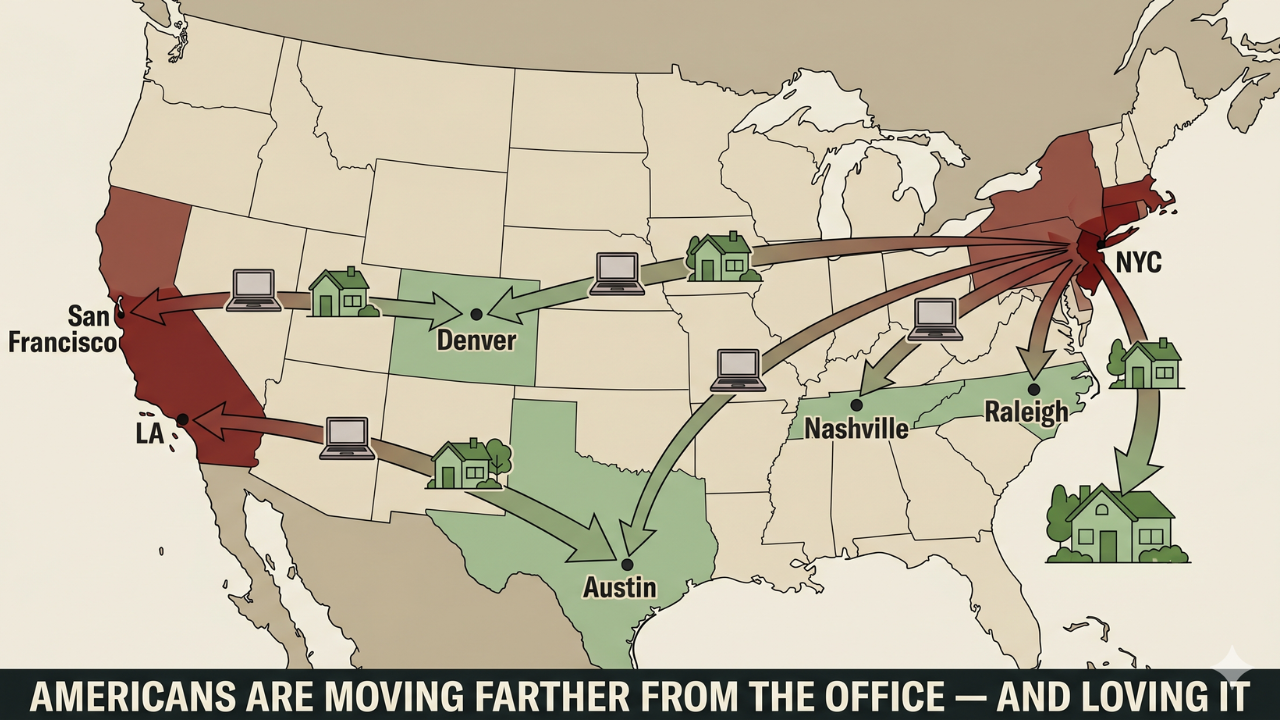
The data from Zillow, U-Haul, and the U.S. Census Bureau tells a consistent story. Workers are leaving dense, expensive metros for mid-size cities with lower costs of living — while remaining within a hybrid-commutable distance of their offices.
- Austin, TX — tech workers from the Bay Area, still flying in for quarterly sprints
- Nashville, TN — healthcare and finance employees from Chicago and Atlanta
- Raleigh-Durham, NC — Research Triangle drawing East Coast professionals
- Denver, CO — remote-first tech and outdoor lifestyle convergence
- Phoenix, AZ — California escapees seeking affordability with urban amenities
These cities share a common thread: they’re affordable enough to buy a home, livable enough to enjoy, and connected enough (via airport or short drive) to satisfy a hybrid schedule.
Recommended Home Office Essentials
Build Your Perfect Hybrid Workspace
Whether you’re working from home 2 days or 5, the right setup makes all the difference. These are the tools I actually use.
🔌 Desk Clamp Power Strip with 40W Fast Charging
2 PD USB-C ports, 3 outlets, surge protection. Clamps right to your desk edge — no more cable chaos.
🖥️ ErGear Electric Standing Desk (48×24 in.)
Height-adjustable sit-stand desk with memory presets. The foundation of any serious home office setup.
As an Amazon Associate, I earn from qualifying purchases.
The Home Office Is Now a Career Investment
If you’re going to work from home two or three days a week — indefinitely — your home office is no longer a temporary setup. It’s professional infrastructure. And Americans are treating it that way.
According to the Consumer Technology Association, home office equipment sales surged over 40% between 2020 and 2023 and have remained elevated. The category has shifted from “emergency pandemic purchases” to “deliberate career investments.” Workers are buying ergonomic chairs, standing desks, monitor setups, and high-quality lighting — not because their employer told them to, but because they understand that their environment directly affects their output.
What the Best Home Office Setups Have in Common
After interviewing dozens of remote and hybrid workers for this piece, patterns emerged. The most productive home offices share these characteristics:
- A dedicated, ergonomic seating arrangement — not the kitchen table
- Height-adjustable desk or monitor riser to alternate between sitting and standing
- Controlled lighting — both for video call appearance and for focus
- Clean cable and power management — clutter is a cognitive tax
- Noise management — whether through soundproofing, white noise, or headphones
What Employers Are Doing — and Getting Wrong
Not every company has navigated the hybrid transition gracefully. In fact, some of the biggest names in American business have stumbled badly — generating backlash, turnover, and negative press in the process.
Return-to-Office Mandates: When Flexibility Gets Revoked
Amazon made headlines in late 2023 when it mandated employees return to the office three days a week. The backlash was swift and public — thousands of employees signed internal petitions, and the company saw elevated attrition among senior technical staff. Similar patterns played out at Disney, Google, and Salesforce.
The core tension: companies invested billions in office real estate and corporate culture. Workers invested in their homes, their neighborhoods, and their routines. When mandates arrive without genuine consultation, it’s not just a policy conflict — it feels like a broken promise.
The Companies Getting It Right
On the flip side, companies like Airbnb, Dropbox, and GitLab have built genuine hybrid or async-first cultures with impressive results. Their approaches share some common threads:
- Clear, written policies about which roles can be hybrid vs. on-site
- Investing in home office stipends (often $500–$2,000 for setup)
- Designing office spaces for collaboration — not heads-down work that can be done anywhere
- Measuring outputs, not presence
Level Up Your Home Office Setup
Comfort + Productivity — Picked for Hybrid Workers
If you’re spending 2–3 days a week at your home desk, these are worth every penny.
🪑 TRALT Ergonomic Mesh Office Chair (330 LBS)
Full mesh back, lumbar support, wheels. Comfortable for those long hybrid workdays — and it looks great on video calls too.
📦 EclatBain Adjustable Furniture Risers (up to 4.3″)
Raise your desk or monitor to eye level. Simple fix, huge ergonomic impact — supports up to 4,000 lbs.
💡 Industrial Dimmable Desk Lamps Set of 2 (USB-A & C)
Fully dimmable with USB charging ports and outlet. Great for video calls and late-night work sessions. Comes in a set of 2.
As an Amazon Associate, I earn from qualifying purchases.
The Numbers: What 2024 Data Tells Us About Hybrid Work
Let’s ground this conversation in data. Here’s what the research tells us about the state of hybrid work in America right now:
63%
Workers prefer hybrid
2–3
Office days per week
$11K
Avg annual savings (workers)
54%
Would quit over RTO mandate
That last number deserves emphasis. More than half of hybrid workers say they would consider leaving their job if forced back to a full-time on-site schedule. That’s not just a preference — it’s leverage. And it’s reshaping how companies think about talent retention.
Hybrid Work and Mental Health: The Untold Side of the Story
The benefits of hybrid work go beyond commute time and housing costs. The psychological effects are significant — and the research is increasingly clear.
A Stanford study found that workers with hybrid schedules reported higher levels of job satisfaction, lower burnout, and better work-life integration compared to both fully remote and fully on-site counterparts. The sweet spot, researchers found, was roughly three days remote per week.
Why? Fully remote workers often struggle with isolation and the blurring of work-life boundaries. Fully on-site workers bear the full cost of commuting — in time, money, and stress. Hybrid workers get the social benefits of occasional in-person collaboration without the daily grind of commuting.
The Isolation Problem That No One Talks About
There’s a darker current here, though. For workers who live alone, or who don’t have strong local social networks, excessive remote work can amplify loneliness. The two or three in-office days that hybrid mandates provide aren’t just about productivity — they serve a genuine social function. The watercooler, derided for decades as a symbol of unproductive chatter, turns out to matter for human wellbeing.
What’s Next: Where Hybrid Work Goes From Here
The hybrid model is not a resting point. It’s an evolving equilibrium — and several forces are already pushing it toward its next phase.
AI and Automation Will Reshape the Calculus
As AI tools increasingly handle routine cognitive tasks — drafting, summarizing, scheduling, analyzing — the value of in-person time will shift toward irreplaceable human activities: creative problem-solving, relationship-building, mentorship, and nuanced negotiation. That might actually increase the premium placed on in-office collaboration, even as the overall number of office days decreases.
The “Hub and Spoke” Office Model
Major companies are already experimenting with hub-and-spoke office configurations — a large headquarters city, supplemented by smaller satellite offices in secondary markets where employees have relocated. This directly responds to the commuting radius expansion, bringing the office closer to where workers actually live.
Gen Z Will Set the New Norms
Generation Z — the first generation to enter the workforce with hybrid work as the default expectation, not the exception — will ultimately determine what “normal” looks like. Early indicators suggest they actually want more in-person time than Millennials, not less. They missed formative mentorship and socialization during the pandemic years and are actively seeking that kind of structured connection. The hybrid model may, paradoxically, end up with more office time for younger workers than older ones.
Final Thoughts: This Is the New American Work Contract
Hybrid work and the commuting radius revolution aren’t a blip. They’re a structural reset of the American work contract — one that was decades overdue. The pandemic didn’t create these desires; it simply forced both employers and workers to confront what had always been true: that the daily commute, the mandatory 9-to-5 presence, and the rigid geography of work were largely conventions — not necessities.
The workers who thrive in this new era will be those who invest in their own infrastructure: their home offices, their skills, and their ability to communicate and deliver results regardless of location. The companies that succeed will be the ones that stop measuring presence and start measuring impact.
As for the commuting radius? Americans have figured out that time is the one resource you can’t buy back. A Tuesday morning spent in a home office instead of bumper-to-bumper traffic isn’t just a convenience — it’s a quality-of-life decision that compounds, day after day, into a profoundly different kind of life.
Home Office Essentials
Shop Our Full Home Office Picks on Amazon
Everything you need to build a workspace that actually works for you.
Tags
remote work trends
commuting radius
home office setup
work from home 2024
💡 Frequently Asked Questions
Q: How is hybrid work different from remote work — and does it actually pay off for employers?
Hybrid work requires employees to come into the office a set number of days per week, whereas fully remote work allows employees to work from anywhere permanently. For employers, hybrid has shown measurable advantages: Stanford research found hybrid workers were 13% more productive than their fully on-site counterparts, while companies saved significantly on real estate costs. The arrangement also dramatically reduces voluntary turnover, with studies showing hybrid workers are 35% less likely to quit than fully on-site employees.
Q: How far are Americans now willing to commute under a hybrid schedule — and how does this affect housing decisions?
The commuting radius has expanded significantly. When workers only commute 2–3 days per week, a 45-to-60-minute one-way commute becomes tolerable in ways it never was under a 5-day schedule. This has pushed the effective commute radius from roughly 27 miles (pre-pandemic average) to 35–50 miles in many metro areas. The result: workers are buying homes in suburbs and exurbs that would have been considered too far before 2020, unlocking lower prices and more space while remaining within reach of urban employers.
Q: What are the most important investments for a hybrid worker’s home office setup?
If you’re working from home 2–3 days a week indefinitely, your home office is professional infrastructure — not a temporary experiment. The highest-return investments are: (1) an ergonomic chair with proper lumbar support, (2) a height-adjustable standing desk, (3) controlled lighting for both focus and video call appearance, (4) organized power and cable management at desk level, and (5) a reliable, high-speed internet connection. Together, these five elements create an environment that supports sustained productivity and protects your long-term physical health.
🌿 Weekly wellness, health & beauty insights — straight to your inbox
Free subscription · Cancel anytime