
Published on Dannywrites.us | Category: AI Tools, Side Hustle, Creator Economy
Living in California’s Bay Area, I’ve watched the AI revolution reshape everything from startup culture to the corner coffee shop’s marketing strategy. But the most profound shift isn’t happening in Silicon Valley boardrooms — it’s unfolding in spare bedrooms, kitchen tables, and coworking spaces across America, where ordinary people are quietly building automated income machines powered by artificial intelligence.
The 9-to-5 isn’t dead. But in 2026, it’s no longer the only viable path — and for millions of Americans, it’s no longer even the most profitable one. This is the era of the AI Production Line: a systematic, scalable approach to generating income that leverages AI tools to do the heavy lifting while you architect the strategy.
Whether you’re a freelancer looking to 10x your output, a content creator trying to break through the noise, or a knowledge worker ready to monetize your expertise without burning out, this guide breaks down exactly how to build your own profitable AI production line — from the tools to the workflow to the numbers that actually matter.
What Exactly Is an “AI Production Line”?
An AI production line is not a single app or a one-click money machine. Think of it as a modular, repeatable system — a pipeline — where AI handles the repetitive, time-intensive tasks and humans supply the irreplaceable ingredients: creativity, judgment, lived experience, and strategic direction.
Just as Henry Ford didn’t make cars himself but designed the process that made cars at scale, your job in 2026 is not to do everything — it’s to design a process that produces value at scale with your AI stack doing the heavy lifting.
The core components of a modern AI production line include:
- Input layer: Research, ideation, and data sourcing
- Processing layer: AI generation, transformation, and refinement
- Quality control layer: Human review, fact-checking, and brand alignment
- Output layer: Publishing, distribution, and monetization
- Feedback loop: Analytics, iteration, and system improvement
The magic happens when these layers connect seamlessly, running with minimal friction and maximum consistency.
Why 2026 Is the Inflection Point
The Tool Landscape Has Matured
Three years ago, AI tools were impressive but brittle. Today, the ecosystem has consolidated around a set of genuinely professional-grade platforms. According to McKinsey’s 2026 State of AI Report, 74% of US businesses now use AI in at least one business function — up from just 55% in 2023. More importantly, the quality gap between AI-assisted and purely human output has narrowed dramatically in content-driven fields.
This maturation means two things for independent operators: the barrier to entry for high-quality production has dropped, and the competition has intensified. The window to build a durable, defensible production line is open — but it won’t stay wide open forever.
The Creator Economy Has Crossed a Critical Threshold
The US creator economy is projected to exceed $500 billion by 2027, according to Goldman Sachs research. But the distribution of that revenue has shifted. The middle tier of creators — those with 1,000 to 100,000 followers — is actually gaining ground on mega-influencers, as platforms reward consistency, niche authority, and engagement depth over raw follower counts.
AI production lines are the great equalizer. A solo operator with the right system can now produce content volume and quality that previously required a team of 5-10 people.
The Regulatory Climate Has Stabilized
After years of uncertainty, the US AI landscape has reached a workable regulatory equilibrium. The FTC’s 2025 AI Content Disclosure Guidelines are now broadly understood and easy to comply with, removing a major anxiety point for AI-assisted content creators. Disclosing AI assistance isn’t a scarlet letter — it’s now a professional norm.
The Four Pillars of a Profitable AI Production Line
Pillar 1: AI-Assisted Content Creation
Content remains the foundational currency of the digital economy. An AI-powered content production line typically follows this structure:
Step 1 — Strategic Ideation (Human-led) Use tools like Perplexity AI or Claude to research trending topics within your niche, then apply your own expertise to select angles that are both timely and differentiated. The AI surfaces the landscape; you determine the path.
Step 2 — Structured Drafting (AI-primary) Tools like Claude, GPT-4o, or Gemini Ultra can generate full article drafts, video scripts, email sequences, and social captions from detailed prompts. The key is in the prompt architecture — structured, role-specific prompts consistently produce better outputs than vague requests.
Step 3 — Human Refinement (Human-led) This is where your voice, expertise, and lived experience enter the pipeline. Inject personal anecdotes, verify factual claims, and ensure the content reflects your actual perspective. This layer is non-negotiable for long-term credibility.
Step 4 — Multi-Platform Repurposing (AI-assisted) A single well-researched article becomes a LinkedIn post, an email newsletter, a YouTube script, three tweet threads, and a podcast outline — with AI handling the format transformation. Tools like Descript, Opus Clip, and custom GPT workflows make this systematic.
Real-World Numbers: A solo content operator using this system can realistically produce 5-8 high-quality long-form articles per week, compared to 1-2 without AI assistance. At even $150/article for B2B clients, that’s a meaningful revenue shift.
Recommended Tool
Blue Yeti USB Microphone
Podcasts, online courses, YouTube scripts — your voice is your brand. Start with the mic that pros trust.
⚠️ As an Amazon Associate, I earn from qualifying purchases.
Pillar 2: AI-Powered Digital Product Creation
Digital products — ebooks, templates, courses, prompt libraries, toolkits — are among the highest-margin products in the creator economy. AI dramatically compresses the production timeline.
High-Traction AI Product Categories in 2026:
- Prompt Libraries and Workflows — Curated, tested prompt systems for specific professional use cases (legal, healthcare, marketing, education). These sell as one-time purchases or SaaS subscriptions.
- AI-Assisted Online Courses — The fastest-growing segment. Creators use AI to generate curriculum frameworks, lesson scripts, quiz questions, and supplementary materials, then record the final video content themselves.
- Niche Data Products — Curated datasets, industry reports, and market intelligence packages. AI assists in aggregation and synthesis; human expertise provides interpretation.
- Custom GPT Products and API Wrappers — With the proliferation of accessible APIs, productizing specialized AI tools for narrow professional applications has become a genuine cottage industry. Think: a lease review assistant for small landlords, or a social media caption generator trained on a specific brand voice.
- Template Ecosystems — Notion templates, Canva kits, Airtable bases, email sequences — all areas where AI accelerates production and human design sense determines quality.
The Pricing Reality: The US market has shown strong willingness to pay for AI-generated products when the utility is clear. Mid-tier prompt libraries ($27-$97) and niche templates ($17-$67) consistently convert well with minimal paid traffic when positioned correctly.
Pillar 3: AI-Augmented Service Delivery

If you’re a freelancer, consultant, or agency owner, AI doesn’t replace your services — it expands your capacity and margin.
The Leverage Math: If AI tools handle 60% of the production work on a $3,000 copywriting contract, and the AI subscription costs $200/month, your effective hourly rate on that project may double or triple — without changing the client-facing deliverable.
This is the core insight that separates AI-fluent service providers from those merely experimenting with the tools: AI is a margin improvement engine, not just a time saver.
High-leverage service applications include:
- SEO content at scale: Producing optimized article clusters for clients using AI for research, drafting, and internal linking suggestions
- Social media management: Batch-creating content calendars, caption drafts, and engagement responses
- Email marketing: Segmented campaign copywriting, A/B variant generation, and drip sequence development
- Video production support: Script writing, caption generation, description optimization, and chapter markers
- Data analysis and reporting: AI tools can process client data and generate preliminary reports that humans review and contextualize
Positioning Strategy: The most successful AI-augmented service providers in 2026 don’t lead with “I use AI.” They lead with outcomes, speed, and value — and disclose AI as part of their professional process when directly asked. Clients pay for results, not tools.
Pillar 4: Data-Driven Optimization and Scaling
A production line without measurement is just guesswork at scale. The fourth pillar is the intelligence layer that separates amateur operations from scalable businesses.
Key Metrics to Track:
- Output Volume vs. Revenue: How many units (articles, products, client projects) are you producing, and what’s the revenue per unit?
- Production Efficiency: Time from input to publishable output; cost per unit including AI subscriptions
- Conversion Rates: For content, what’s the email list conversion rate? For products, what’s the page visit to purchase ratio?
- Audience Quality Signals: Engagement depth, return visitor rates, repeat purchase rates — these matter more than raw traffic
The Compounding Effect: Unlike a traditional 9-to-5 where you trade hours for dollars, a well-built AI production line produces compounding returns. Content published six months ago continues to drive traffic. Products sold require no additional production hours. Systems improve with iteration. The ROI curve bends upward over time in ways that hourly employment simply cannot match.
Building Your Stack: The Essential AI Tools in 2026
Not all AI tools are created equal, and the right stack depends on your production focus. Here’s a practical starting framework:
Foundation Layer (For Everyone)
- Claude (Anthropic) — Long-form reasoning, complex writing, analysis, and system prompting. Exceptional for nuanced content and client deliverables.
- ChatGPT (OpenAI) — Versatile drafting, brainstorming, and code assistance via GPT-4o
- Perplexity AI — Real-time research with source citations; essential for factual accuracy
Content Production Layer
- Descript — Audio/video editing with AI transcription and content repurposing
- Opus Clip — Automated short-form clip generation from long-form video
- Midjourney / DALL-E 3 — AI image generation for visual content and product design
SEO and Distribution Layer
- Surfer SEO — Content optimization and keyword clustering
- Beehiiv / ConvertKit — Email marketing with AI-assisted personalization
- Buffer / Metricool — AI-powered social scheduling and analytics
Product Creation Layer
- Canva AI — Design generation for digital products and templates
- Kajabi / Gumroad — Product hosting and sales infrastructure
Automation and Integration Layer
- Make (formerly Integromat) — Workflow automation between tools
- Zapier — Trigger-based automations for publishing and distribution
Monthly Cost Reality Check: A professional AI production stack runs approximately $200-$500/month for a solo operator. This sounds significant until you realize it replaces the equivalent of 1-3 freelancers’ hourly output.
Recommended Tool
LG 27″ IPS Monitor
Run Claude, Descript, and your CMS side by side. A second screen is the single fastest upgrade to your AI production workflow.
⚠️ As an Amazon Associate, I earn from qualifying purchases.
The Monetization Matrix: How the Revenue Actually Flows
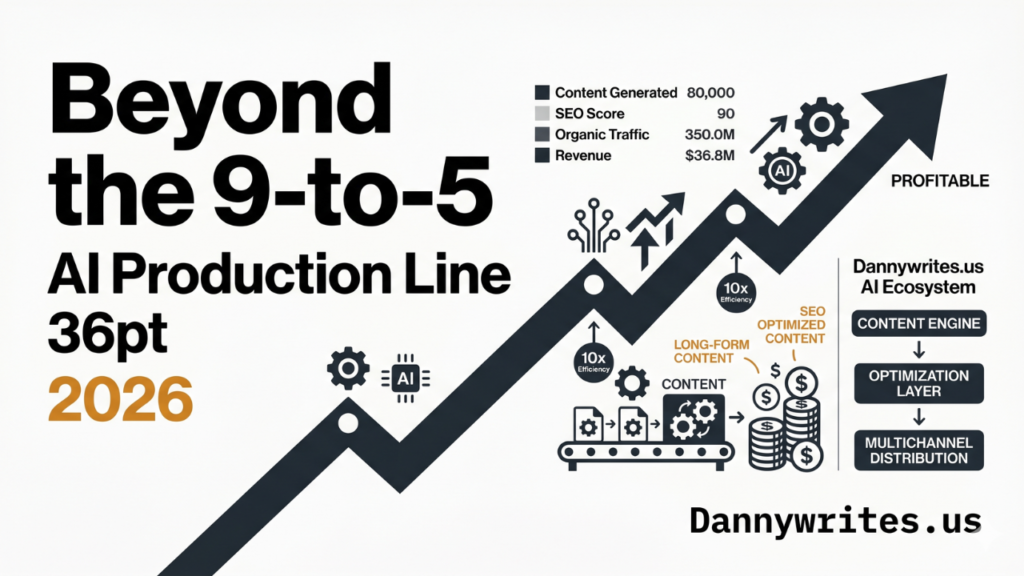
Successful AI production line operators rarely rely on a single revenue stream. The model that’s generating the most consistent $5,000-$25,000/month for solo operators in 2026 combines:
- Content Monetization (Ads, Sponsorships, Affiliate): $500-$5,000/month depending on audience size
- Digital Product Sales: $1,000-$10,000/month for established niches
- Service Retainers: $2,000-$8,000/month per active client
- Licensing and Syndication: Selling AI-assisted content to publications, aggregators, or B2B clients
The key is sequencing: most successful operators build an audience through content first, convert that audience to a product or service offering second, and layer licensing and syndication revenue third.
Common Mistakes That Kill AI Production Lines Before They Start
Mistake #1: Over-automating the human elements The fastest way to destroy credibility is to publish AI content that lacks genuine perspective, accurate information, or a coherent voice. Quality control cannot be automated. Build non-negotiable human review into every pipeline.
Mistake #2: Chasing every new tool instead of mastering the stack The AI tool landscape is noisy and deliberately marketed to induce FOMO. Resist the urge to constantly switch tools. Master your core stack before experimenting with additions.
Mistake #3: Ignoring the platform algorithm changes AI-generated content that doesn’t serve genuine human intent is increasingly penalized by both search engines and social platforms. Google’s Helpful Content updates have consistently targeted low-value, high-volume AI content. The solution is not to avoid AI — it’s to ensure your content is genuinely useful.
Mistake #4: Underpricing AI-assisted work Many new operators discount their services or products because they feel “guilty” about using AI. This is economically irrational. Your clients pay for outcomes, not production methods. Price accordingly.
Mistake #5: Neglecting the legal and disclosure landscape The FTC now requires disclosure of AI-generated content in certain commercial contexts. Ignoring this isn’t just an ethical lapse — it’s a business risk. Build compliance into your workflow from day one.
Your 90-Day Launch Roadmap
Days 1-30: Foundation
- Define your niche and core audience persona
- Select and master your core AI tool stack (3-4 tools maximum)
- Build your content production workflow and test it with 10 pieces of content
- Establish your distribution channels (website, email list, one primary social platform)
Days 31-60: Production
- Systematize your production pipeline with documented SOPs
- Launch your first digital product or service offering
- Publish consistently (minimum 3x per week across formats)
- Begin building an email list with a lead magnet
Days 61-90: Optimization
- Analyze what’s working (traffic sources, conversion rates, revenue per hour)
- Double down on the highest-ROI activities
- Automate what can be automated; improve what can’t
- Set your 6-month revenue targets based on actual data
Recommended Tool
Sony WH-1000XM5 Noise Cancelling Headphones
Deep focus is your competitive advantage. Block out distractions and stay in flow during long AI production sessions.
⚠️ As an Amazon Associate, I earn from qualifying purchases.
The Bigger Picture: What This Means for Work in America
The AI production line isn’t just a hustle strategy — it’s a structural shift in how value is created and distributed in the American economy. For the first time in decades, the tools to build a genuinely scalable, professional-grade media and product business are accessible to anyone with an internet connection and the discipline to build a system.
That said, it’s worth being clear-eyed: AI production lines require real work, real expertise, and real judgment. The people succeeding with this model are not simply “prompting their way to passive income.” They are skilled operators who have learned to leverage AI as a force multiplier for their existing knowledge and creative capacity.
The 9-to-5 isn’t disappearing. But in 2026, the question isn’t whether you can build an AI production line — it’s whether you’ll start building yours before someone else in your niche does.
💡 Frequently Asked Questions (FAQ)
Q1: Do I need technical skills or a coding background to build an AI production line in 2026?
A: No technical background is required to build a profitable AI production line. The majority of the tools in the modern AI stack — Claude, ChatGPT, Descript, Canva AI, Make, and others — are designed for non-technical users with intuitive interfaces and guided workflows. What is required is a systems mindset: the ability to think in processes, identify bottlenecks, and iterate on your workflow based on data. The more important investment is in developing strong prompt engineering skills, which is a learnable discipline that dramatically improves AI output quality. Most successful solo operators in 2026 built their systems through deliberate practice over 30-90 days, not through technical training.
Q2: How much money can I realistically make with an AI production line, and how long does it take to become profitable?
A: Realistic income projections vary significantly based on niche, distribution channel, and consistency of execution. Based on patterns observed across the creator economy in 2026, solo operators with a well-built AI production line typically reach $2,000-$5,000/month within 6 months if they combine content monetization with at least one digital product or service offering. The $10,000-$25,000/month range is achievable within 12-18 months for those who systematically build audience, product, and service revenue streams simultaneously. The key variables are niche selection (B2B niches monetize faster), distribution strategy (email lists outperform social-only distribution), and the quality of the human expertise layer — AI amplifies expertise, but cannot replace it. Tool costs of $200-$500/month are recoverable within the first month for anyone generating even modest client or product revenue.
Q3: How do I differentiate my AI production line in an increasingly crowded market where everyone has access to the same tools?
A: The paradox of AI democratization is that while it lowers production barriers, it simultaneously raises the importance of differentiation in areas AI cannot replicate. The operators winning in 2026 differentiate across three dimensions: Niche depth — serving a specific, defined audience with specialized expertise rather than competing as a generalist. Voice and perspective — an authentic, consistent point of view that runs through all content and products, built on lived experience and genuine opinion. System sophistication — a production pipeline refined over months or years produces consistently higher-quality output than one assembled overnight. The tools are commodities; the system, the expertise, and the distribution relationships are the moat. Additionally, as AI content proliferates, audiences are actively seeking creators who demonstrate genuine knowledge and original analysis — which is precisely what the human layer of a well-built production line delivers.
🌿 Weekly wellness, health & beauty insights — straight to your inbox
Free subscription · Cancel anytime