By The Truth Hunter | Investigative Series: South Korea’s Shadow Democracy.( Episode 3)
“The country you see on the map is not the country that actually governs you. There is the Republic of Korea — and then there is the other one. The hidden one.”
🔴 DRAMATIC HOOK: The Day Democracy Wore a Mask
Imagine a democracy that holds elections, maintains a constitution, and projects the image of a free society — yet operates according to a parallel set of rules written by people you never voted for, never elected, and may never even know by name.
This is not a hypothetical. This is South Korea.
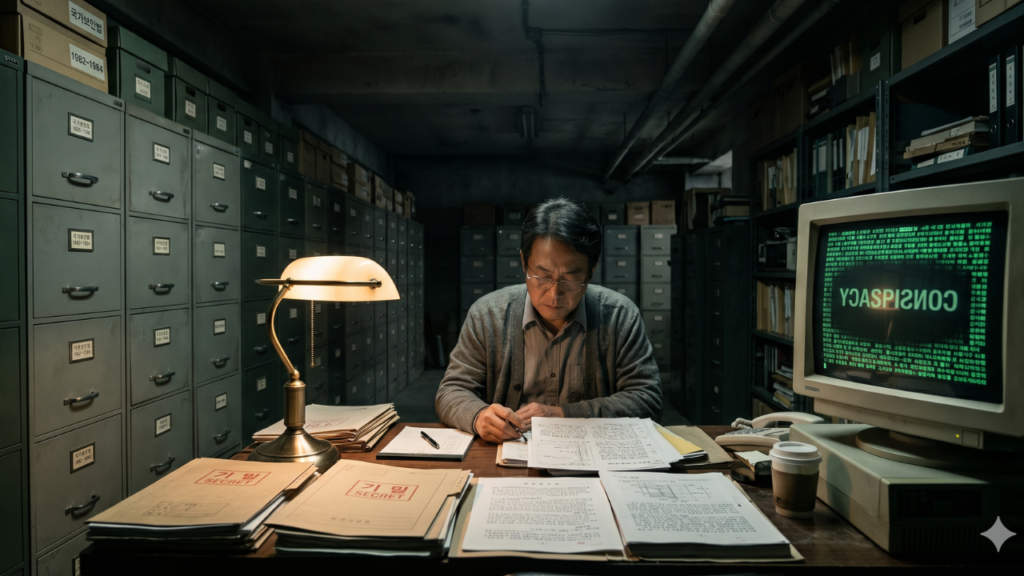
In the spring of 1999, a young journalist sat at his desk at Wolgan Chosun, one of Korea’s oldest conservative publications, staring at a set of documents that would upend his understanding of the country he thought he knew. What he had uncovered wasn’t a single corrupt official or a rogue agency. It was something far more unsettling: a structured, generational network of ideological operatives who had quietly colonized the institutions of South Korean democracy from the inside — the courts, the media, the universities, and eventually the presidential advisory offices themselves.
The story he was about to tell — and the one we are telling now — is the story of the Hidden State: a shadow architecture of power built not through coups or violence, but through decades of patient institutional infiltration, narrative control, and the ruthless exploitation of a society’s most sacred democratic processes.
What you are about to read is not a conspiracy theory. It is a documented pattern.
And it has implications not just for South Korea — but for every democracy in the world that believes its elections are its own.
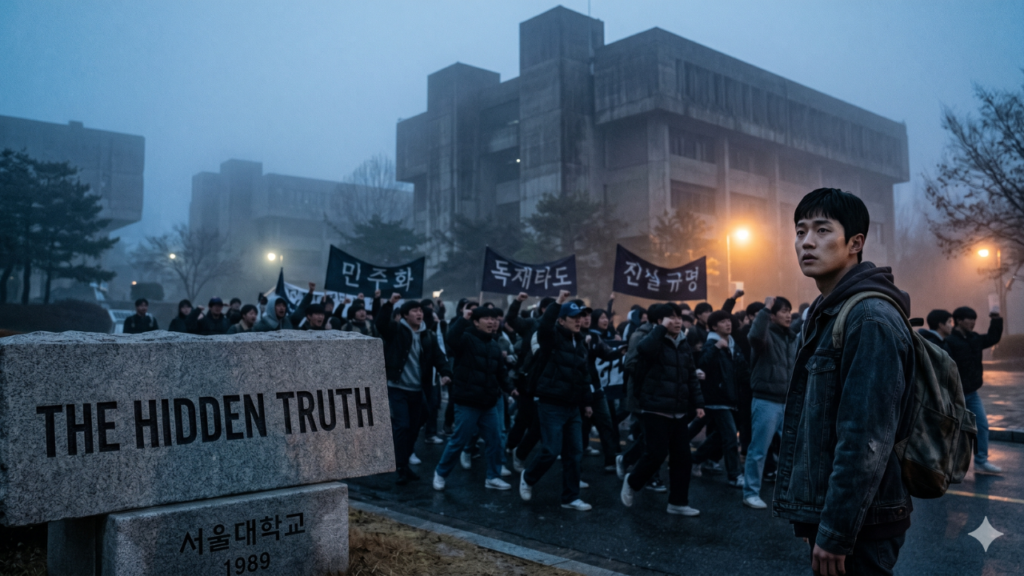
PART I: ANATOMY OF THE HIDDEN STATE — Defining the Informal Power Structure
To understand South Korea’s Hidden State, you must first understand its origins.
In 1989, the campuses of South Korea’s elite universities were not centers of learning in any conventional sense. They were ideological boot camps. At Seoul National University — the country’s most prestigious institution — freshman orientation was not a welcome ceremony. It was an indoctrination sequence, carefully designed by upperclassmen who had inherited a revolutionary tradition stretching back to the resistance movements of the 1970s and 1980s.
New students were greeted not with career counseling but with agitation sessions — called “RP” (Reproductor) training — where senior activists taught the techniques of crowd mobilization, chant leadership, and ideological framing. The songs sung at these gatherings were not pop songs. They were 19th-century European labor anthems, repackaged for a Korean audience burning with anti-American nationalism.
The bookstore near campus quietly stocked texts that were technically illegal under South Korea’s National Security Law. Marxist theory. Juche ideology. Revolutionary manifestos. Nobody pretended this was accidental. The institution — formally committed to academic freedom — had become a delivery mechanism for a specific political project.
Two rival factions competed for dominance within this ecosystem:
The NL Faction (National Liberation) operated from the premise that South Korea’s primary enemy was American imperialism, not North Korean aggression. Their ultimate strategic goal was Korean reunification — on terms that did not require the North to democratize. The Korean War, in their ideological framework, was reframed as a minjok haebang jeonjaeng — a “war of national liberation” — a formulation lifted almost verbatim from Pyongyang’s official state narrative.
The PD Faction (People’s Democracy) was more classically Marxist, focused on labor exploitation and the dismantling of South Korea’s capitalist structure. Less interested in North Korea as a model, but equally committed to the fundamental transformation of the South Korean state.
These two factions competed furiously on campus. But they shared something more important than their differences: a long-term strategic patience that their opponents consistently underestimated.
“They didn’t need to win elections immediately. They needed to become the people who trained the people who would eventually run everything.”
This is the foundational mechanism of the Hidden State. Not seizure of power. Succession of power — achieved through the systematic placement of ideologically aligned individuals into positions of institutional authority over a period of thirty years.
By the late 1990s, the generation that had sung revolutionary anthems at freshman orientation in 1989 was entering law firms, newsrooms, government ministries, and presidential advisory boards. They had not renounced their past. They had professionalized it.
PART II: ELECTORAL VULNERABILITIES — The Systematic Anomalies
The Hidden State’s relationship with South Korea’s electoral system is not primarily about ballot-stuffing or vote-counting fraud — though those concerns have been raised and deserve serious scrutiny. It operates at a more sophisticated level: the corruption of the informational and institutional environment in which elections occur.
Consider the following documented pattern:
Narrative Control Through Media Placement. The same generation of campus activists who were trained in ideological framing techniques in the late 1980s moved — in significant numbers — into South Korea’s major media organizations throughout the 1990s and 2000s. This was not coincidence. It was the predictable outcome of a deliberate long-term strategy to occupy the institutions that shape public perception. A democracy’s elections are only as free as its information environment. When the people who determine which stories get told, which framing is “objective,” and which voices are amplified share a common ideological origin — the election outcome is shaped before a single vote is cast.
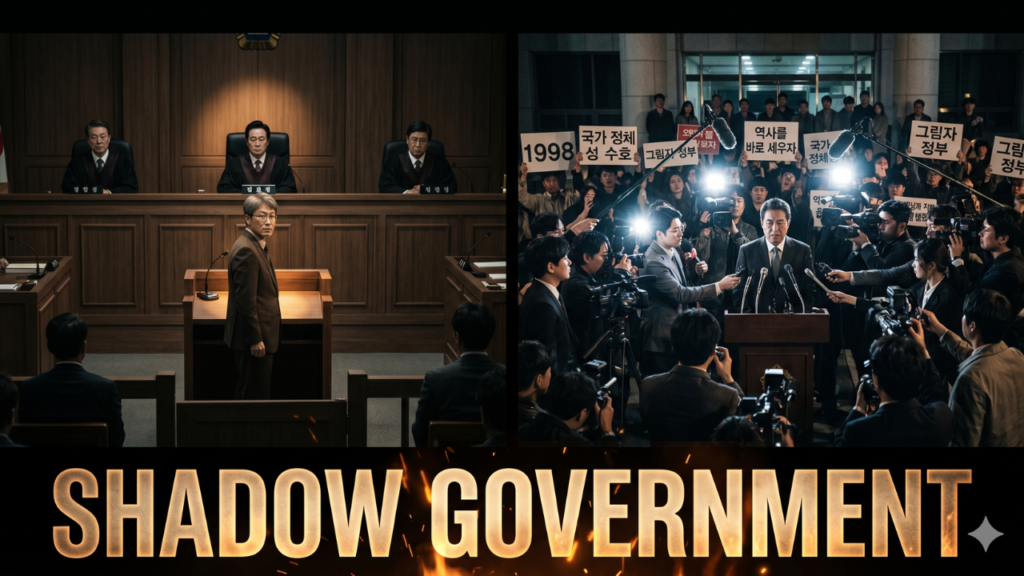
Judicial Capture and the 1998 Precedent. The Choi Jang-jip controversy of 1998-1999 was not merely an academic dispute. It was a test case for the Hidden State’s judicial reach. When Seoul District Court issued a preliminary injunction restricting further publication of Wolgan Chosun‘s article on Professor Choi — a sitting presidential advisor — the message was clear: the judiciary could be mobilized to protect ideologically aligned figures from scrutiny. The court’s intervention was framed as protecting against defamation. Critics argued it was prior restraint on legitimate political journalism at the highest level.
The speed and coordination of the response was itself revealing. Within days of the original article’s publication, the following occurred in sequence:
- The ruling party (Hankara Party) called for the professor’s resignation
- Chosun Ilbo demanded public accountability
- Dozens of civic organizations issued coordinated statements
- University presidents weighed in publicly
- Military veterans associations demanded removal from the presidential advisory board
- The Seoul District Court received injunction applications
- Counter-mobilization from left-aligned civil society groups began simultaneously
This was not organic public reaction. This was an orchestrated institutional response — the Hidden State’s immune system activating against a perceived threat to one of its nodes.
The Presidential Advisory Penetration. Professor Choi’s position as an advisor to President Kim Dae-jung represented something historically unprecedented in post-war South Korea: a figure whose academic work had been credibly accused of adopting North Korean historiographical framing was now whispering in the ear of the nation’s chief executive. The question this raised — which South Korea’s establishment media largely refused to ask — was not whether Choi was personally a spy or an agent. It was far more disturbing: had the Overton window of acceptable elite opinion shifted so far that nobody in the presidential inner circle considered this problematic?
The Generational Mechanism of Electoral Influence. Perhaps the most structurally significant finding is this: the Hidden State does not primarily influence elections through direct fraud. It influences them through the slow transformation of what counts as a legitimate political position. When the professors who train the lawyers who become the judges who certify election results all emerged from the same ideological ecosystem — when the journalists who cover campaigns, the NGO leaders who mobilize voters, and the civil society figures who frame the national conversation share a common intellectual formation — the election is a formality ratifying a decision already made upstream.
This is what makes the Hidden State so difficult to prosecute and so easy to dismiss as paranoia. It operates in the realm of culture, not crime. Its most powerful tools are not ballots or bribes. They are definitions — of who counts as extreme, what counts as legitimate, and which questions are allowed to be asked.
PART III: THE EVIDENCE TRAIL — What the Documents Show
The source material for this investigation — a political memoir by an insider journalist who navigated these networks from the late 1980s through the late 1990s — provides a rare ground-level view of the Hidden State’s operational mechanics.
Several findings stand out as particularly significant for electoral integrity analysis:
Finding 1: The “Sidae Jeongsin” Network. After the 1998 controversy, the journalist attempted to interview five editorial board members of a radical publication called Sidae Jeongsin (Spirit of the Age) — a magazine founded in the 1980s by figures aligned with the pro-North student movement. Every single contact refused to speak. Former colleagues disappeared from their offices before calls could be returned. One acquaintance warned him directly: “Covering the Kang group is dangerous. You can’t get out once you’re in.” This was not the behavior of people with nothing to hide. This was the operational security of an organization that understood its own vulnerability.
Finding 2: The Japanese Connection. In the lead-up to the 1997 presidential election, the journalist encountered a Japanese political operative — a graduate of Waseda University who had traveled to Korea specifically to observe the election process over six months. The operative’s explicit purpose: to study Korean politics and the presidential election. The question his presence raised — which the author found himself unable to answer — was: who sent him, and what was he reporting back? Foreign observation of a domestic election is normal. Six months of embedded observation by a representative of a foreign political faction is something else entirely.
Finding 3: The Kang Cheol-hwan Revelation. The journalist’s investigation eventually led him to Kang Cheol-hwan — a former North Korean political prisoner and defector who had become one of the most authoritative voices on the internal mechanics of the Kim Jong-il regime. Kang’s group had found the journalist through his 1999 article. The implication was chilling: the people most closely tracking ideological drift within South Korean institutions were not South Korean conservatives. They were North Korean defectors — people who had lived inside the system the NL faction romanticized and who understood, with visceral clarity, exactly what was being imported into South Korean democratic institutions under the banner of progressive politics.
PART IV: GLOBAL IMPLICATIONS — Why the World Must Care
South Korea is not a peripheral case study. It is the canary in the coal mine for every democracy navigating the post-Cold War ideological landscape.
The mechanism described here — the long-term institutional capture of a democracy’s key organs by a network of ideologically aligned operatives trained in a specific radical tradition — is not unique to Korea. What makes Korea uniquely instructive is the documentation: a paper trail of campus organizations, court cases, publication records, and personal testimonies that allows us to trace the mechanism with unusual precision.
The lessons are universal:
Lesson 1: Democracies are most vulnerable not at the ballot box but in the institutions that shape the ballot box. Free and fair elections require free and fair information environments, independent judiciaries, and academic institutions committed to genuine intellectual pluralism. When any of these is captured by a faction committed to a predetermined outcome, the election becomes theater.
Lesson 2: Ideological patience is a strategic weapon. The Hidden State did not attempt to seize power in 1989. It invested in a thirty-year project of institutional placement. This time horizon is longer than most democratic accountability mechanisms are designed to address. Annual elections, four-year terms, rotating administrations — none of these are calibrated to detect or resist a generational infiltration strategy.
Lesson 3: The language of democracy can be used to dismantle democracy. The most sophisticated feature of the Hidden State is its fluency in democratic rhetoric. It defends its judicial interventions as protecting free speech. It frames its media dominance as journalistic independence. It presents its electoral influence as civic participation. The vocabulary of liberation becomes the camouflage of control.
Lesson 4: Defectors see what citizens cannot. In South Korea, it was North Korean defectors — people with direct experience of the system being replicated — who most clearly understood what was happening. In every democracy, the people who have lived under the system being imported are the most reliable witnesses to its nature. Their testimony deserves more institutional weight than it currently receives.
FEARLESS CONCLUSION: The Republic That Hid Itself
South Korea built one of the most remarkable democracies in modern history. In less than forty years, it transformed from a military dictatorship into a technologically advanced, economically powerful, constitutionally governed republic. That achievement is real and should not be minimized.
But democracy is not a destination. It is a practice — one that requires constant, vigilant, and sometimes uncomfortable maintenance.
What the evidence assembled in this investigation suggests is that South Korea’s democratic practice has been compromised — not suddenly, not through a single dramatic event, but gradually, systematically, and with extraordinary strategic patience — by a network of actors whose foundational commitments were formed in the revolutionary campus culture of the late 1980s and whose operational methods were refined over three decades of institutional navigation.
The Hidden State did not abolish elections. It learned to inhabit them — to occupy the spaces between votes where power actually lives: the editorial meetings, the judicial chambers, the advisory councils, the faculty senates, the civil society organizations that define the boundaries of legitimate political speech.
The young journalist who stumbled into this story in 1999 did not set out to be a truth-teller. He set out to write a magazine article. What he found instead was the architecture of a parallel republic — one that had been under construction for thirty years, hiding in plain sight behind the facade of the democracy it was slowly, methodically replacing.
The question his story leaves us with is not a Korean question. It is a question for every citizen of every democracy on earth:
Who is actually governing your country — and how would you know if it wasn’t the people you voted for?
❓ FAQ: The Hidden State Explained
Q1: Is the “Hidden State” in South Korea a proven fact or a theory?
A: The structural pattern described in this investigation — ideological networks from 1980s campus movements moving into judicial, media, and governmental positions — is documented through court records, publication archives, personal testimony, and organizational histories. What remains contested is the degree of intentional coordination versus organic ideological affinity. The evidence strongly supports the existence of a structured informal power network. Whether it constitutes a centrally directed conspiracy or a decentralized ecosystem of shared commitments is a legitimate analytical question — not a reason to dismiss the underlying pattern.
Q2: How does electoral corruption work if there’s no direct ballot fraud?
A: The most durable form of electoral corruption operates upstream of the ballot. When the institutions that shape public opinion, certify candidates, adjudicate disputes, and define the boundaries of acceptable political speech are disproportionately populated by people sharing a common ideological origin, the election ratifies a decision already made in the information environment. Direct ballot manipulation is detectable and prosecutable. Institutional capture is neither — which is precisely why it is the preferred method of sophisticated political networks.
Q3: Why did South Korea’s mainstream media not expose this earlier?
A: The investigation’s source material provides a direct answer: by the time the pattern became visible, significant portions of South Korea’s mainstream media had been staffed, over a period of decades, by graduates of the same campus ideological ecosystem being investigated. This is not a claim that every Korean journalist is an operative. It is an observation that institutional culture shapes what gets defined as a story worth telling — and that a media environment shaped by a particular ideological formation will have systematic blind spots corresponding to that formation’s interests.
Q4: What is the connection between South Korea’s Hidden State and North Korea?
A: The NL faction’s foundational ideological commitment included the adoption of North Korean historical framing regarding the Korean War’s origins and the characterization of American military presence as the primary obstacle to Korean reunification. This does not mean NL-aligned figures were North Korean agents. It means their ideological framework was structurally compatible with North Korean strategic interests — particularly the goal of weakening the US-Korea alliance and delegitimizing the South Korean state’s foundational narrative. The distinction between ideological alignment and operational coordination is real but should not be used to dismiss the strategic significance of the former.
Q5: Could this pattern exist in Western democracies?
A: The mechanisms described — long-term institutional placement by ideologically aligned networks, narrative control through media capture, judicial protection of preferred figures — are not culturally specific to Korea. The South Korean case is unusually well-documented because it unfolded rapidly in a concentrated institutional environment during a period of intense political polarization. The question of whether analogous mechanisms operate in Western democratic institutions is one of the most important and least adequately investigated questions in contemporary political science.
{ “@context”: “https://schema.org”, “@graph”: [ { “@type”: “NewsArticle”, “@id”: “https://danntwrites.us/south-korea-hidden-state-electoral-corruption”, “headline”: “Electoral Corruption and the ‘Hidden State’: The Secret Power Structure in South Korea”, “description”: “An investigative deep-dive into South Korea’s shadow power structure — how 1980s campus radicals became judges, media elites, and presidential advisors, and what it means for democratic integrity worldwide.”, “image”: “https://danntwrites.us/images/hidden-state-korea-cover.jpg”, “datePublished”: “2026-04-14”, “dateModified”: “2026-04-14”, “author”: { “@type”: “Organization”, “name”: “The Truth Hunter”, “url”: “https://danntwrites.us” }, “publisher”: { “@type”: “Organization”, “name”: “Danntwrites”, “url”: “https://danntwrites.us”, “logo”: { “@type”: “ImageObject”, “url”: “https://danntwrites.us/logo.png” } }, “mainEntityOfPage”: { “@type”: “WebPage”, “@id”: “https://danntwrites.us/south-korea-hidden-state-electoral-corruption” }, “keywords”: [ “Electoral Corruption”, “Hidden State South Korea”, “Secret Power Structure”, “South Korea Deep State”, “Korean War Narrative”, “NL Faction South Korea”, “Shadow Government Korea”, “Institutional Capture Democracy” ], “articleSection”: “Investigative Journalism”, “inLanguage”: “en-US” }, { “@type”: “FAQPage”, “mainEntity”: [ { “@type”: “Question”, “name”: “Is the ‘Hidden State’ in South Korea a proven fact or a theory?”, “acceptedAnswer”: { “@type”: “Answer”, “text”: “The structural pattern — ideological networks from 1980s campus movements moving into judicial, media, and governmental positions — is documented through court records, publication archives, and personal testimony. Whether it constitutes a centrally directed conspiracy or a decentralized ecosystem of shared commitments is contested, but the underlying pattern is supported by substantial evidence.” } }, { “@type”: “Question”, “name”: “How does electoral corruption work if there is no direct ballot fraud?”, “acceptedAnswer”: { “@type”: “Answer”, “text”: “The most durable form of electoral corruption operates upstream of the ballot — through control of information environments, judicial appointments, and the institutional definition of legitimate political speech. When these spaces are disproportionately populated by ideologically aligned networks, elections ratify decisions already made elsewhere.” } }, { “@type”: “Question”, “name”: “Why did South Korea’s mainstream media not expose this earlier?”, “acceptedAnswer”: { “@type”: “Answer”, “text”: “Significant portions of South Korea’s mainstream media had been staffed, over decades, by graduates of the same campus ideological ecosystem being investigated. Institutional culture shapes what gets defined as a story worth telling, creating systematic blind spots corresponding to the dominant formation’s interests.” } }, { “@type”: “Question”, “name”: “What is the connection between South Korea’s Hidden State and North Korea?”, “acceptedAnswer”: { “@type”: “Answer”, “text”: “The NL faction’s ideological framework was structurally compatible with North Korean strategic interests — particularly weakening the US-Korea alliance and delegitimizing South Korea’s foundational historical narrative. This represents ideological alignment, which must be distinguished from but should not excuse dismissal of operational coordination questions.” } }, { “@type”: “Question”, “name”: “Could this pattern of institutional capture exist in Western democracies?”, “acceptedAnswer”: { “@type”: “Answer”, “text”: “The mechanisms described — long-term institutional placement by ideologically aligned networks, narrative control through media capture, judicial protection of preferred figures — are not culturally specific to Korea. Whether analogous mechanisms operate in Western democratic institutions is one of the most important and least investigated questions in contemporary political science.” } } ] } ] }🎬 YouTube Outro
You’ve read the investigation. Now watch us go deeper.
The documents. The network maps. The court transcripts. The defector testimony. The thirty-year timeline of institutional capture — visualized, analyzed, and explained in a way no written article can fully capture.
The full investigative video is live now on The Truth Hunter YouTube channel.
We break down exactly how South Korea’s Hidden State was built, who built it, how it operates today — and what every democracy in the world needs to learn from this story before it’s too late.
👉 Search “The Truth Hunter South Korea Hidden State” on YouTube — or click the link below.
Subscribe. Share. Because the truth doesn’t spread itself.
— The Truth Hunter Team | Danntwrites.us
© 2026 Danntwrites. All rights reserved. This investigation is based on documented sources and firsthand testimony. All analytical conclusions represent the editorial judgment of The Truth Hunter investigative team.
🌿 Weekly wellness, health & beauty insights — straight to your inbox
Free subscription · Cancel anytime