A Truth Hunter Investigation | Filed from Seoul, April 19, 2026
Deck
For 58 days in the autumn of 1998, South Korea fought an invisible civil war. More than sixty organizations issued statements. A magazine was banned by court order. Pyongyang weighed in on the side of a South Korean professor. What the public called an “ideological controversy” was, in reality, the first open sighting of a Hidden State — and the architecture it built has since burrowed into the electoral machinery of Asia’s fourth-largest democracy.
Key Stats
- 58 Days of Ideological Combat in 1998
- 60+ Organizations Issuing Official Statements
- 1 Court-Ordered Magazine Ban
- 50 Years of Conservative Dominance Ended
I. The Fragility of Korean Democrac
Democracy is a loud thing. Its enemies are quiet. In South Korea, the loud thing has functioned for four decades — direct presidential elections since 1987, peaceful transfers of power, a constitutional court with real teeth. But the quiet thing has been working in parallel. It operates through magazines that appear and disappear, through academic appointments that pre-select the thinkable, through street movements that arrive on cue, and through a press corps that knows which questions cannot be asked. Investigators of Korean politics have a name for this parallel architecture. They call it the Hidden State.
The Hidden State is not a conspiracy in the cartoon sense. It is something harder to prosecute: a coordinated ideological infrastructure that treats electoral politics as a downstream variable. When the machinery is working, the winners of elections inherit a country whose terms of debate have already been decided for them. When it fails — when a single magazine refuses to accept the framing — the apparatus reacts with the precision of a nervous system. The autumn of 1998 is the clearest case study on record.
On October 19, 1998, Monthly Chosun — a conservative investigative magazine — published a cover story titled “The Shocking Korean War View of Presidential Policy Planning Chairman Choi Jang-jip.” The subject was a Korea University political scientist who had been appointed by newly elected President Kim Dae-jung to chair the Presidential Policy Planning Committee. In plain language, Choi Jang-jip was one of the most powerful unelected officials in the country. He was also the author of academic work that, the magazine argued, reframed the Korean War in terms borrowed from North Korean historiography.
The response was instantaneous. Within 48 hours, more than a dozen organizations had issued statements. Within a week, the statements were arriving daily — from lawyers’ associations, from labor federations, from religious councils, from overseas Korean studies scholars, from the National Association of Retired Generals. By mid-November, a Seoul District Court judge had taken the extraordinary step of ordering the November issue of Monthly Chosun removed from circulation. On November 13, the Central Committee of the North Korean Journalists Union issued its own statement: Professor Choi’s work, it said, contained nothing objectionable.
“A certain acquaintance said to me: ‘You’re investigating the Gangcheol group? In Korean society, putting your foot into the ideological question is a heavy thing. You may not be able to pull it back out.'”
— Author’s account, Hidden Republic, p. 47
That warning, delivered privately in 1999, captures what the official record cannot. The architecture was defending itself — and everyone close enough to see it knew the rules. Democracies die in the space between what is formally legal and what is socially permissible. Korean democracy in 1998 was formally intact. What was under attack, and what would not survive unchanged, was the space in which an ordinary citizen could ask a question about an official’s published work without inviting the response of a coordinated national apparatus.
II. Anatomy of the Hidden State
To understand the Secret Power Structure in South Korea, one has to discard the American template. There is no Korean equivalent of a partisan think-tank ecosystem feeding talking points to cable news. The Hidden State operates on older circuitry: the underground student movement networks of the 1980s, the Jusapa (Juche-ist faction) cells that once took their ideological direction from Pyongyang, and the NL and PD lineages that split Korean radicalism into two rival tributaries of the same river. Most of those cadres did not disappear when the Soviet bloc collapsed. They changed address.
The author of Hidden Republic, himself a product of the 1980s student movement at Seoul National University, describes the transition with clinical precision. In the mid-1990s, he writes, the ideological intensity of the movement “ran out of steam,” and its leading figures began looking for a new address inside the system. By 1997, with Kim Dae-jung’s election to the presidency, they had found it. “Forces that had been hidden underground, or in the political wilderness,” he writes, “began, with Kim Dae-jung’s victory, to stretch their limbs and walk into the world in earnest.”
This is the critical hinge. The Hidden State did not enter politics in 1998. It had been there all along. What changed in 1998 was the direction of the pressure. For fifty years, the dominant side of the ideological equation had been anti-communist conservatism. Suddenly, for the first time since 1948, that dominance was not a given. The machinery responded by revealing itself.
The Seven Points of Combat
Reduced to its essentials, the Choi Jang-jip controversy turned on seven disputed propositions. The magazine identified each; the professor’s defenders contested each; and Korean readers were forced, for the first time in a generation, to have the argument in public:
- The Korean War as “historic decision” — language the magazine argued rehabilitates Kim Il-sung’s 1950 invasion
- The war as “war of national liberation” — a direct adoption of North Korean terminology
- The question of war responsibility — whether it falls on Kim Il-sung alone
- The identity of the war’s greatest victims — whether “the people of North Korea” constitutes a revisionist framing
- Leftist lexicon — the re-labeling of communist uprisings as “people’s uprisings” and “resistance”
- The Namrodang (South Korean Workers’ Party) as a “nationalist force” — one of the magazine’s most explosive charges
- The court’s injunction itself — the question of whether a civil court had the authority to pre-emptively suppress a political magazine
Each of these is a historiographical question on its surface. Each is a question of sovereign legitimacy underneath. A nation that cannot agree on who started its defining war cannot agree on who has the moral authority to govern it. This is why the Hidden State fights on the terrain of history books before it ever fights on the terrain of ballots. By the time the election arrives, the outcome has been pre-loaded.
III. Electoral Vulnerabilities: The Systemic Anomalies
The Choi Jang-jip affair is not an electoral scandal in the narrow sense. No ballots were stuffed. No voting machines were tampered with. But it is the foundational case for understanding why Electoral Corruption in South Korea cannot be measured by counting irregular ballots alone. The deeper corruption is upstream. It lies in the manufacture of the permissible.
Consider the 58-day timeline. Monthly Chosun publishes. Within hours, the Hannara Party demands “thorough and broad verification.” Within days, the Korean Political Science Association demands the magazine stop its “distorted reporting.” The Minbyeon lawyers’ group demands the magazine cease ideological testing. The Korean Confederation of Trade Unions demands Monthly Chosun stop “Red-baiting.” The national Civil Society Council demands an end to ideological verification altogether. Blue House Spokesman Park Jie-won announces there is “no problem whatsoever.”
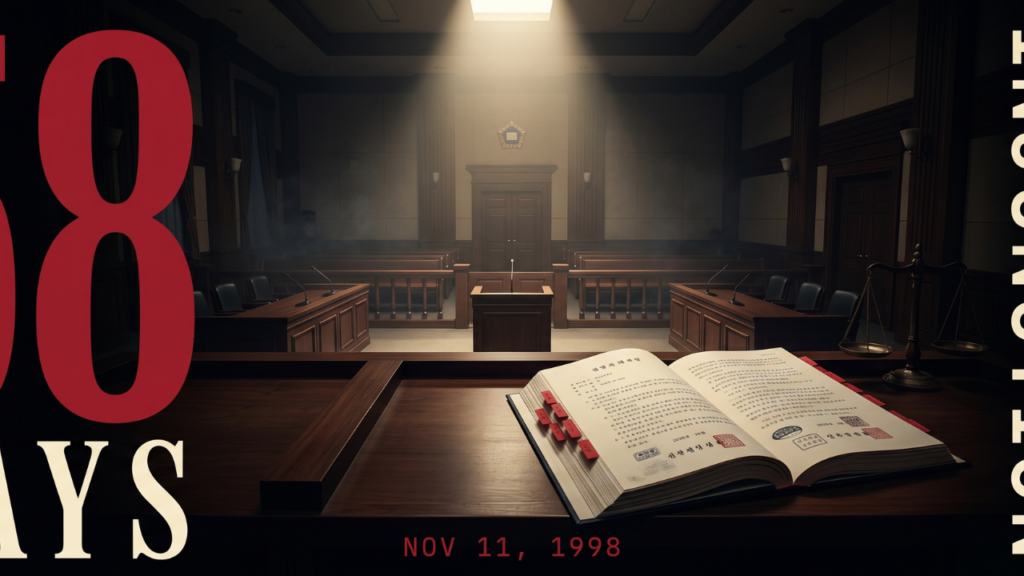
Then the legal machinery activates. On November 11, 1998, the Seoul District Court’s 51st civil division — with Judge Shin Young-cheol presiding — orders publication, sale, and distribution of the November issue halted. Three days later, the injunction is executed against Chosun Ilbo, the country’s largest newspaper, which had reprinted portions of the material. This is not normal democratic practice. This is a system with an immune response.
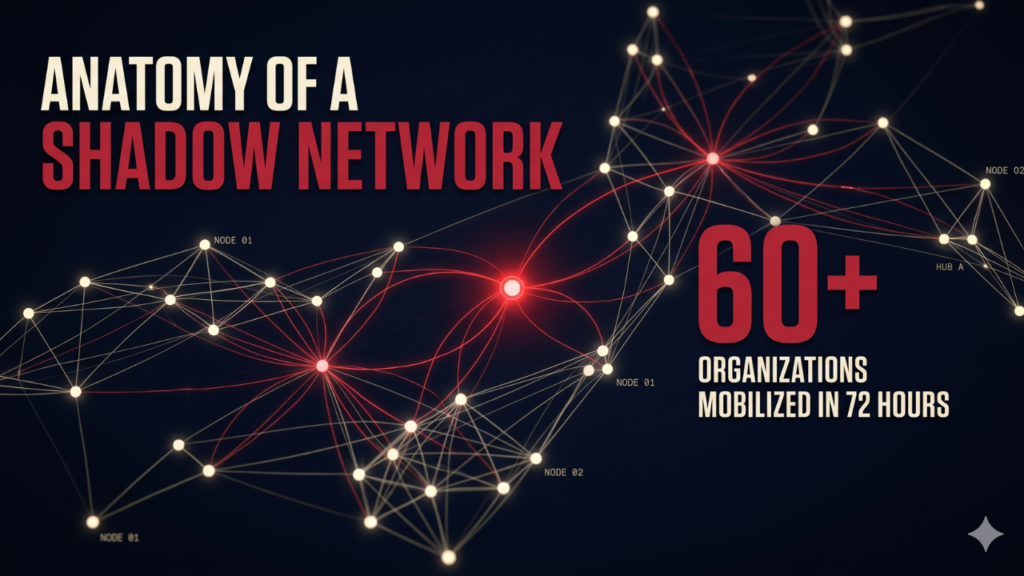
And this is where the electoral implications begin. A system that can mobilize sixty organizations inside 72 hours can also mobilize them on election day. A system that can obtain a court injunction against the country’s largest news magazine can also obtain injunctions against electoral challenges. A system that can receive a statement of support from Pyongyang within 25 days of its opening salvo is a system whose ideological terrain extends beyond the 38th parallel. Every one of these capabilities translates directly into what political scientists politely call “pre-electoral conditioning.” In the Korean context, it is the terraforming of the electorate.
The Kim Young-hwan Reversal
The most dangerous thing that can happen to a Hidden State is a defection from within. This is exactly what happened in June 1999. Kim Young-hwan — codename Gangcheol (“Steel”), the intellectual father of South Korea’s Jusapa movement, the man who had personally traveled to Pyongyang and met Kim Il-sung in a submarine rendezvous — published a public declaration repudiating the Kim Jong-il regime.
The author of Hidden Republic was the reporter who covered that story. His account of the immediate aftermath is one of the most disturbing passages in the modern Korean political canon. After the article ran, he writes, he lifted the telephone to call the editorial board of the ideological journal he had just helped investigate. No one picked up. “The entire staff had walked out of the office,” he recalls. “Had they all abandoned their desks? The article was titled ‘A Turning Point in Korean Intellectual History: Gangcheol Kim Young-hwan’s Declaration to Overthrow the Kim Jong-il Regime.'” The Hidden State’s reaction to the defection of its most important theorist was not to argue. It was to vanish.
IV. Global Implications: Why the World Must Care
South Korea is not a peripheral democracy. It is the world’s tenth-largest economy, a treaty ally of the United States, the host of 28,500 American troops, and the northeastern anchor of the Indo-Pacific strategic posture. A structural weakness in South Korean electoral integrity is, functionally, a structural weakness in the Western alliance system. This is not an abstraction. It is the geopolitical terrain on which the next decade of Sino-American competition will be fought.
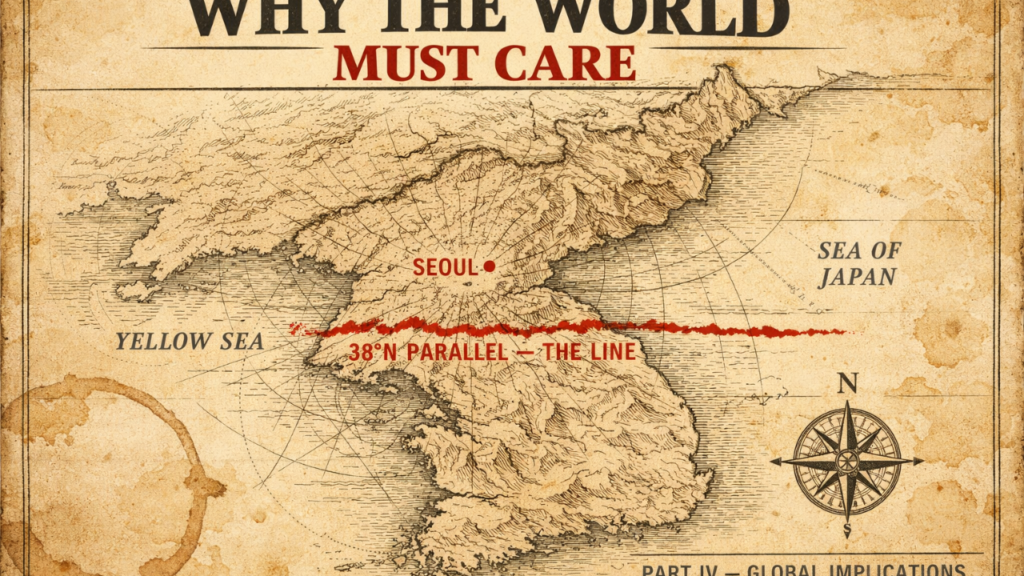
The Hidden State South Korea problem matters globally for three converging reasons:
First, it is a template. The 1998 playbook — synchronized statements, legal harassment of critical media, the weaponization of academic credentialism, the cross-border alignment with a hostile regime’s propaganda line — has since been observed in Eastern Europe, in Latin America, and in democracies experiencing ideological polarization. South Korea is not an outlier. It is an early warning.
Second, it is a test of institutional resilience. The Korean judiciary, in 1998, granted the injunction. It did not refuse. A Western democracy whose courts are willing to pre-emptively suppress political journalism — for any reason, in any direction — has crossed a line that cannot be uncrossed by subsequent rulings. Every citizen in every allied democracy should be studying what Korean civil society did, and failed to do, in the aftermath.
Third, it is a live operation. The networks exposed in 1998 did not disband. They aged into the mainstream. Former student radicals became National Assembly members, cabinet ministers, municipal mayors, television commentators, and university presidents. The institutional capture that the author of Hidden Republic describes as the defining fact of post-1998 Korean political life is ongoing, and it is the direct inheritance of the architecture revealed in that autumn.
V. A Fearless Conclusion
The standard account of Korean politics treats the Monthly Chosun-Choi Jang-jip controversy as a closed chapter — a nasty episode in the ideological wars of the late 1990s, resolved by a court injunction and absorbed into the historical record. This account is wrong. The controversy was not resolved. It was metabolized. The machinery revealed in those 58 days went on to shape the presidential administrations that followed, the curriculum decisions of the Ministry of Education, the editorial policies of the state broadcasters, the reporting priorities of the National Intelligence Service, and — most critically — the terms under which electoral disputes can even be raised.
Every election in South Korea since 1998 has been conducted on ground that was pre-loaded in 1998. This is the meaning of the Secret Power Structure. It is not a cabal. It is a substrate. The ballots are real. The vote counts are real. What is not real is the pretense that the terrain on which those votes are cast is neutral.
The author of Hidden Republic, standing at the beginning of his investigation in 1999, sensed what was coming. “At that time,” he writes, “I already had the premonition that this reporting might bring a storm into my life.” A quarter-century later, the storm has not passed. It has merely become the weather. The task of the next generation of Korean journalism — and of the citizens who support it — is to begin, at last, to name the climate.
The Hidden State survives on the assumption that no one will do so. The one piece of luck democracy has left is that assumption, and it has a shelf life.
Frequently Asked Questions
Q1: Is the “Hidden State” a conspiracy theory, or is there documentary evidence it actually exists?
The evidence is documentary, contemporaneous, and preserved in the court record. On November 11, 1998, Seoul District Court’s 51st Civil Division ordered the suppression of a published magazine issue — a court act that is, by itself, part of the public record. More than sixty organizations issued named statements over 58 days, all archived in JoongAng Ilbo‘s November 19 chronology. On November 13, the Central Committee of the North Korean Journalists Union issued a supporting statement. The question is not whether the coordination existed. The question is what to call it.
Q2: If the machinery is so powerful, why did it fail to stop the Kim Young-hwan defection in 1999?
It did not fail to stop it. It failed to contain it. Kim Young-hwan — codename Gangcheol — was the intellectual founder of the Jusapa faction, the South Korean political movement that had accepted Pyongyang’s ideological leadership since the 1980s. His June 1999 public declaration repudiating the Kim Jong-il regime was “a turning point in Korean intellectual history.” The apparatus’s response was not to argue with him. It was to evacuate. When the reporter telephoned the editorial board of the affiliated ideological journal immediately after publication, he was told that the entire staff had abandoned the office. That is the behavior of a network, not a debating society.
Q3: How does the 1998 ideological controversy actually connect to modern-day Electoral Corruption in South Korea?
The connection is infrastructural, not anecdotal. Electoral Corruption in the Korean context cannot be measured by counting irregular ballots alone. The deeper corruption is upstream: it lies in the manufacture of the permissible. A political system in which sixty organizations can be mobilized within 72 hours to discredit a single magazine article is a system in which the same capacity exists to mobilize sixty organizations against a single election result, a single recount petition, or a single investigative journalist.
Q4: Why did the Seoul District Court grant the injunction? Isn’t pre-publication suppression of a magazine unconstitutional?
Judge Shin Young-cheol granted the injunction on defamation grounds, accepting Choi’s argument that the magazine’s characterization of his Korean War scholarship constituted reputational damage. The Monthly Chosun legal team argued that the court’s reading was so broad that it effectively prohibited future scholarly debate on the disputed questions. That argument was not accepted. The precedent remains on the books. A Korean civil court retains the authority to pre-emptively suppress a political magazine issue for defamation against a sitting government official.
Q5: What should international observers — American allies, Japanese counterparts, European journalists — be doing now?
Three things. First, stop treating South Korean domestic politics as opaque. The 1998 episode is richly documented in Korean-language primary sources. Translation is a solvable problem. Second, recognize that the Hidden State apparatus crosses borders. The November 13, 1998, Pyongyang statement is not incidental. Third, defend the Korean investigative press now, not retrospectively. International solidarity is not a luxury here. It is a structural requirement for the continued viability of Korean democracy.
Watch the Full Investigation on YouTube
The story doesn’t end here. It begins here. Our full video investigation traces every organization, every statement, and every court filing of the 58 days that exposed South Korea’s Hidden State — with archival footage, expert interviews, and exclusive English translations of the primary documents. Subscribe to The Truth Hunter YouTube channel for the complete series.
🌿 Weekly wellness, health & beauty insights — straight to your inbox
Free subscription · Cancel anytime