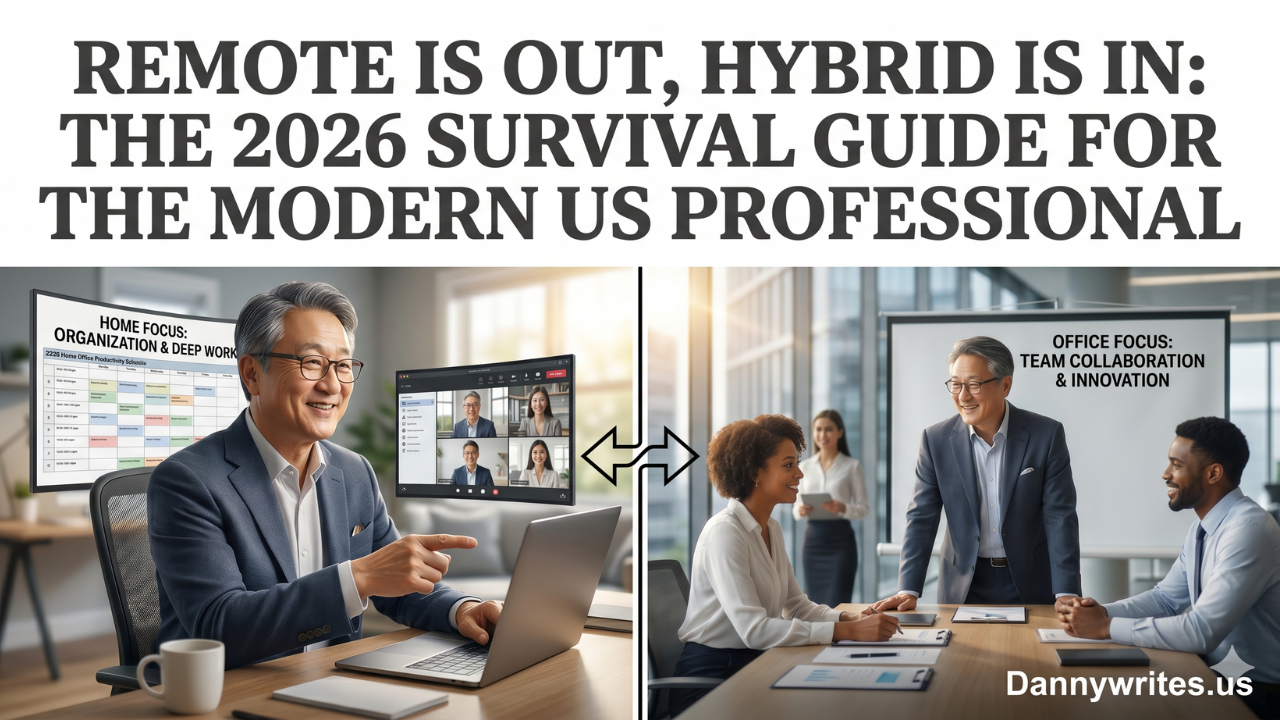
Published on Dannywrites.us | Category: Career & Workplace Trends
⚠️ Disclosure: This post contains affiliate links. If you purchase through these links, I may earn a small commission at no extra cost to you. This helps support Dannywrites.us — thank you!
Living in California, I’ve watched the workforce transform in real time — startups pivoting overnight, tech giants reversing their own remote-first policies, and talented professionals wrestling with a question that would have seemed absurd in 2020: Is working from home actually becoming a liability?
The short answer is complicated. And if you’re a modern US professional navigating 2026, the way you handle this shift could define your career trajectory for the next decade.
The era of pure remote work as the dominant professional ideal is fading — fast. What’s rising in its place is something more nuanced, more politically charged, and far more consequential: hybrid work. And if you don’t have a plan, you’re already behind.

The Numbers Don’t Lie: Where We Actually Stand in 2026
Before we dive into strategy, let’s get oriented in the data.
According to Robert Half’s Q1 2026 analysis of US job postings, 77% of new listings are fully on-site, while 19% are hybrid and a mere 4% are fully remote. That’s a seismic reversal from the peak of pandemic-era flexibility.
Yet here’s the paradox: 52% of remote-capable US employees currently follow a hybrid schedule, per Gallup’s ongoing workforce surveys. And a SurveyMonkey study conducted in February 2026 found that 55% of job seekers rank hybrid as their top preference — with workers nearly evenly split between those wanting 1–2 vs. 3–4 days in the office.
Translation? Employees want hybrid. Employers are increasingly demanding on-site. And the tension between those two realities is the defining workplace drama of 2026.
The Great RTO Rollout: Who’s Pulling Workers Back
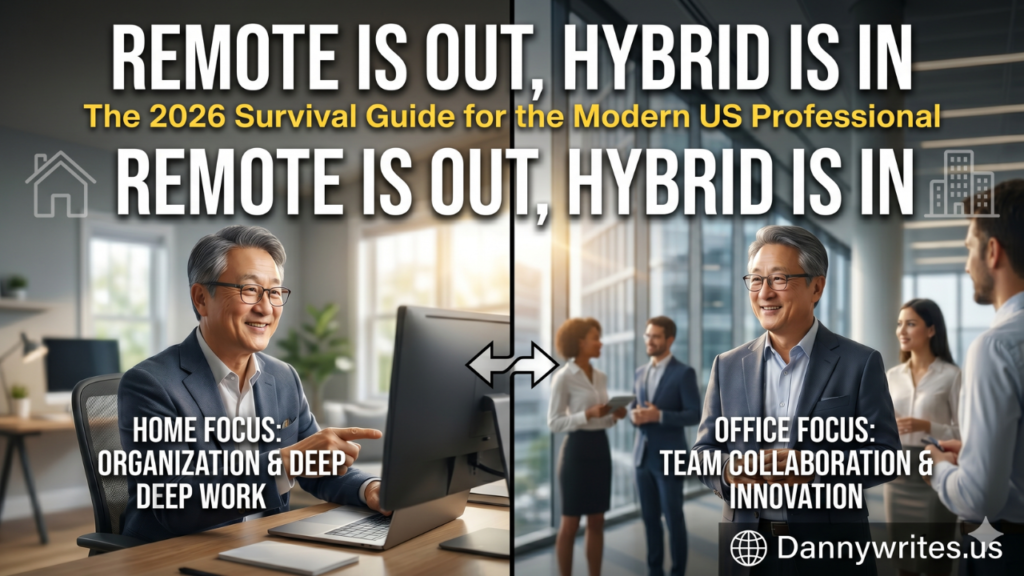
The return-to-office (RTO) wave didn’t arrive quietly. It came with press releases, executive memos, and in some cases, government executive orders.
Here’s a partial roll call of major organizations that have mandated significant in-person time:
- US Federal Government – In January 2025, President Trump ordered all federal employees back to the office full-time. Badge data showed hybrid rates among federal workers dropped from 61% to 28% almost immediately.
- Amazon – Called 350,000 employees back to full-time office attendance in January 2025.
- JP Morgan Chase – Ended remote work in April 2025.
- AT&T – Required 5-day-per-week office attendance starting January 2025.
- Microsoft – As of February 2026, hybrid workers must be on-site 3+ days per week.
- Instagram – Mandated 5 days per week in-office effective February 2026.
- TikTok – Required full on-site work for all employees in 2026.
- NBC Universal – Employees must report 4 days per week starting January 2026.
- Truist – As of January 2026, all employees are required in-office 5 days a week.
Meanwhile, companies like Google, Apple, Meta, Netflix, Wells Fargo, and Charles Schwab have all increased required in-office days — typically landing at 3–4 per week.
The message from the C-suite is clear: the fully remote experiment, for large enterprises, is effectively over.
Why Companies Are Doing This (And Why Employees Push Back Hard)
The Case For Hybrid/RTO
Executives cite a range of justifications for pulling workers back:
Collaboration and culture. There’s a widely held belief in leadership circles that serendipitous hallway conversations, in-person brainstorming, and shared physical space drive innovation in ways that Slack channels and Zoom calls simply can’t replicate.
Management visibility. A 2025 Cisco study found that 86% of CEOs plan to reward employees who come into the office with favorable assignments, raises, or promotions. That’s a brutal incentive structure — but it’s real.
Office lease obligations. Remote workers have pointed this out, and surveys back them up: 46% of remote workers believe RTO mandates are at least partly about companies wanting to maximize their office leases. These are not empty accusations — commercial real estate exposure for major firms runs into the billions.
Perception of productivity. Despite mixed evidence, 83% of CEOs anticipated a full return to office by 2027, per a KPMG survey. Executive instinct — however data-resistant — has significant institutional weight.
The Case Against Forced Returns
The employee response has been both vocal and data-rich.
Workers value flexibility at a dollar amount. Stanford economist Nick Bloom’s research found the average employee values hybrid work at roughly 8% of their annual salary. That’s not a preference — that’s compensation.
Retention is at stake. A 2025 Owl Labs survey found that if hybrid or remote options were eliminated entirely, 40% of workers would start job hunting, 22% would demand a raise, and 5% would quit immediately. Gallup’s data confirms six in ten fully remote-capable employees say they are extremely likely to search for new work if that flexibility disappears.
The productivity argument is largely unfounded. BLS research shows every 1-point rise in an industry’s remote-work share correlates with a 0.09-point lift in labor productivity growth. More damning for RTO advocates: 66% of executives said their in-office policies did not improve team productivity, per Atlassian’s 2025 survey.
Mental health and wellbeing are measurably better with flexibility. In 2025, 79% of remote professionals report lower stress levels, and 82% say their mental health is better with flexible work arrangements.
The Hybrid Sweet Spot: What the Data Actually Recommends
Not all hybrid structures are created equal. And the data points to a genuinely interesting insight: the amount of flexibility matters more than the specific model.
Cisco’s 2025 study found that 69% of employers reported improved employee retention after introducing hybrid arrangements. The biggest retention boost — a 41% improvement on average — came from companies requiring only one in-office day per week.
That said, most hybrid arrangements settling in corporate America look more like 2–3 days in office, 2–3 days remote. This “3-2” or “2-3” model has emerged as the informal standard across industries, balancing employer control with enough flexibility to keep top talent from walking.
Industry-by-Industry Breakdown: Who Gets What
Not all professionals face the same landscape. Here’s how hybrid availability breaks down by sector, based on Robert Half’s Q1 2026 job posting analysis:
| Industry | Fully On-Site | Hybrid | Fully Remote |
|---|---|---|---|
| Marketing & Creative | 70% | 21% | 9% |
| Legal | 72% | 23% | 5% |
| Technology | 74% | 18% | 8% |
| Finance & Accounting | 76% | 19% | 5% |
| Human Resources | 76% | 21% | 3% |
| Healthcare | 85% | 6% | 9% |
| Admin & Customer Support | 87% | 8% | 5% |
Tech workers who assumed their field would remain a remote-friendly haven may be surprised. At 74% on-site, even technology roles have largely bowed to the RTO wave. Marketing and legal roles offer slightly better odds for flexibility seekers.
Experience level also plays a major role. Senior-level roles are significantly more likely to include hybrid or remote options. Entry-level workers (0–2 years experience) see the least flexibility, with only 13% of postings offering hybrid arrangements.
The Gender Dimension Nobody’s Talking About
Remote work has not been equally distributed — and the shift toward hybrid has disproportionate implications depending on who’s doing the work.
As of March 2026, BLS data shows 24.9% of women in the US workforce worked remotely at least partially, compared to 20.5% of men. Women are also significantly more likely to cite hybrid arrangements as a reason for staying in their current role.
This matters because forced RTO mandates that strip flexible arrangements disproportionately affect working mothers, women in dual-income households managing childcare logistics, and professionals who relocated during the pandemic on the assumption that remote work was permanent. The economic and career consequences of rigid return policies are not gender-neutral.
The Gen Z Factor: Why This Matters for the Next Decade
The tension over work location isn’t just a current-events debate. It’s a generational negotiation with long-term consequences for how companies attract and retain the future workforce.
A 2025 Deloitte survey revealed that 65% of Gen Z and Millennials would leave their jobs if forced back to the office full-time. This isn’t posturing — it reflects a cohort whose foundational career assumptions were shaped entirely in the remote-first era.
At the same time, some research suggests younger workers actually benefit from in-person mentorship, networking, and visibility in ways that full-time remote arrangements can undermine. The nuance here is important: what Gen Z says they want and what might actually accelerate their careers aren’t always perfectly aligned.
The Salary-Flexibility Trade-off: A New Compensation Equation
Here’s a development that’s reshaping how total compensation is calculated: 20% of fully in-office companies have announced they will pay hybrid employees less than their in-office counterparts.
Meanwhile, a separate Vena survey found that 66% of professionals say they would work on-site full-time for a higher salary. Remote work, it turns out, saves employees around $7,000 per year in commuting, lunches, and work-related costs — a figure that’s now entering salary negotiation conversations directly.
This creates a new kind of compensation math. When evaluating a job offer in 2026, smart professionals are calculating:
- Base salary
- Flexibility premium (how much is 2–3 remote days worth to you personally?)
- Commute cost savings or losses
- Promotion visibility risk (are in-office employees actually getting better assignments?)
If your employer is rewarding in-person presence with career advancement — and 86% of CEOs say they intend to — then the true cost of remote or hybrid work may be hiding in your long-term compensation trajectory, not your paycheck today.
Your 2026 Hybrid Survival Strategy: Practical Steps

Given everything above, here’s a concrete action plan for modern US professionals navigating this landscape:
1. Audit Your Current Position’s Vulnerability
Ask yourself: Is your role on the list of high-flexibility sectors, or are you in administrative/healthcare/customer support? Are you senior enough to negotiate? Understanding your real leverage is step one.
2. Make Yourself Visible When You’re In
If you’re working hybrid, treat in-office days as high-ROI performance time. Be the person who shows up for the brainstorm, catches the manager in the hallway, and participates visibly in collaborative work. Reserve your remote days for deep focus.
🎧 The Hybrid Worker’s Essential Tech Stack
When you’re on camera, your audio and video quality IS your professional brand.
- Sony WH-1000XM5 — Best-in-class noise canceling for home focus & commutes
- Logitech C920x HD Webcam — Crystal-clear video calls, plug and play
- BenQ ScreenBar Halo — Professional lighting = professional image
3. Negotiate Before You Accept
Hybrid arrangements are significantly easier to negotiate before you join an organization than after. In 2026, it’s not inappropriate to ask directly: “What does the hybrid schedule look like for this role, and is there flexibility on which days are in-office?”
4. Build a “Hybrid Brand”
In distributed environments, your reputation is increasingly shaped by async work: your Slack responses, your document quality, your ability to communicate clearly in writing. Invest in these skills regardless of how many days you’re in the office.
💼 Stay Productive Anywhere
Travel light, work at full power — wherever you land.
- Roost Laptop Stand — Ultralight, foldable, fits in any bag
- Anker 655 USB-C Hub (8-in-1) — One hub connects everything at home AND office
5. Track the Policy Signals at Your Company
Is your employer extending badge swipe tracking? Introducing productivity monitoring software? Announcing new office renovation projects? These are leading indicators of incoming RTO policy changes. Staying ahead of the curve gives you time to adapt — or make a calculated exit.
6. Know Your Non-Negotiables
Research from Owl Labs shows workers would give up around 10% of their salary to keep remote work. What’s your number? Knowing it clearly — before you’re in a negotiation or facing a mandate — helps you make rational, values-aligned decisions rather than reactive ones.
The Bigger Picture: Is Hybrid Actually the Future, or Just the Present?
Here’s an honest take most workplace trend pieces won’t give you: hybrid is a negotiated compromise, not an ideal solution.
Fully remote workers report higher autonomy, lower stress, and better mental health. Fully in-office workers show higher visibility and — in companies with RTO-rewarding cultures — faster promotion timelines. Hybrid workers get some of both, and sacrifice some of both.
The permanence of hybrid as the dominant model seems structurally solid. Only 6% of businesses are fully remote as of late 2025, and only 30% of companies plan to completely eliminate remote work by 2026. The data strongly suggests hybrid is here to stay — even as the form of hybrid continues to evolve.
What’s less certain is whether the balance of power between employer mandates and employee preference will shift. In tight labor markets, employees win flexibility. In loose ones, employers tighten the screws. Watch unemployment figures and hiring conditions in your sector carefully — they’re the canary in the coal mine for your own work-location autonomy.
Final Word: The Modern Professional’s Mindset Shift
The professionals who will thrive in 2026 and beyond won’t be those who “won” the remote work debate. They’ll be those who mastered the art of being strategically present — wherever that is.
The modern US professional needs to be fluent in both modes: capable of deep async remote productivity and high-impact in-person collaboration. The ones who treat these as either/or are already losing.
Hybrid isn’t the end of remote work. It’s the beginning of something more sophisticated: a workforce learning, finally, how to be intentional about where, when, and how work actually gets done.
Your survival guide starts with knowing which side of that equation you’re on — and why.
💡 Frequently Asked Questions (FAQ)
Q1: Is fully remote work actually disappearing in the US?
Not disappearing — but clearly declining as the default. As of Q1 2026, only 4% of new US job postings are fully remote, down from a pandemic-era peak, and major corporations from Amazon to Instagram have mandated full or near-full office returns. However, approximately 22.6% of US employees still work remotely at least part-time, and hybrid remains the dominant flexible model. Fully remote work still exists — it’s just become a premium option concentrated in senior roles and specific tech sectors rather than a broad expectation.
Q2: Will companies actually punish employees who prefer remote work over in-office?
Increasingly, yes — in subtle and explicit ways. Cisco research shows 86% of CEOs plan to reward in-office employees with better assignments, raises, and promotions. Additionally, 20% of fully in-office companies have announced they’ll pay hybrid employees less. This creates what analysts call “proximity bias at scale” — where career advancement becomes structurally tied to physical presence. Professionals who remain fully remote may not be fired, but they may find themselves sidelined in performance reviews and advancement cycles over time.
Q3: How should a professional negotiate hybrid terms in 2026 without jeopardizing their job offer?
The most effective approach is to treat hybrid as a factual, operational question rather than a demand. During the offer stage, frame it as: “I want to make sure I understand the working arrangement — what does the hybrid schedule look like for this team?” This surfaces the policy without positioning it as a dealbreaker. If flexibility matters to you, research the company’s public policy before applying, target firms with explicit hybrid commitments, and avoid waiting until after you’ve accepted to raise the issue. Stanford economist Nick Bloom’s data shows workers value hybrid at roughly 8% of salary — meaning if a role’s location structure doesn’t work for you, the true cost can be quantified and compared against competing offers.
🌿 Weekly wellness, health & beauty insights — straight to your inbox
Free subscription · Cancel anytime