The True Left Must Lead the Charge Against Kim Jong-il’s Regime —
The Hidden Nation Confession
BY DANNY · DANNYWRITES.US · MAY 10, 2026
📌 3 Key Takeaways
- Juche ideology and the North Korean regime must be understood separately — yet South Korean society has long conflated the two, creating dangerous blind spots.
- A genuine leftist must most strongly oppose the Kim Jong-il regime — because Juche’s own humanist principles fundamentally negate that regime’s existence.
- The spread of pro-North sentiment in the 1990s caused lasting damage to South Korean democracy — its shadow stretched over law, media, and academia for more than a decade.
🔍 The Other War Inside South Korea
Democracy is fragile. Not always because of foreign enemies, tanks, or missiles — but because of the quiet battles fought within a society’s own ideological foundations. South Korea presents one of the most striking examples of this fragility in the modern world.
Hidden Nation (숨은민국) is not a political thriller. It is a meticulous dissection of the ideological fault lines buried deep inside South Korean society. As a U.S. citizen reporting from the outside, I — Danny — am drawn to this book for one reason: from an external vantage point, South Korea appears to harbor a second, invisible “nation” within itself.
One of the book’s central figures is Gang Cheol (a pen name), a Juche ideology researcher whose 1999 interview in the monthly magazine Chosun dropped a rhetorical bomb on the Korean political establishment: “The true left must be the first to lead the charge against Kim Jong-il’s regime.” That single sentence sent shockwaves through both the left and right wings of South Korean politics. Today, we examine why those words remain as explosive as ever — and why South Korea has continued to look away from this truth.
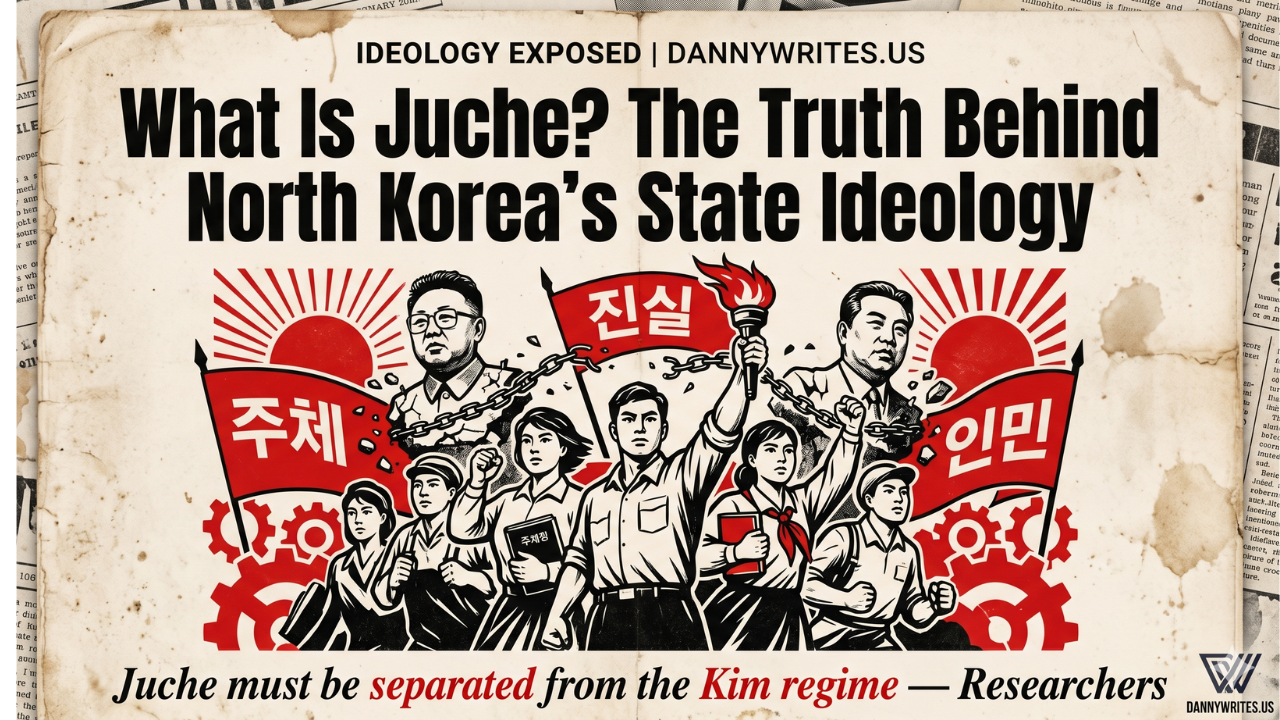
▲ Researchers argue that Juche as a philosophy must be separated from the Kim regime’s weaponization of it.
1. What Is Juche — And What It Is Not
Most South Koreans understand Juche as the ruling ideology of North Korea — a tool used to justify the Kim dynasty’s totalitarian grip on power. But Gang Cheol and a small circle of researchers argue this is a fundamental misreading.
At its philosophical core, Juche is centered on human-centered thought — a form of humanism asserting that people are the masters of all things, and that autonomy, creativity, and consciousness are the essential properties of human beings. On its face, this language closely resembles that of universal progressive thought. The problem, as researchers like Gang Cheol point out, is that the North Korean regime borrowed this language to produce the exact opposite outcome: a system that comprehensively crushes the very autonomy it claims to celebrate.
▶ The Hwang Jang-yop Defection: An Ideological Turning Point
In 1997, Hwang Jang-yop — the chief architect of Juche ideology and one of the most senior officials ever to defect from North Korea — crossed into South Korea. His defection was not merely a political event. It was an ideological earthquake.
For the first time, the possibility that Juche as a philosophy could be separated from the Kim regime’s practice became a real, debated proposition. Gang Cheol described Hwang’s defection as the moment “Juche ideology was liberated from the North Korean state.” The speed of the response was remarkable: almost immediately after Hwang’s arrival, pro-North student activist groups at Jeonbuk National University and Jeonnam National University began issuing North Korean human rights declarations — a shift that would have been unthinkable just months before.
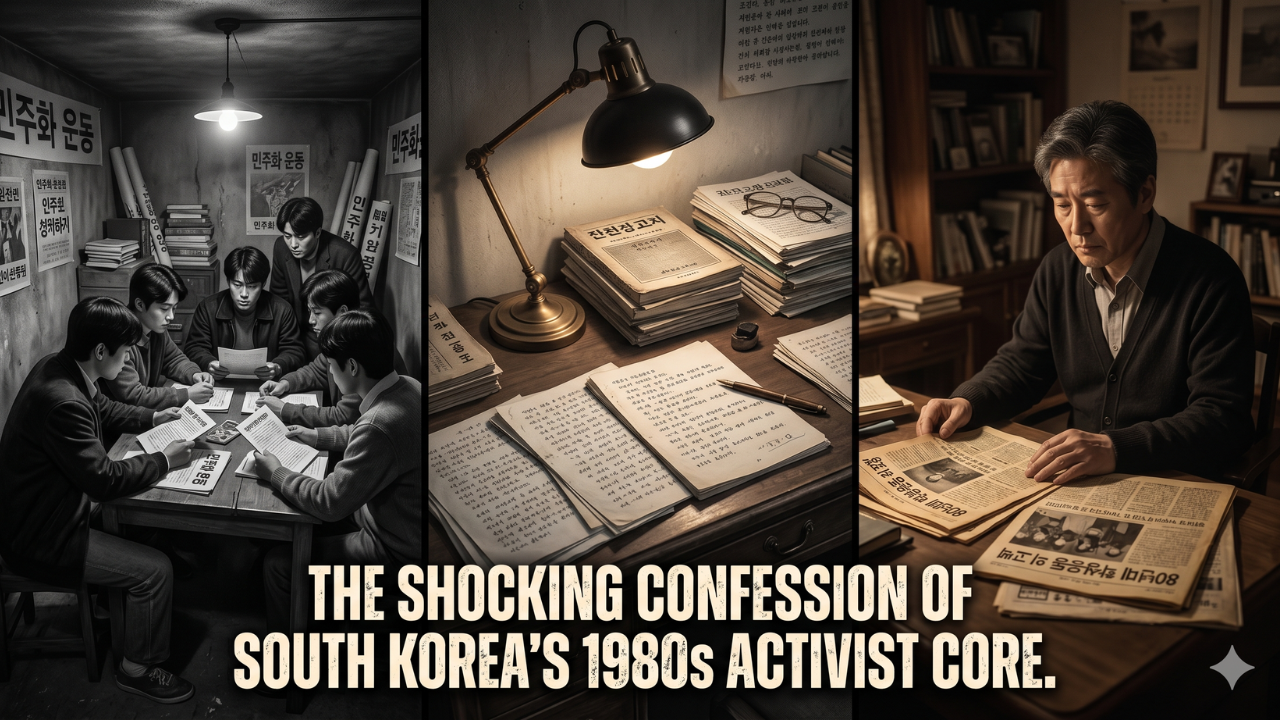
▲ Gang Cheol’s 1999 declaration shocked South Korea’s left and right simultaneously — and its logic remains unrefuted.
2. 47 Days of Torture — The Man Who Never Broke
Hidden Nation is not a dry ideological treatise. It is a record of human suffering. Gang Cheol was detained by the KCIA (Korea Central Intelligence Agency, now the NIS) in 1986 and held for 47 days. The first 20 days involved daily, around-the-clock interrogation and torture.
“Even one or two days of torture inflicts unimaginable suffering beyond comprehension — but I endured this for 20, even 27 consecutive days. Even now, looking back, it was truly horrifying.”
— GANG CHEOL, INTERVIEW IN HIDDEN NATION
The KCIA’s primary lines of questioning focused on alleged connections to North Korea, the structure of underground organizations, and his relationship with an aide to then-opposition leader Kim Dae-jung. To the intelligence services, Gang Cheol was reportedly a core member of a spy network linked to Pyongyang. His actual motivation, he insists, was singular: to study and disseminate Juche ideology as an academic and philosophical system.
This fact carries enormous weight. For decades, South Korea treated the act of researching certain ideas as a criminal offense. The National Security Act erected a legal wall around specific bodies of thought — and the result, as Gang Cheol argues, was a society left with only two extremes: blind fear of Juche, or blind devotion to it. The middle ground of rigorous, honest scholarship was systematically eliminated.
▲ Detained by the KCIA in 1986 — 47 days of interrogation and torture could not break Gang Cheol’s intellectual convictions.
3. Why Genuine Progressives Must Oppose the Kim Regime
Gang Cheol’s logic is paradoxical on the surface but internally airtight. If the philosophical core of Juche is human autonomy — the right of people to be the true masters of their own destiny — then a regime like North Korea’s, which more thoroughly suppresses human autonomy than perhaps any state in the modern world, is not the product of Juche. It is Juche’s most hostile and fundamental opponent.
Therefore, anyone who genuinely believes in Juche’s principles — or in progressive values more broadly — is logically obligated to oppose the Kim Jong-il regime most forcefully of all. This is not a right-wing anti-communist slogan. It is a conclusion derived from the internal logic of the ideology itself.
▶ The Fatal Error of the 1990s Progressive Movement
As testimonies from North Korean defectors began flooding South Korea in the early 1990s, revealing the true horror of life under the Kim regime, Gang Cheol makes a devastating confession: he played a decisive role in spreading pro-North sentiment throughout South Korea’s activist movement. He acknowledges that, as someone who had been deeply moved by Juche as a philosophy, he found it genuinely difficult in practice to separate Juche from North Korea itself.
But he does not offer himself absolution. He states plainly that this serious error cannot be forgiven, even in retrospect. While North Korean citizens were starving and suffering in political prison camps, turning one’s eyes away from those facts — for any reason, under any ideological framework — constitutes a moral failure that admits no justification.
This confession, he argues, is not merely personal. It was a shared error across much of South Korea’s progressive movement in the 1990s — and its consequences rippled through the country’s approach to North Korea, its press, its judiciary, and its academic establishment for more than a decade.

▲ Hidden Nation maps the invisible ideological fault lines running through South Korean society — lines that mainstream media refuses to trace.
4. The Kim Dae-jung Era and the Rise of the Hidden State
Hidden Nation tracks a critical political shift: the transformation of South Korea’s ideological landscape during and after the Kim Dae-jung presidency. Under the banner of “democratization,” the book argues, a dangerous question was never asked: what exactly did Marxism-Leninism or Juche ideology have to do with democracy?
This was the period when the allegedly hidden nation began surfacing from underground. As the boundaries of permissible discourse expanded, a parallel expansion allegedly occurred: the normalization of ideological positions fundamentally incompatible with liberal democracy. The book contends that South Korea’s founding liberal democratic order — established in 1948 — came under sustained, coordinated attack, and that the institutions of democracy became desensitized to that threat.
Gang Cheol and Kim Young-hwan’s group announced their break with the past — declaring their opposition to the Kim Jong-il regime — and were reportedly greeted with astonishment by conservative circles. But Gang Cheol issues a warning that went largely unheeded at the time: their ideological transformation was not, and had never claimed to be, total or complete.
5. Global Implications — Why the World Must Care
As someone who immigrated to the United States and observes South Korean politics from abroad, I view this ideological conflict through a fundamentally different lens. In the American political tradition, “the left” means, at its core: protecting the rights of the marginalized, defending freedom of expression, and holding power accountable. By that standard, any faction within South Korean progressivism that tolerates or tacitly supports North Korean totalitarianism has forfeited its claim to the progressive label.
But this is not merely a domestic South Korean concern. South Korea sits at one of the world’s most consequential geopolitical fault lines. Its internal ideological battles directly shape U.S. military posture in East Asia, the trajectory of North Korea’s nuclear weapons program, and the broader regional order involving China and Japan. When a democracy cannot clearly define its own ideological identity, the consequences do not stop at its borders.
The strength of Gang Cheol’s argument lies precisely here. He does not deploy Cold War anti-communist rhetoric. He traces the internal logic of an ideology to its necessary conclusion — and finds that the Kim Jong-il regime is that ideology’s greatest enemy. This is the kind of rigorous, honest reckoning that South Korean society has allegedly been avoiding for thirty years.
✅ 3-Step Action Guide
Separate Juche from the North Korean state. Before forming any opinion, distinguish between Juche as a philosophical system and the Kim regime’s political exploitation of it.
Cross-reference 1990s defector testimonies with Gang Cheol’s interviews. The June and August 1999 issues of monthly Chosun remain essential primary sources for this era.
Examine your own ideological coordinates. If you identify as progressive, ask yourself honestly: where do you stand on the human rights of North Korea’s 26 million people?
Conclusion: South Korea Must Confront Its Hidden Nation
Dannywrites.us returns to this subject repeatedly for one reason: for South Korea to possess a genuinely reliable ideological compass, it must first acknowledge the existence of the “other nation” hidden within itself. Hidden Nation is the first map of that territory.
Gang Cheol’s confession is not comfortable. His logic is not convenient for anyone on either side of the political spectrum. But it is consistent. And it is honest. In a media landscape dominated by legacy outlets that reportedly prioritize ideological allegiance over factual reporting, that kind of honesty is rare — and dangerous to power.
South Korea’s democracy will remain fragile as long as the hidden nation remains hidden. The first step toward genuine democratic health is the courage to look directly at what has been deliberately kept in the dark.
❓ Frequently Asked Questions
What is the “Hidden Nation” inside South Korea?
+
“Hidden Nation” refers to the parallel ideological structure allegedly operating beneath South Korea’s democratic surface — a network of individuals and institutions whose beliefs and agendas reportedly contradict the liberal democratic order established in 1948. Gang Cheol argues this hidden layer has been shaping South Korean politics, media, and academia for decades.
Is studying Juche ideology legal in South Korea?
+
Under South Korea’s National Security Act, praising or promoting Juche can potentially be a criminal offense. Academic analysis may be treated differently, but the boundary is extremely vague. Gang Cheol has argued that this legal ambiguity has itself functioned as a tool to suppress legitimate scholarly research.
Who is Gang Cheol and why does his 1999 statement still matter?
+
Gang Cheol is a pen name for an underground Juche researcher who survived 47 days of KCIA detention and torture in 1986. His 1999 statement — that genuine leftists must be the first to demand Kim Jong-il’s overthrow — stunned South Korea’s entire political spectrum. It matters today because it remains a logically unrefuted challenge to any progressive movement that tolerates North Korea’s totalitarianism.
How did Hwang Jang-yop’s 1997 defection change the ideological landscape?
+
Hwang Jang-yop, the chief architect of Juche, defected to South Korea in 1997 — the most significant political defection since Korea’s division. His arrival made it possible, for the first time, to credibly argue that Juche as a philosophy could be separated from the Kim regime’s exploitation of it. Almost immediately, pro-North student groups began issuing North Korean human rights declarations — a historically rapid ideological shift.
Why should international audiences care about South Korea’s ideological war?
+
South Korea sits at one of the world’s most critical geopolitical fault lines. Its internal ideological battles directly affect U.S. military strategy in East Asia, North Korea’s nuclear trajectory, and the regional balance involving China and Japan. When a democracy struggles to define its own ideological identity, the consequences extend far beyond its borders.
▶ Watch the Full Investigation
The Hidden Nation — Gang Cheol’s Confession,
47 Days of Torture, and South Korea’s Secret Ideological War
This article only scratches the surface. The full investigative deep-dive — including Gang Cheol’s firsthand testimony, the inside story of Hwang Jang-yop’s defection, and the ideological fault lines still running through South Korea today — is available in full on our YouTube channel.
▶ WATCH ON YOUTUBE — DANNYWRITES
SUBSCRIBE · SHARE · TELL THE TRUTH · DANNYWRITES.US
🌿 Weekly wellness, health & beauty insights — straight to your inbox
Free subscription · Cancel anytime