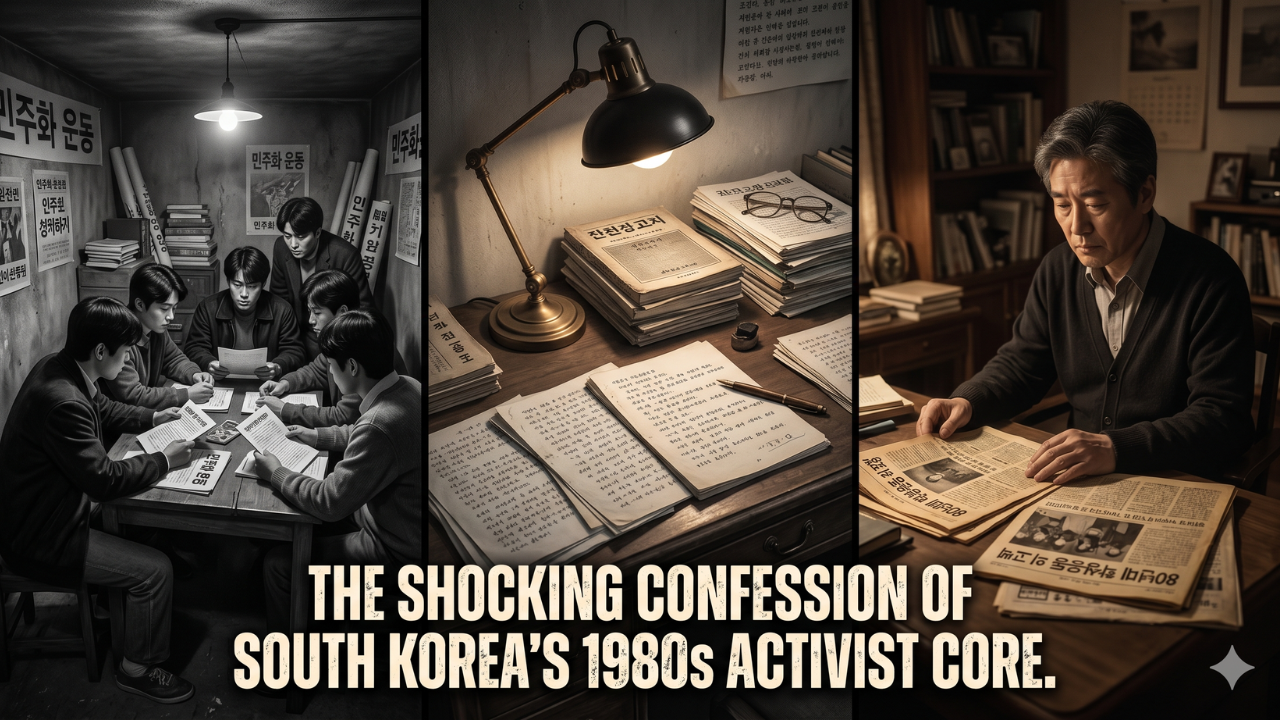
“We Were Wrong” — The Shocking Confession of South Korea’s 1980s Activist Core
How the Men Who Led Korea’s Radical Student Movement Finally Broke Their Silence
by Dannywrites Investigative Desk | May 6, 2026 | Truth Hunter: South Korea
🔑 Key Takeaways
- Five core editors of the Korean political journal Sidae Jeongsin publicly confessed their ideological errors in a landmark 1999 interview — a rare event in Korean left-wing circles.
- These men led South Korea’s radical NL (National Liberation) and PD (People’s Democracy) student movements in the 1980s, and allegedly promoted Juche ideology and Marxism-Leninism on university campuses.
- Their confessions reveal how the 386 Generation — now occupying Korea’s political, media, and academic mainstream — has never fully reckoned with its ideological past.
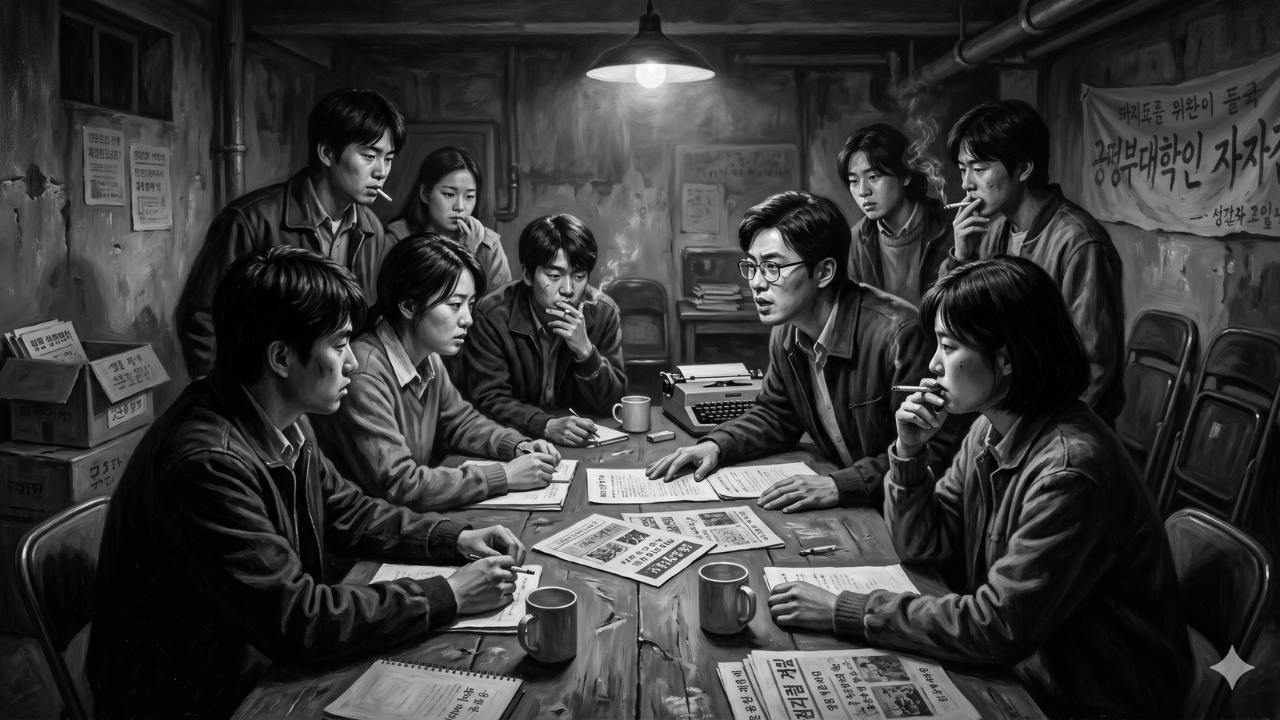
▲ The men who led South Korea’s radical student movement in the 1980s — and the confession that shook the left.
The Silence That Lasted Two Decades
Democracy is fragile. Not because it is attacked from outside, but because the very people who claim to defend it sometimes carry within them the seeds of its destruction. In South Korea, nowhere is this contradiction more visible than in the story of the 386 Generation — the cohort of activists who fought against military dictatorship in the 1980s, only to allegedly import a different kind of authoritarianism through the back door of ideology.
For nearly two decades, the core figures of South Korea’s radical student movement maintained a studied silence about what they had believed, what they had done, and — crucially — whether they had been wrong. Then, in 1999, five men broke that silence. Their names: Cho Hyuk, Hong Jin-pyo, Han Ki-hong, Yoo Jae-gil, and Lee Seung-gyu. Their venue: a bimonthly political journal called Sidae Jeongsin (時代精神, meaning “The Spirit of the Age”). Their message: devastating.
“We were wrong.”
This is the story that South Korea’s mainstream media has largely ignored. This is the investigation that Dannywrites Truth Hunter is bringing to the world.
What Korean Media Won’t Tell You
South Korea’s legacy media — its major television networks and newspapers — have a long and documented history of selective reporting when it comes to the 386 Generation. These are the men and women who now run the country’s newsrooms, sit on its judicial benches, and occupy its legislative seats. Reporting critically on their ideological past is, for many outlets, an act of institutional self-harm.
What the legacy media will not tell you is this: the core of South Korea’s pro-democracy movement in the 1980s was, in significant part, ideologically aligned with Pyongyang. The NL (National Liberation) faction — the dominant force within the student movement — reportedly promoted Juche ideology, the state philosophy of North Korea, as a model for Korean reunification and social transformation. Allegedly, pamphlets, underground study groups, and clandestine networks spread this ideology across dozens of major universities.
The book Hidden Nation (숨은민국), which serves as the primary source for this investigation, documents this history in extraordinary detail — through the words of the activists themselves.

▲ Sidae Jeongsin — The bimonthly journal where South Korea’s 1980s activist core finally broke their silence.
Anatomy of the Hidden State: Who Were These Men?
To understand the significance of the 1999 confessions, you must first understand who these five men were. They were not fringe figures. They were the ideological engine room of South Korea’s most powerful social movement of the 20th century.
Han Ki-hong (born 1961, Yonsei University, Psychology) led labor organizing and ran the group ‘Blue People.’ He was arrested multiple times. Hong Jin-pyo (born 1963, Seoul National University, Political Science) was a unification movement leader with three separate prison records. Lee Seung-gyu (born 1955, Yonsei University, Sociology) had over 20 years of activist experience and had served as policy director of a major civil coalition. Cho Hyuk (born 1963, Korea University, Russian Literature) spent nine years as a fugitive running underground Juche study networks before his arrest in 1994. Yoo Jae-gil (born 1968, Chonbuk National University, Political Science) organized student movements and was the only editor without a prison record.
Together, they represented nearly every major strand of South Korea’s 1980s radical left. And together, in 1999, they sat down and told the truth.
▶ “North Korea is the society where Juche has been least realized”
Han Ki-hong’s confession was perhaps the most explosive. Speaking to Sidae Jeongsin, he delivered a verdict that would have been unthinkable from him a decade earlier: “North Korea is, in fact, the society where Juche ideology has been least realized.”
He broke Juche down into three components: absolute leader worship, a crude adaptation of Marxism-Leninism, and a reworked humanism that repositioned the relationship between people and the world. All three, he argued, had been weaponized by the Pyongyang regime as tools of control — not liberation. The defection of Hwang Jang-yop, Juche’s chief architect, to South Korea in 1997 had, according to Han, finally made the truth undeniable.
“The most exclusive consciousness — believing that we are the most progressive force — is what causes the activist movement to repeat its errors over and over again.”
— Yoo Jae-gil, Sidae Jeongsin interview, 1999
The Real Truth & Evidence: A “Conversion Without Conversion”
Hidden Nation introduces one of the most damning concepts in understanding the 386 Generation: what it calls a “conversion without conversion” (전향 없는 전환). On the surface, these men appeared to acknowledge their errors. But beneath the surface, a deeper psychological resistance to full ideological accountability remained.
Lee Seung-gyu named this tension “the crisis of conscience.” He acknowledged that the movement’s former moral authority — its claim to represent the conscience of Korean society — had quietly eroded into something more troubling: an attachment to power. “I know how selflessly these people threw themselves into the movement,” he said. “But looking at it now, I see that people’s attachment to power has grown stronger. It is a heartbreaking thing.”
Cho Hyuk’s confession was viscerally personal. He described nine years as a fugitive — years in which his own name, “Cho Hyuk,” became the most alien sound in the world to him, because he had buried it under a pseudonym to evade arrest. He described having his wedding delayed because love affairs were the most common way activists were caught by authorities. He described the moment of ideological collapse not as liberation, but as an almost unbearable existential crisis. “It wasn’t just ‘I was wrong,'” he said. “The conclusion that arrived was ‘my entire life was wrong.’ That is a different kind of wound entirely.”
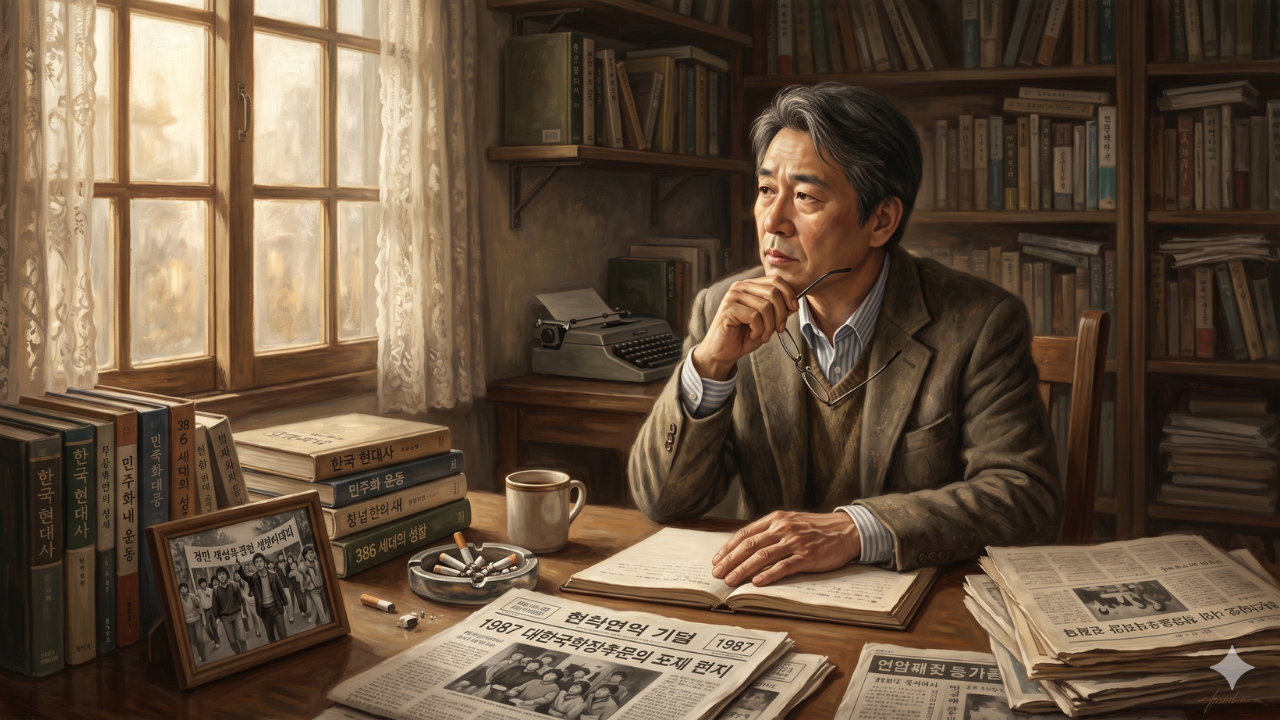
▲ Between idealism and reality — where does the 386 Generation stand today?
The Three Ideological Currents That Shaped a Generation
Hidden Nation identifies three structural forces that powered the 1980s Korean student movement — and which continue to shape Korean society today, largely unexamined.
The first was the radical rejection of the existing regime. After the Gwangju Massacre of May 1980 — in which the military government reportedly killed hundreds of pro-democracy protesters — trust in both the Korean state and its American ally collapsed among a generation of students. Into that vacuum poured ideology.
The second was the preference for North Korean or socialist models as alternatives. This was not a fringe phenomenon. By the late 1980s, reportedly over 80 major universities had NL-aligned student councils. The underground text Kang Cheol Seo Sin (“Letters of Steel”), allegedly written by Kim Young-hwan under the pseudonym “Kang Cheol,” served as a generational manifesto — a how-to guide for Juche-based social transformation.
The third was the idealism and radicalism unique to youth. This is the most sympathetic element, and the one the 386 Generation most frequently invokes in its own defense. But sympathy, as Hidden Nation argues forcefully, does not equal absolution — particularly when the downstream consequences of that idealism included providing political cover for a regime in Pyongyang that was reportedly starving its own people to death.
Global Implications: Why the World Must Care
South Korea is not just a regional story. It is the world’s 10th largest economy, a cornerstone of the US alliance system in the Indo-Pacific, and one of the most consequential democracies in Asia. What happens inside South Korea’s ideological ecosystem has direct implications for regional security, US foreign policy, and the global contest between democratic and authoritarian systems.
The 386 Generation’s reported failure to fully reckon with its Juche-influenced past is not a matter of academic historical interest. It is a live political issue. Reportedly, over 100 people with student movement backgrounds have entered the legal profession. Many more occupy positions in government, the media, and civil society. Their past ideological commitments — however they have evolved — reportedly continue to shape their worldview and their decisions.
For the United States and its allies, the question is pointed: Can a democracy fully trust a leadership class that has never transparently accounted for its past sympathy with a hostile authoritarian regime? For South Koreans themselves, the question is even more urgent: when will the reckoning actually come?
📌 Dannywrites Truth Hunter — Core Finding
The 1999 confessions of the Sidae Jeongsin editors were not the end of a story. They were the beginning of a question that South Korea has still not answered: Can a society build a healthy democratic future on an ideological past it has never honestly confronted?
Fearless Conclusion: The Reckoning That Never Came
Twenty-seven years after the events described in Hidden Nation, the 386 Generation sits at the apex of South Korean power. They are judges, lawmakers, journalists, professors, and presidents. And the reckoning — the full, transparent, public accounting of what they believed, what they did, and what damage they may have caused — has reportedly never come.
Hong Jin-pyo put it starkly in his 1999 interview: “If you cannot make peace with Park Chung-hee, you cannot become the mainstream.” This was not a call for whitewashing history. It was a recognition that unresolved ideological wounds do not disappear — they fester, and they distort.
Lee Seung-gyu warned that North Korea’s human rights crisis was not something that could wait. “This is a matter of human dignity. It is not the kind of thing you can delay.” And yet, delay — strategic, self-interested delay — is reportedly exactly what a significant portion of Korea’s progressive establishment has chosen.
Hidden Nation is more than a history book. It is a mirror held up to a society that has not yet found the courage to look into it clearly. The truth is not comfortable. But the alternative — a democracy built on unexamined lies — is far more dangerous.
✅ 3-Step Action Guide for Readers
Learn who the NL and PD factions were, what they believed, and how they differed. This is the essential context for understanding modern South Korean politics.
Look at who leads South Korea’s major political parties, media organizations, and judicial institutions. Ask: have they ever publicly addressed their ideological past?
Support independent investigative journalism that holds power accountable — regardless of which side of the political spectrum that power sits on. Share this article. Start the conversation.
❓ Frequently Asked Questions
Q1. What exactly is the “386 Generation” in South Korea?
The “386 Generation” refers to South Koreans who were in their 30s during the 1990s (when the term was coined), attended university in the 1980s, and were born in the 1960s. They were the core of South Korea’s pro-democracy student movement, which fought against the military dictatorships of Park Chung-hee and Chun Doo-hwan. Many went on to dominate Korean politics, media, and civil society in the 2000s and 2010s.
Q2. What is Juche ideology and why did Korean students adopt it?
Juche is the official state philosophy of North Korea, developed under Kim Il-sung. It emphasizes national self-reliance and positions the leader as the supreme embodiment of the people’s will. Korean students in the 1980s reportedly adopted it partly because, after the Gwangju Massacre, they had lost faith in both the South Korean state and its American backers. Juche offered an alternative ideological framework — one that, allegedly, they later came to see as a vehicle for totalitarian control rather than liberation.
Q3. What is Sidae Jeongsin and why does it matter?
Sidae Jeongsin (時代精神, “The Spirit of the Age”) was a bimonthly political journal launched in November 1998. Its editorial board consisted of former core figures from South Korea’s NL-aligned student movement. The journal was notable for being one of the first platforms where these individuals publicly grappled with — and reportedly confessed to — the errors of their ideological past. It is considered a landmark document in the internal history of South Korea’s progressive movement.
Q4. Why hasn’t South Korea’s mainstream media covered this story?
South Korea’s major media outlets are, to a significant degree, staffed and led by members of the very generation whose ideological history is in question. Critical reporting on the 386 Generation’s Juche-influenced past would amount to institutional self-examination — something that is reportedly rare in any media ecosystem. Independent investigative outlets like Dannywrites Truth Hunter exist precisely to fill this gap.
Q5. Does this story matter for US-South Korea relations?
Significantly. South Korea is one of America’s most important allies in the Indo-Pacific. Understanding the ideological backgrounds and potential blind spots of South Korea’s leadership class is directly relevant to US strategic interests — particularly regarding North Korea policy, alliance management, and the broader contest between democratic and authoritarian systems in Asia.
🎬 DANNYWRITES TRUTH HUNTER — YOUTUBE EXCLUSIVE
The full investigative deep-dive is now on YouTube.
What you’ve read here is only the beginning. The complete investigation — with additional sources, analysis, and the full behind-the-scenes story — is waiting for you on the Dannywrites Truth Hunter YouTube channel.
This is the story South Korea’s mainstream media won’t touch.
Watch it. Share it. Make them answer for it.
🌿 Weekly wellness, health & beauty insights — straight to your inbox
Free subscription · Cancel anytime