The internet is loud. Everywhere you look, there are gurus shouting into ring lights, dancing on short-form videos, and engaging in aggressive “bro marketing” tactics. If you are an introvert, the mere thought of launching a personal brand that requires constant face-to-camera interaction is enough to make you want to close your laptop forever. But here is the truth: you do not need to be the loudest person in the room to build a highly profitable, sustainable online business.
Living in Elk Grove, California, I’ve seen countless digital nomads hustling in bustling local coffee shops, constantly filming themselves—but the most successful entrepreneurs I know are the ones quietly building automated systems from the comfort of their living rooms. They are living the “cozy pajama lifestyle,” generating passive income without ever stepping in front of a lens.
In 2026, the online landscape has evolved. Consumers are looking for hyper-specific solutions, detailed text, and genuine value over flashy personalities. If you want to start a quiet, soft-marketing online business, this guide will walk you through seven highly effective, completely faceless passive income strategies.
The “Cozy” Business Model: Why Faceless Commerce is Thriving
Before we dive into the specific income streams, it is crucial to understand why this model works. The “cozy entrepreneur” movement is built on the foundation of providing extreme value through low-friction products.
When you remove the personal brand aspect, your product has to stand on its own merit. This forces you to create better templates, more comprehensive guides, and highly targeted solutions. You aren’t selling access to you; you are selling a shortcut to their success.
Core Advantages of the Faceless Model:
- Zero Performance Anxiety: You never have to worry about lighting, makeup, or stumbling over your words on camera.
- Evergreen Value: A well-written ebook or template sells just as well at 2:00 AM as it does at 2:00 PM.
- Ultimate Privacy: You can scale to a million page views and thousands of email subscribers without anyone knowing your real identity.
7 Faceless Passive Income Streams for Introverts
1. Launching Low-Ticket Digital Products
You do not need an established Shopify empire or a massive Etsy storefront to start selling digital products. Your first step into passive income can be astonishingly simple. Think about printables, digital planners, workbooks, or a focused ebook.
The strategy here is to solve one specific micro-problem for your audience. For example, if you run a faceless blog about morning routines, package your best tips into a $7 “Dream Morning” guide. Low-ticket offers are perfect because they remove the buyer’s hesitation.
Case Study: Consider the trajectory of a simple budget planner. By creating a hyper-organized PDF and selling it for $9 via an automated checkout page (like Payhip or Stan Store), you only need 100 sales a month to generate nearly $1,000 in purely passive income.
Actionable Checklist:
- Identify a top-performing post on your blog or a highly-searched Pinterest keyword in your niche.
- Expand that topic into a 20-page actionable workbook using Canva.
- Price it between $7 and $15 to encourage impulse purchases.
- Set up an automated delivery system so the customer receives the file instantly upon payment.
2. Strategic Affiliate Marketing via Email Funnels
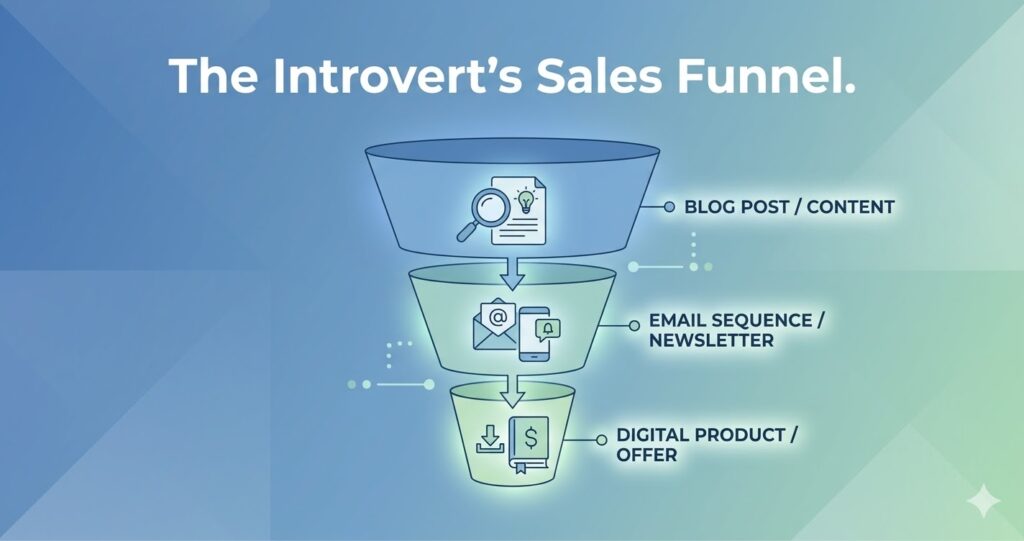
Most beginners fail at affiliate marketing because they simply scatter links across their website and hope for the best. Strategic affiliate marketing is entirely different. It requires building an automated email sequence that nurtures your audience and soft-sells products you genuinely use and trust.
As an introvert, email is your ultimate superpower. It allows you to craft thoughtful, compelling narratives without the pressure of a live audience.
How to Execute This: Instead of writing a generic review, build a “Resource Library” on your blog. When someone signs up for your email list to get a free checklist, put them into a 5-day automated sequence. By day three, introduce an affiliate product that solves a problem mentioned in your freebie. You earn anywhere from 5% to 50% commission per sale, all while you sleep.
Pro Tip: Always track your affiliate links using software or simple UTM parameters. Knowing exactly which blog post or email generated a sale allows you to double down on what works.
3. Selling Systems and Digital Templates
People are naturally curious—and admittedly, a bit nosy—about how successful people organize their lives and businesses. If you have a streamlined workflow in Notion, ClickUp, or even a set of heavily optimized email response scripts, you have a product.
“Templatizing” your daily operations is one of the highest-ROI activities you can do. You have already done the hard work for your own business; now, you are simply packaging it for others.
Top Template Ideas for 2026:
- Notion Dashboards: Life wikis, content calendars, or freelance client portals.
- Canva Brand Kits: Pre-designed social media graphics for specific niches (e.g., real estate agents or wellness coaches).
- Spreadsheets: Advanced Google Sheets for tax tracking, meal planning, or wedding budgets.
4. The Print-on-Demand (POD) Ecosystem
If you lean toward the creative and visual side but want strictly hands-off logistics, Print-on-Demand is the answer. POD allows you to design custom merchandise—mugs, journals, t-shirts, tote bags—without ever holding inventory or visiting a post office.
When a customer places an order on your storefront, the POD provider (like Printify or Printful) automatically prints, packages, and ships the item directly to the buyer. Your only job is to create designs that resonate with a specific subculture or niche. Keep it simple: aesthetic typography, relatable quotes, or minimalist line art perform exceptionally well.
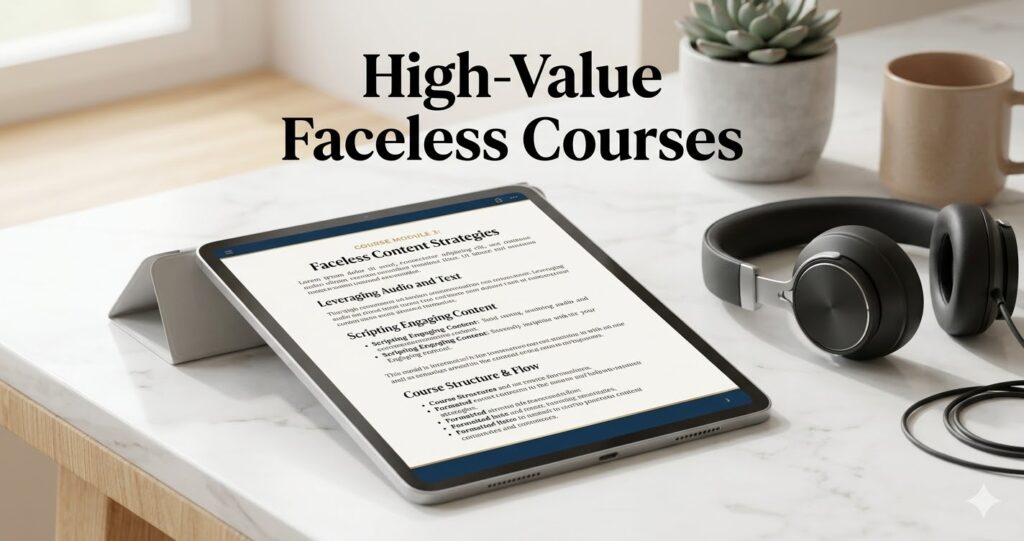
5. Text-Based and Audio-Free Online Courses
There is a massive misconception that an online course must feature high-production video modules. This is entirely false. Some of the most valuable, high-ticket courses on platforms like Teachable or Podia are 100% text-based.
A written course functions like an interactive, highly structured textbook. You can include written modules, downloadable PDF worksheets, and checklists. If you want to add a multimedia element without showing your face, you can record your voice over simple presentation slides.
Why Text-Based Courses Convert: Many students actually prefer text-based learning. It allows them to read at their own pace, easily copy and paste important notes, and search the curriculum for specific keywords without having to scrub through hours of video footage.
6. Premium Audio Subscriptions
If you dislike video but have a soothing voice or a knack for audio production, consider the private podcast model. You can record educational content, guided meditations, calming soundscapes, or daily affirmations, and sell access via a private RSS feed.
Platforms like HelloAudio make it incredibly simple to gate your audio content. Customers pay a one-time fee or a monthly subscription, and they receive a unique link to listen to your premium audio directly in their favorite podcast app (like Apple Podcasts or Spotify).
7. Licensing Stock Photography and Digital Art
If you own a decent camera or have a talent for digital illustration, your hard drive might be sitting on untapped revenue. Selling stock photos or digital assets on platforms like Unsplash, Adobe Stock, or Wirestock requires zero face-to-face interaction.
What Sells Best:
- Authentic Lifestyle Shots: People working at laptops, coffee cups, cozy home interiors.
- Niche Flat Lays: Desks organized with specific tools (e.g., a coder’s desk, a painter’s studio).
- Faceless Human Elements: Hands typing on a keyboard, someone holding a warm mug (where the face is cropped out).
Comparing Your Faceless Passive Income Options
To help you decide where to start, here is a quick breakdown of the required effort and potential return for these strategies:
| Income Strategy | Initial Setup Effort | Technical Skill Required | Passive Income Potential |
| Low-Ticket Digital Products | Medium | Low | Medium |
| Email Affiliate Marketing | High | Medium | High |
| Selling Templates | Low (if already built) | Medium | Medium |
| Print-on-Demand | Medium | Low (Design focus) | Medium |
| Text-Based Courses | Very High | Low | Very High |
| Premium Audio | Medium | Medium (Audio editing) | High |
| Stock Photography | Low | High (Photography skills) | Low to Medium |
The Introvert’s Action Plan: Your Next Steps
Starting a business is intimidating, especially when you are asking people to pull out their credit cards and pay for something you created. The key to building online confidence as an introvert is to start incredibly small.
Do not try to build a $500 text-based course on day one. Start by turning a popular blog post into a $7 PDF guide. Prove to yourself that a stranger on the internet will buy your digital product while you are walking on the treadmill or sipping tea on your couch. Once you hear that first notification of a sale, your entire perspective on making money online will shift.
Take it at your own pace. You can absolutely build a highly profitable, deeply fulfilling online business in a quiet, soft, and authentic way.
💡 자주 묻는 질문 (FAQ)
Q1: Do I need a large social media following to succeed with faceless affiliate marketing?
A1: Not at all. In fact, relying on search engine optimization (SEO) through a blog or utilizing visual search engines like Pinterest is far more effective for faceless affiliate marketing. By capturing organic traffic and directing those visitors to an automated email sequence, you can generate consistent sales without ever posting a single reel or having a large social media footprint.
Q2: What is the most beginner-friendly digital product to create for passive income?
A2: A low-ticket PDF guide or a simple template (like a Notion dashboard or a Google Sheet) is the best starting point. These products require zero overhead, can be designed for free using tools like Canva, and solve an immediate, specific problem for the buyer. Pricing it between $7 and $15 lowers the barrier to entry and helps you build immediate confidence in your ability to sell online.
Q3: Can text-based online courses truly charge the same premium price as video courses?
A3: Yes, provided the value and the transformation are clear. Customers do not pay for video; they pay for results. If your text-based course features highly actionable written modules, comprehensive checklists, and templates that save the user hours of frustration, you can absolutely charge premium prices. Positioning it as a “digital curriculum” or “interactive playbook” often appeals to professionals who prefer skimming text over watching lengthy videos.
🌿 Weekly wellness, health & beauty insights — straight to your inbox
Free subscription · Cancel anytime