Quiet AI Side Hustles for Introverts 2026: 9 Ways to Earn Without Networking
Updated for 2026 | 24 min read
If you’ve been searching for quiet AI side hustles for introverts 2026, you’re not alone — and the good news is that 2026 might be the best year yet to start one.
There is a particular kind of exhaustion that has nothing to do with hours worked. It is the exhaustion of small talk, of forced enthusiasm on sales calls, of pretending to be “on” in a Zoom room full of strangers. If you have ever left a networking event feeling like you had run a marathon while sitting in a chair, you already know the feeling I am describing. Living in California, I have watched an entire generation of remote workers quietly build second incomes that never once require them to pitch a stranger, work a room, or “put themselves out there” in the way every hustle-culture guru insists is mandatory.
That old rulebook is being rewritten in 2026, and artificial intelligence is the reason why. For the first time, the tools that once required a marketing degree, a design background, or a golden radio voice are available to anyone willing to learn a workflow. You do not need to be extroverted to succeed with them. You need to be observant, consistent, and comfortable working alone — which, if you are an introvert, is probably your natural resting state anyway.
I want to be upfront about something before we go further: this is not a “get rich by Friday” post. Almost everything genuinely worthwhile about these nine ideas takes real weeks of unglamorous setup before it produces its first dollar. What makes them worth your time is not speed — it’s that the setup happens entirely on your own terms, in your own room, at your own pace, with no one watching and no one to impress until the work is already finished and speaking for itself.
This guide walks through nine AI-powered paths to income that are built for people who would rather refine a process at 11 p.m. in a quiet room than shake hands at a conference. Some of these ideas can realistically produce a few hundred dollars a month as a supplement. A handful of them, treated seriously over twelve to eighteen months, have the structural potential to replace a full income. None of them require you to become someone you are not. By the end of this article, you’ll also find a comparison table to help you pick the single best-fit idea, a breakdown of the mistakes that quietly sabotage most beginners, a realistic look at what a working week actually feels like once you’re a few months in, and a practical walk-through of the unglamorous but necessary parts — budgeting your startup costs and understanding basic US tax obligations for solo earners.
A quick note on what this article is not: it is not a promise that any of these nine ideas will make you rich, and it is not a claim that “passive income” means zero ongoing effort. Every idea here still requires real work — the difference is where that work happens and who it happens in front of. Instead of a boss watching you type, or a customer expecting an instant reply, or a room full of strangers expecting you to sell yourself, the work happens on your screen, on your schedule, judged only by whether the final product is good enough for someone to pay for it. That shift, subtle as it sounds, changes everything about how sustainable this kind of income feels for a genuinely introverted person.
Living in California, I have also noticed something else worth mentioning up front: the people who do best with these quiet, AI-assisted paths are rarely the most naturally talented writers, designers, or speakers. They are the ones who treat the work like a long, private hobby they happen to get paid for — checking in consistently, improving in small increments, and never needing an audience’s applause to keep showing up the next day.
📌 Before You Start
If you’re building more than one income stream, having the right foundation matters. We’ve broken down our full toolkit for quiet, systems-based earners.
Explore the Full Resource →Why “Quiet Work” Is Having a Real Moment in the US Economy
It’s worth pausing on why this shift is happening now, and the numbers tell a clear story. According to a 2026 side hustle survey from Bankrate, roughly a quarter to a third of American workers currently hold an active side hustle, and that share climbs to well over half among Gen Z respondents. Separately, Intuit QuickBooks’ 2026 Entrepreneurship Study found that nearly one in two Americans reported earning income from a side hustle this year, with four in ten planning to start a brand-new one specifically to build wealth rather than just cover a bill.
What almost none of these surveys ask, but what I think matters most for this conversation, is how that income is being earned. This is exactly the gap that quiet AI side hustles for introverts 2026 fill. The old side-hustle economy ran on visibility: driving for a rideshare app, waiting tables, selling at a farmers market, doing sales calls for a multi-level-marketing product. The 2026 version increasingly runs on production — writing, designing, narrating, and building things that a computer distributes on your behalf while you stay exactly where you are: at your desk, alone, headphones on.
The Data Behind the Shift
- Roughly 30% of side hustlers now sell products online rather than performing a service in person, making e-commerce the single most common category of secondary income in the country.
- The U.S. gig economy has been valued at nearly half a trillion dollars in 2026, a figure that increasingly includes digital-only work: content, design assets, audio, and automated storefronts.
- In the print-on-demand space specifically, industry analysts at Grand View Research and Mordor Intelligence both put the global market above $12 billion in 2026, expanding at a compound annual growth rate north of 20% — and AI-native merchandise tools are reportedly growing nearly three times faster than the traditional print-on-demand segment.
- Nearly 40% of Americans say they plan to start a brand-new side hustle or business in 2026, and among Gen Z that figure rises to roughly half — suggesting the competitive window for AI-assisted work is wide open right now but will not stay that way indefinitely.
None of this means quiet, AI-assisted work is a guaranteed windfall. The same surveys that show rising participation also show a punishing reality: many side hustlers report burnout, and the median monthly income across all hustle types sits closer to a few hundred dollars than a few thousand. The people who do well are not the ones chasing every shiny idea. They are the ones who pick one lane, build a repeatable system inside it, and let a few months of unglamorous consistency compound. Keep that in mind as you read the nine ideas below — think in terms of one primary lane and, at most, one experimental side project, not nine parallel businesses.
What Makes a Side Hustle Genuinely “Introvert-Friendly”
Before diving into the nine ideas, it helps to define terms. Not every “work from home” opportunity is actually quiet. Plenty of remote jobs — sales development representative roles, customer support with call quotas, virtual assistant work involving constant client calls — are performed from a home office but are just as socially draining as an in-person job, sometimes more so, because video calls carry their own particular fatigue. For the purposes of this guide, a genuinely quiet hustle has three characteristics: it is asynchronous (you are never required to respond in real time), it is production-based rather than conversation-based (your income comes from what you make, not who you convince), and it scales without proportional social contact (ten customers require roughly the same amount of talking as a thousand). Every idea below was chosen because it meets all three conditions.
A Realistic Look: What a Working Week Actually Feels Like
It’s easy to read a list of nine ideas and picture an abstract, glossy version of “passive income.” The reality, four to six months into any of these paths, is quieter and more repetitive than the marketing around AI side hustles tends to admit — which, for the right kind of person, is exactly the appeal rather than a drawback.
Picture a Tuesday morning. No alarm rush to a video call, no Slack notifications demanding an immediate response. Coffee first, then forty-five minutes reviewing overnight sales on a print-on-demand dashboard or comment activity on a blog post published the week before. Nothing urgent — a routine check, the digital equivalent of watering a plant. By mid-morning, the actual production work begins: drafting two blog outlines with AI assistance, or generating a batch of design concepts, or recording twenty minutes of narration for a client’s training video. This is the deep-focus block, usually ninety minutes to two hours, done with the door closed and notifications silenced.
Afternoons tend to be lighter and more administrative: editing the morning’s output, tagging and uploading a finished digital product, replying to two or three written client messages that arrived overnight, updating a spreadsheet that tracks income for tax purposes. By late afternoon, the workday is done — not because the clock says so, but because the day’s planned production is finished. There is no meeting that runs long, no colleague who needs “just five minutes,” no client call that turns into an hour of unpaid hand-holding.
What is conspicuously absent from this description is conversation. A full, productive day in any of these nine hustles might involve writing forty or fifty messages total — replies to marketplace inquiries, a few emails, maybe a short exchange with a freelance editor — and zero live calls. For someone who finds real-time conversation draining rather than energizing, this is not a minor perk. It is the entire reason the model works. The trade-off is that growth is slower and less immediately validating than a sales job with instant commission checks; the compensation is that almost none of the day is spent performing a version of yourself for someone else’s benefit.
Weekends and evenings, notably, stay mostly free. Because none of these nine ideas depend on being reachable in real time, there is no expectation of checking a phone every twenty minutes the way many customer-facing gig jobs demand. A Saturday morning batch-production session, if you choose to do one at all, is a deliberate choice rather than a response to pressure — which is precisely the kind of autonomy that tends to matter most to people who have spent years in jobs demanding constant availability and constant social performance.
Idea 1: AI-Powered Blogging & Content Writing
Writing has always been a natural fit for introverts, and AI has removed the two biggest bottlenecks that used to make blogging painfully slow: the blank page and the research grind. This does not mean typing a prompt and publishing whatever comes out — search engines and readers alike have gotten sharp at spotting generic, unedited AI text, and that kind of content typically underperforms. What has changed is the ratio of thinking-to-typing. A writer who used to spend three hours drafting a 1,500-word post can now spend forty minutes outlining and fact-checking with AI assistance, then another hour shaping the draft into something that sounds unmistakably like a real person who actually knows the topic.
How the Workflow Actually Works
A sustainable AI-assisted blogging workflow usually breaks into four quiet, solitary stages: keyword and topic research, AI-assisted drafting, human editing for voice and accuracy, and monetization through display ads, affiliate links, or a related digital product. None of these stages require you to talk to anyone. You are essentially running a small, one-person publishing house from a laptop.
- Pick a narrow niche you can credibly write about weekly. “Personal finance” is too broad; “budgeting for single-income households in their first year of a mortgage” is specific enough to rank and narrow enough to master.
- Use AI for structure, not soul. Let it generate outlines, counter-arguments, and first-draft data summaries. Rewrite the actual sentences in your own voice — this is what both readers and search algorithms increasingly reward.
- Publish on a schedule you can sustain alone. Two well-researched posts a week for a year will outperform twenty rushed posts in a month.
Tools & Setup You’ll Actually Need
You do not need an expensive stack to start. A basic WordPress or Ghost blog, a paid AI writing assistant subscription, a keyword research tool with a free tier, and a grammar-checking browser extension cover roughly 90% of what a solo blogger uses daily. Resist the urge to buy every plugin and tool advertised to new bloggers in your first month — most of that spending happens before a writer has any traffic to justify it, and it is one of the fastest ways to turn a nearly-free hobby into a money-losing obligation.
Your First 30 Days
- Week 1: Choose your niche and write down twenty specific questions your target reader is actively searching for answers to.
- Week 2: Set up your blog’s basic structure and publish two fully edited, AI-assisted posts.
- Week 3: Publish two more posts and begin internally linking new posts to older ones to build topical authority.
- Week 4: Apply to a display advertising network and set up one or two relevant affiliate partnerships, even if your traffic is still small — approval often takes longer than expected, so it’s worth starting the process early.
Realistic Earnings Potential
A niche blog with consistent AI-assisted publishing typically takes six to twelve months before search traffic becomes meaningful. Once it does, income tends to arrive through three channels layered on top of each other: display advertising (a few dollars per thousand page views), affiliate commissions on products you genuinely recommend, and eventually a digital product of your own, such as a template pack or a short guide. Writers who stay consistent for a full year commonly describe crossing from zero to a few hundred dollars a month around month eight to ten, with the number continuing to climb as the archive of posts grows and compounds in search visibility.
A Realistic Example
Consider a hypothetical blogger — call her Maya, a former paralegal working from a home office in Sacramento — who starts a niche blog covering elder-care planning for adult children managing a parent’s finances remotely. She has no journalism background, but she has lived experience and a comfortable, methodical relationship with research. Using an AI writing assistant for outlines and first drafts, she publishes two thoroughly edited, 1,800-word posts a week without exception. By month four, a handful of posts begin ranking for long-tail search terms with low competition. By month nine, she’s approved for a display ad network and has negotiated two affiliate partnerships with financial planning tools relevant to her audience. Her monthly income at the one-year mark sits around $650 — not life-changing, but earned entirely through writing and editing, with zero cold outreach, zero sales calls, and zero networking events.
✍️ Need Editing or Research Help?
Even solo bloggers outsource the parts they don’t enjoy. Freelance editors, fact-checkers, and researchers on Fiverr can turn a rough AI-assisted draft into a polished, publish-ready post — without a single meeting.
Find a Freelance Editor →Idea 2: AI-Designed Print-on-Demand Products

Print-on-demand has quietly become one of the most introvert-friendly business models that exists, because it removes every customer-facing step that used to make retail exhausting. There is no storefront to staff, no inventory to manage, and — with AI design tools now built into platforms like Printful, Printify, and Canva’s merch integrations — no need to be a trained graphic designer either. You upload a design, a customer orders, a third-party facility prints and ships it, and you collect the margin. The entire operation can run from a laptop in a spare bedroom.
Why the Timing Matters
Market researchers at Grand View Research and Mordor Intelligence both estimate the global print-on-demand market at somewhere between $12 billion and $15 billion in 2026, with several forecasts projecting the market to more than triple in size by the early 2030s. What is more interesting for a solo, AI-assisted seller is a narrower trend inside that number: industry analysis on AI-native merchandise design suggests that segment is expanding at close to 67% annually — nearly three times the growth rate of traditional print-on-demand — as AI design tools make it possible for individual sellers to produce professional-grade artwork without hiring anyone.
A Realistic Starting Workflow
- Choose a tightly defined audience (plant parents, retired nurses, disc golf players) rather than a broad category like “funny shirts.”
- Use an AI image generator to produce a batch of design concepts, then refine the two or three strongest ones with basic editing software.
- List the designs across multiple product types — shirts, mugs, tote bags, phone cases — so a single design earns from several product formats at once.
- Let SEO-optimized listings and, later, a small amount of paid social promotion do the selling. No cold outreach required.
Choosing a Platform
Most beginners start on Etsy paired with a Printify or Printful integration, since Etsy already brings built-in search traffic from buyers actively looking for niche, personalized products. More experienced sellers eventually branch into their own Shopify storefront once they have a proven design or two, since owning the storefront means keeping a larger share of each sale and controlling the customer relationship directly. There is no wrong place to start, but starting on a marketplace with existing search traffic dramatically shortens the time to your first sale compared to building a standalone store from zero.
The honest caveat here is that print-on-demand rewards patience over speed. Return rates in this model run under 5%, far below traditional retail’s roughly 20%, but per-unit margins are thinner than owning inventory outright. Sellers who treat it as a slow-building catalog — adding a handful of well-researched designs every week for months — tend to see far better long-term results than those who upload fifty designs in one weekend and then disappear.
A Realistic Example
Picture a hypothetical seller — call him Derek, a quiet, detail-oriented former warehouse supervisor in Ohio — who starts an Etsy shop focused entirely on minimalist illustrations for people who breed and show working dogs, a hobby he already knows intimately. He uses an AI image generator to rough out concepts, then spends an evening a week refining the two or three strongest ones in an editing tool before listing them across shirts, stickers, and tote bags through a Printify integration. His first sale arrives in week three. By month five, he has forty listings live and has identified that three specific breed-focused designs account for most of his revenue, so he begins producing variations of those three rather than constantly inventing new concepts. Monthly revenue settles around $400–$500, entirely handled through order automation, with Derek never once speaking to a customer directly.
🛍️ Building a Product-Based Side Income?
We’ve put together a deeper walkthrough on structuring a quiet, no-inventory product business from scratch.
Read the Full Guide →Idea 3: AI Voiceovers & Audiobook Narration
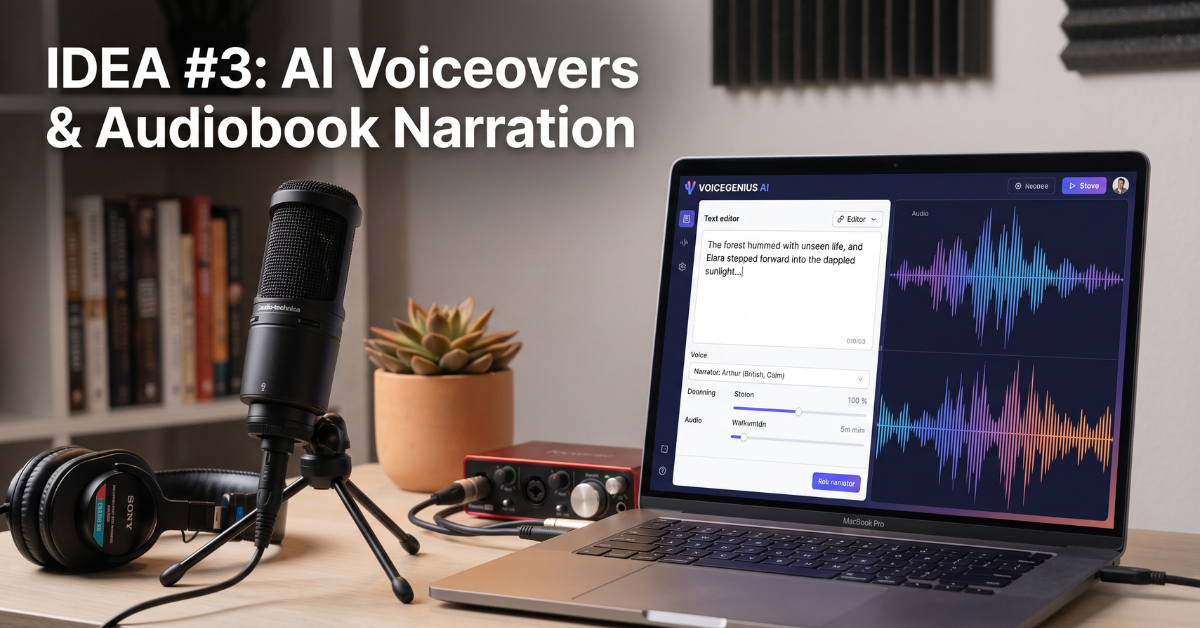
This one surprises people the first time they hear it, because narration sounds like the opposite of quiet work — surely you need to perform, to be theatrical, to enjoy being “heard”? In practice, most working voice-and-audio freelancers in this space describe their actual working conditions as deeply solitary: a closed door, a decent microphone, and hours of focused, repetitive line-reading with no audience in the room. What has changed in 2026 is that AI text-to-speech and voice-cloning tools have opened a second, even quieter lane inside this category — one where you never speak a single word yourself.
Two Paths, Same Quiet Core
Path A — Human narration for niche audiobooks and explainer videos. Independent authors on self-publishing platforms consistently struggle to find affordable narrators for shorter or niche-category books. A calm, clear reading voice recorded in a treated home closet can fill this gap, and AI tools now handle the noisy, technical post-production — noise removal, leveling, mastering — that used to require expensive studio time.
Path B — AI-generated voice production and editing. Here you never record your own voice at all. Instead, you become the person who takes a script, runs it through a licensed AI voice model, and handles the editing, pacing, and emotional direction so the final product sounds natural rather than robotic. Businesses producing training videos, YouTube explainers, and app onboarding flows increasingly need exactly this service, and it is entirely screen-based work.
Setting Up a Simple Home Recording Space
You do not need a professional studio. A quiet closet lined with hanging clothes, a mid-range USB condenser microphone, and free editing software like Audacity produces perfectly serviceable recordings for most explainer video and short-form audiobook work. The single biggest quality upgrade for the least money is almost always acoustic treatment — reducing echo — rather than a more expensive microphone. Many working narrators describe their first “studio” as exactly this kind of improvised closet setup.
Getting Your First Clients Without Selling Yourself
- List services on freelance marketplaces where buyers come to you, rather than pitching cold.
- Build a short demo reel showcasing two or three narration styles (calm/educational, energetic/promotional, warm/storytelling).
- Price per finished audio minute rather than per hour, so your quiet, methodical pace is never a disadvantage.
- Ask satisfied clients for a written testimonial rather than a call — most are happy to provide one over email or through the marketplace’s review system.
A Realistic Example
Consider a hypothetical narrator — call her Priya, a soft-spoken former teacher in Texas — who sets up a simple closet recording space with a $90 USB microphone and free editing software. She lists narration services for short, independently published nonfiction titles, a category major audiobook narrators often overlook because the pay per finished hour is lower than fiction work. Her calm, unhurried reading style, which once felt like a liability in a classroom full of restless students, turns out to be exactly what self-help and instructional authors want. Within two months she has narrated four short books, communicating with every author entirely through written messages and shared audio files. Her income remains modest and project-based, typically $300–$600 per finished book depending on length, but the entire relationship — from first inquiry to final delivery — happens without a single phone call.
🎧 Curious What Else Fits a Home Studio Setup?
We’ve rounded up more low-noise, screen-based income ideas that pair well with audio and video work.
See More Ideas →Idea 4: Selling AI Prompts & Digital Templates
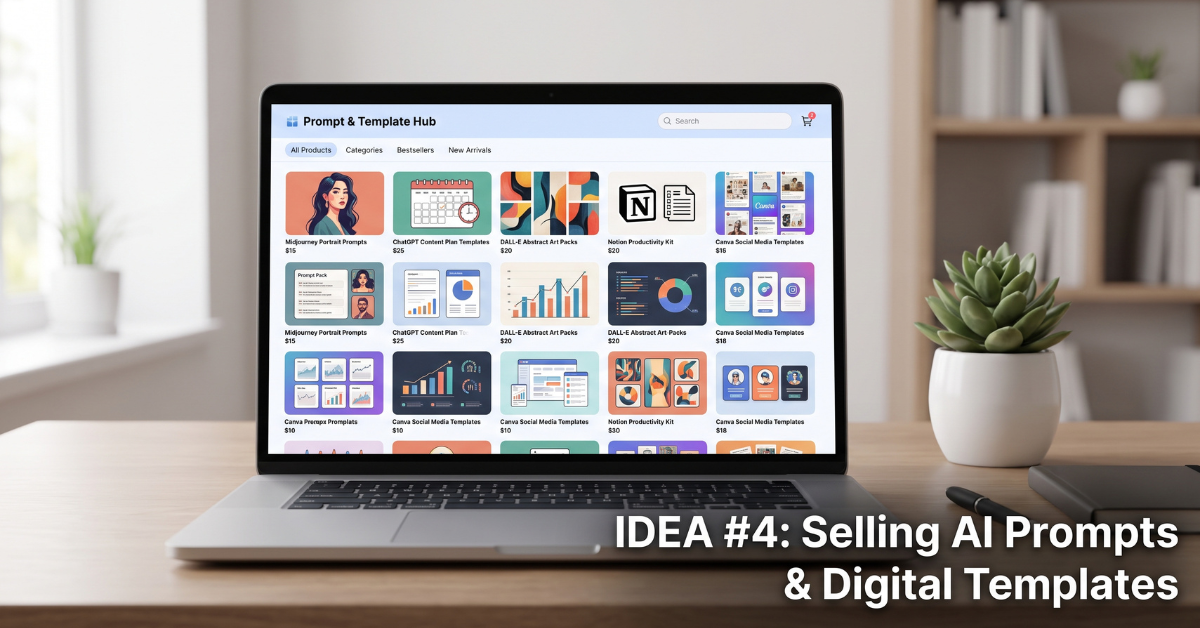
Of every idea on this list, this is probably the most literally “quiet” — you build something once, list it in a digital storefront, and it can generate sales indefinitely without another minute of your active involvement. As more people adopt AI tools for writing, design, and productivity, a genuine skills gap has opened up: most users know an AI tool exists, but very few know how to prompt it well enough to get consistently professional results. That gap is the entire market for this idea.
What Actually Sells
- Prompt packs for a specific job. “50 prompts for real estate listing descriptions” sells far better than “500 general AI prompts,” because it solves one person’s Tuesday-afternoon problem.
- Notion and spreadsheet templates. Budget trackers, content calendars, and small-business invoicing systems remain consistent sellers on digital marketplaces because they save a buyer hours of setup.
- Canva and design templates. Pre-built social media kits, resume designs, and presentation decks appeal to buyers who want a professional look without the professional skillset.
Building a Product Once, Selling It Forever
The workflow here rewards obsessive, detail-oriented people — which, again, tends to describe introverts quite well. You spend real, focused hours testing which prompts actually produce consistent results, documenting them clearly, and packaging them attractively. Then you list the product on a marketplace such as Etsy’s digital goods category, Gumroad, or your own storefront, and the selling happens through search and browsing rather than conversation. Sellers who succeed here typically maintain five to fifteen small digital products simultaneously rather than betting everything on one, since each product earns modestly on its own but adds up meaningfully as a portfolio.
Pricing Without a Single Negotiation
One underrated advantage of digital products is that pricing happens once, at the listing stage, and never requires an uncomfortable back-and-forth. A well-researched prompt pack solving a specific professional problem typically prices in the $9–$29 range, while more comprehensive template systems with ongoing updates can command $30–$75. Study five to ten competing listings in your category before setting your price, paying close attention to what buyers say in reviews about what they wished the product also included — that feedback is often your next product idea.
Tools Worth Knowing
A Notion or Google Sheets template can be built entirely with free tools already on your computer. Prompt packs benefit from a simple PDF layout tool like Canva to present them cleanly, plus a delivery platform such as Gumroad or Etsy’s digital download feature, both of which automatically handle file delivery, payment processing, and buyer receipts without any manual intervention on your part after the sale.
A Realistic Example
Consider a hypothetical seller — call him Tom, a spreadsheet-obsessed former operations coordinator in Colorado — who notices small landscaping business owners in online forums repeatedly asking how to write professional client quotes. He builds a clean, editable quote-and-invoice template paired with a set of AI prompts for drafting polite follow-up emails to slow-paying clients, then lists the bundle on Etsy for $19. It sells modestly at first, three or four copies a week, but because the product required no ongoing production once built, every sale after the first week is close to pure profit. Over the following months he builds four more niche-specific bundles the same way, each targeting one narrow professional frustration he noticed people complaining about online, and the combined catalog produces a steady few hundred dollars a month with essentially no weekly maintenance required.
📦 Ready to Package Your Own Digital Product?
Our step-by-step breakdown covers pricing, platform choice, and listing optimization for first-time digital sellers.
Get the Breakdown →Idea 5: Automated E-Commerce with AI Chatbots
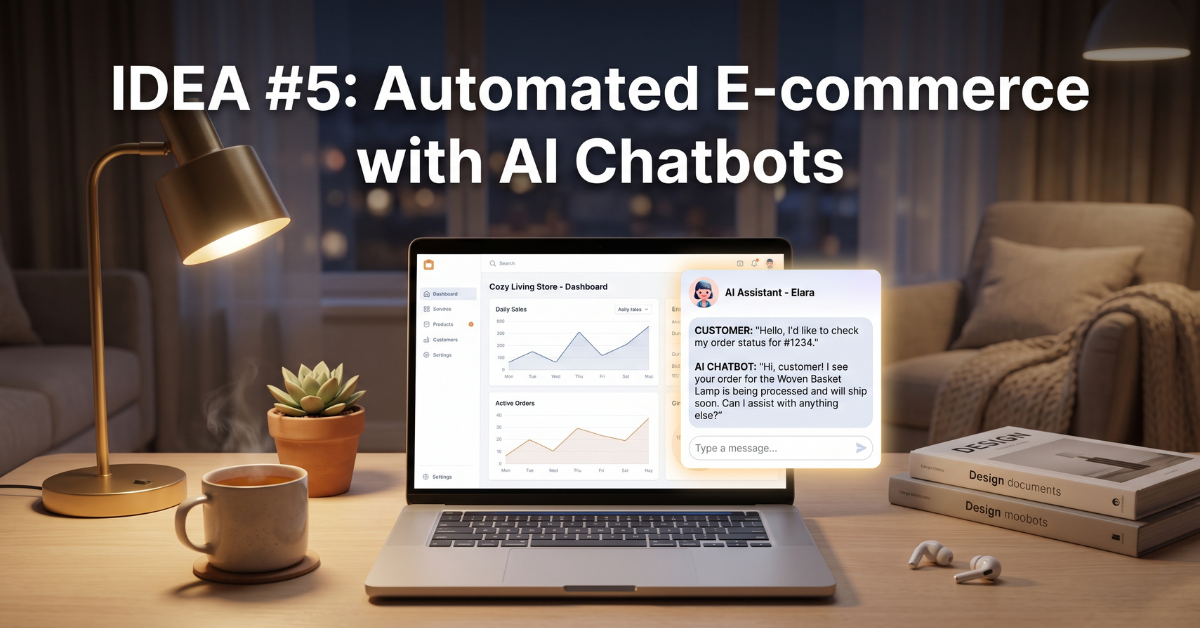
Running an online store used to mean being reachable constantly — answering the same shipping question forty times a day, fielding complaints in real time, and feeling obligated to reply within minutes to keep your seller rating intact. AI customer-service chatbots have quietly removed the most draining part of that equation. A well-configured chatbot can answer product questions, track orders, process simple returns, and even upsell related products, all without you being present for the conversation at all.
Setting Up a Store That Runs Without You
- Choose a narrow product category you can source through print-on-demand or a small dropshipping supplier, so fulfillment is automated from day one.
- Install an AI chat widget trained on your product catalog, shipping policy, and common questions, so it can resolve the vast majority of buyer messages without escalation.
- Automate the follow-up sequence — order confirmations, shipping updates, and review requests — using email automation tools rather than manual messages.
- Check in on a schedule, not a notification. Reviewing the chatbot’s conversation logs and sales dashboard twice a week is enough to catch issues without living inside your inbox.
Where Human Judgment Still Matters
Full automation does not mean zero oversight. The stores that stay profitable long-term are the ones where the owner reviews chatbot transcripts weekly, spots the two or three questions the bot keeps handling poorly, and updates its training data accordingly. Think of the chatbot less as a replacement for you and more as a junior employee who gets slightly better every week because you took fifteen quiet minutes to coach it, rather than a “set it and forget it forever” fix.
Tools Worth Knowing
Shopify’s built-in Shopify Magic and third-party apps like Tidio, Gorgias, and Zendesk’s AI features all offer chatbot functionality that plugs directly into an online store without custom coding. For sellers just starting out, a free or low-tier plan on one of these platforms is usually more than enough to automate the repetitive 80% of customer questions — shipping timelines, sizing, order status — that otherwise eat up hours of a solo seller’s week.
A Realistic Example
Picture a hypothetical seller — call her Renee, a former retail assistant manager in Arizona who left the job specifically because the constant customer-facing interaction was draining her — who launches a small Shopify store selling minimalist ceramic planters sourced through a print-on-demand-style fulfillment partner. She installs a chatbot trained on her shipping policy, sizing guide, and care instructions before her first product even goes live. In her first month, the chatbot resolves roughly 85% of incoming questions without her involvement; she reviews the transcripts every Sunday evening and adjusts the bot’s training twice in the first two months to handle a recurring question about drainage holes it kept answering vaguely. By month four, the store runs on roughly three hours of her attention per week, split between design updates and the weekly transcript review, generating modest but steadily growing revenue with almost no live customer interaction.
A Note on Trust and Security
Running any online storefront means handling customer data, payment information, and your own business logins from what is often a home network. This is one area where quiet, methodical people tend to actually outperform more casual sellers — because taking security seriously from day one prevents a much louder problem down the road: a compromised account or a data breach that damages customer trust permanently.
🔒 Protect Your Store and Your Data
If you’re managing logins, customer information, and payment dashboards from home Wi-Fi, a reliable VPN adds a simple layer of protection that’s easy to set up once and forget about.
Secure Your Connection →Idea 6: Creating & Selling AI Stock Visuals

Every blog post, ad campaign, and social media account on the internet needs images, and stock photography has always been a business built almost entirely on solitary, repetitive production. AI image generation has lowered the barrier to entry dramatically: instead of scheduling photoshoots, hiring models, and renting studio space, a single creator can now produce dozens of polished, licensable images in an afternoon from a laptop.
Where the Demand Actually Is
The most consistent buyers of AI-generated stock visuals are not consumers browsing for fun — they are businesses with an ongoing, unglamorous need: bloggers needing header images, small businesses needing social media graphics, and marketing teams needing quick concept visuals for internal presentations. Understanding this buyer is what separates sellers who earn a meaningful supplemental income from those who upload a hundred pretty images and wonder why nothing sells.
- Themed collections outperform one-off images. A set of 30 cohesive “cozy home office” images sells more reliably than 30 unrelated pretty pictures.
- Keyword-focused metadata matters as much as the image itself, since most buyers find stock visuals through search rather than browsing.
- Multiple marketplaces multiply passive reach — the same collection can be listed across several stock platforms simultaneously with almost no added effort.
A Simple Weekly Production Rhythm
Sellers who treat this as a real, ongoing catalog business tend to work in weekly batches: one afternoon dedicated to generating and curating a themed set of twenty to thirty images, followed by an hour of keyword tagging and uploading across platforms. This rhythm — a single focused block rather than scattered daily effort — suits introverted work styles particularly well, since it front-loads the creative decision-making into one uninterrupted session and leaves the rest of the week free.
A Word on Licensing and Originality
Reputable stock platforms increasingly require sellers to disclose AI-generated content and confirm they hold appropriate rights to any reference material used in prompts. Building a habit of clean, original prompting from the start protects your account long-term and keeps your small catalog sellable on every platform, not just the ones with looser policies today.
Tools Worth Knowing
Adobe Stock, Shutterstock, and Freepik all accept AI-generated contributions under clearly disclosed terms, and each offers a straightforward contributor dashboard for tracking downloads and royalties. For image generation itself, Midjourney and Adobe Firefly remain popular starting points because of their strong photorealism and commercial licensing clarity — an important detail, since a platform’s willingness to accept your work often depends on being able to show clean licensing on the tools you used to create it.
A Realistic Example
Consider a hypothetical creator — call her Grace, a former interior design assistant in Oregon — who begins generating and curating themed collections of cozy, softly lit interior scenes, drawing on her professional eye for color and composition. She spends one focused Saturday afternoon a week producing twenty to thirty images around a single theme — “quiet reading nooks,” “minimalist kitchen mornings” — then spends an hour tagging and uploading the set across two stock platforms. She never negotiates a price or speaks with a single buyer; sales happen entirely through platform search and licensing. After eight months and roughly fifteen themed collections, her catalog produces a modest but genuinely passive few hundred dollars a month, with new sales still arriving from collections she uploaded five months earlier and hasn’t touched since.
🎨 Want More Visual, Screen-Based Income Ideas?
We’ve collected additional low-contact creative side hustles that pair naturally with AI image tools.
Browse More Ideas →Best Quiet AI Side Hustles for Introverts 2026: How to Choose Yours
With six solid options on the table, the temptation is to try to do all of them at once. Resist it. Finding the right fit among quiet AI side hustles for introverts 2026 is less about picking the “best” idea in the abstract and more about matching an idea to your actual schedule and temperament. The single biggest reason quiet, AI-assisted side hustles fail is not lack of skill — it’s split focus. Use the comparison below to identify the one lane that fits your current schedule, skills, and patience level, and commit to it for at least ninety days before judging the results.
| Hustle | Time to First $ | Startup Cost | Best Fit If You… |
|---|---|---|---|
| AI Blogging | 4–8 months | Very low | Enjoy writing and research |
| Print-on-Demand | 1–3 months | Low | Like visual design and trends |
| AI Voice/Narration | 2–6 weeks | Low–Medium (mic) | Have a clear, calm voice or editing patience |
| Digital Products | 2–4 weeks | Very low | Are detail-oriented and organized |
| AI E-Commerce | 1–3 months | Medium | Want a scalable, systems-based business |
| AI Stock Visuals | 3–6 months | Very low | Enjoy image tools and aesthetics |
If you’re still unsure after reviewing the table, default to whichever idea overlaps most closely with something you already do for fun. Someone who already journals or reads voraciously will find blogging comes naturally. Someone who already tinkers in Canva for personal projects will find print-on-demand and digital templates feel like an extension of an existing habit rather than an entirely new skill to build from zero. The best “quiet hustle” is rarely the one with the highest theoretical ceiling — it’s the one you’ll actually still be doing in month four.
Common Mistakes Introverts Make When Starting
Having watched dozens of quiet, methodical people start and stall on these exact paths, a few patterns show up again and again. Recognizing them early will save you months of wasted effort.
- Perfecting instead of publishing. Introverts often use “I need to research more first” as a comfortable excuse to avoid the vulnerability of putting work into the world. Ship the imperfect version.
- Confusing “no networking” with “no visibility.” You don’t need to attend events, but your blog, store, or product listing still needs to be found — which means learning basic SEO or marketplace search optimization is non-negotiable.
- Starting five hustles at once. Split attention across six ideas usually produces worse results than deep focus on one for ninety days.
- Treating AI output as a finished product. Every idea above works best when AI handles the repetitive first draft and a human — you — adds the judgment, taste, and quality control that makes it worth paying for.
- Underpricing out of conflict-avoidance. Many introverts price low because raising rates feels like an uncomfortable confrontation. Your price should reflect the value delivered, not your comfort with negotiation.
- Going completely dark after a slow first month. The quietest, most consistent producers almost always outperform the loudest, most sporadic ones. A slow first month is data, not a verdict.
- Ignoring the paperwork until it’s overdue. Tracking income, saving for taxes, and understanding basic legal obligations feels like the least urgent task on a new side hustler’s list — right up until it becomes the most urgent one. Build the habit in week one, not month six.
What It Actually Costs to Start
One reason these ideas suit cautious, methodical people so well is that none of them require a significant upfront financial risk. Here’s a realistic budget breakdown for launching any single idea from this list, assuming you already own a laptop and reliable internet.
| Expense | Typical Monthly Cost |
|---|---|
| AI writing/image tool subscription | $15–$30 |
| Domain + basic hosting (blogging only) | $5–$15 |
| Marketplace listing/transaction fees | Variable, usually 5–10% per sale |
| USB microphone (one-time, voice work only) | $50–$120 one-time |
| Keyword/SEO research tool | Free tier available; $20–$40 for paid tools |
Notice what’s missing from that table: office rent, employee wages, inventory storage, and travel. This is precisely why these ideas are considered low-risk compared to traditional small business ownership — your maximum monthly exposure, in nearly every case, is well under $100, and most people can start meaningfully with $0 by using free tiers of AI tools and marketplaces that only charge fees once you make a sale.
Taxes & Legal Basics for Solo Earners in the US
It’s easy to get so absorbed in the creative and technical side of a new hustle that the paperwork gets ignored until it becomes a problem. A few basics apply to nearly everyone reading this, regardless of which idea you choose.
You’re Probably a Sole Proprietor by Default
In the US, if you start earning money from a side hustle without formally registering a business entity, you are automatically operating as a sole proprietor. This means your business income and personal income are treated as one and the same for tax purposes — a simple starting point, though many solo earners eventually consider forming an LLC once income becomes substantial enough to justify the added liability protection and paperwork.
Set Aside Money for Self-Employment Tax
Side hustle income isn’t automatically taxed the way a W-2 paycheck is, since no employer is withholding anything on your behalf. Most solo earners who take this seriously set aside roughly 25–30% of every payment they receive into a separate savings account earmarked strictly for taxes, and many make quarterly estimated tax payments rather than being surprised by a large bill the following spring. This single habit — moving money to a separate account the moment it arrives — prevents the most common financial mistake new side hustlers make.
Keep Records From Day One
Track income and expenses from your very first dollar, even if the amounts feel too small to matter. A simple spreadsheet listing date, source, amount, and category is sufficient for most solo earners in the early months, and it becomes essential once you’re ready to file taxes or claim legitimate business deductions such as software subscriptions, a portion of home internet costs, or equipment purchases.
This section is general information, not tax or legal advice. Rules vary by state and individual circumstance, so consult a licensed tax professional or accountant before making decisions specific to your situation.
Building Sustainable Income Without Burnout
It’s worth returning to a statistic mentioned earlier: a large share of side hustlers in recent surveys report burnout, even as participation in secondary income keeps climbing. Quiet, AI-assisted work is genuinely gentler on your social battery than traditional side hustles, but it can still become exhausting if you treat it like a second full-time job stacked directly on top of your first one.
Three Habits That Actually Protect Your Energy
- Batch your production days. Write five blog posts in one focused session rather than one post every evening. Introverts recharge with uninterrupted stretches of deep focus more effectively than with frequent short bursts.
- Automate the check-ins, not just the sales. Set a fixed weekly time to review your chatbot logs, store dashboard, or content analytics — once — rather than checking sporadically throughout the day.
- Treat month three as the real starting line. Almost every idea on this list looks unimpressive in the first eight to twelve weeks. The compounding — in search rankings, in catalog size, in repeat buyers — is where the real income appears, and it only shows up if you’re still there to see it.
It’s also worth being honest with yourself about the difference between quiet work and isolated work. Even the most introverted among us benefit from some outside perspective — a single trusted friend who reviews your blog draft, an online community of other solo digital sellers where you can lurk and occasionally ask a question, or a mentor you check in with monthly. None of this requires networking events or small talk; it just means not disappearing entirely into your own head for months at a time, which is a genuine risk when your entire workflow is designed around solitude.
Scaling Past Your First $1,000 a Month
Most of what’s covered so far focuses on getting started — the first sale, the first client, the first hundred dollars. Scaling past that point requires a slightly different mindset, and it’s worth addressing directly because this is where many otherwise-successful solo earners plateau without understanding why.
Stop Trading Time for Each Unit of Output
Every idea in this guide starts as a one-to-one relationship between your effort and your output: one blog post, one design, one narrated script. The path past $1,000 a month almost always involves breaking that relationship. A blogger builds a backlog of fifty published posts that keep earning ad revenue whether or not a new post goes up this week. A print-on-demand seller identifies their three best-selling designs and licenses variations of them across dozens of product types rather than constantly chasing new concepts. A digital product seller builds a bundle of their five most popular templates and prices it higher than any individual item, capturing buyers who want everything at once.
Reinvest Selectively, Not Everywhere
Once an idea proves it can reliably produce income, it’s tempting to reinvest that income into every tool, ad platform, and upgrade available. A more disciplined approach is to identify the single bottleneck actually limiting growth — traffic, for a blog; design output speed, for print-on-demand; client capacity, for narration work — and reinvest specifically there. A blogger whose bottleneck is traffic might invest in a paid keyword research tool before anything else. A print-on-demand seller whose bottleneck is design speed might upgrade to a faster AI image generation plan before spending on paid ads.
Consider Combining Two Ideas, Deliberately
After establishing one lane, some solo earners find real value in adding a second, complementary idea rather than a completely unrelated one. A blogger who has built topical authority in a niche is well-positioned to also sell a digital product to that same audience. A print-on-demand seller with a following built around a specific aesthetic can license their designs as stock visuals for other creators in adjacent niches. The key word is complementary — the second idea should reuse an asset you’ve already built (an audience, a design library, a reputation) rather than starting an entirely separate skill from zero.
Final Thoughts

None of the nine paths in this guide require you to become a different person to succeed. They ask for the traits introverts already tend to have in abundance: patience with repetitive work, comfort with solitude, attention to detail, and a preference for getting things right over getting attention. That’s the whole premise behind quiet AI side hustles for introverts 2026 — AI has simply removed the parts of these businesses that used to require a team, a studio, or a talent you didn’t have — leaving behind the parts that reward exactly the kind of quiet, focused person who is reading this sentence right now.
Pick one idea. Give it ninety honest days. Let the compounding do the rest.
If you take nothing else from this guide, take this: the “quiet” in quiet AI side hustles is not a limitation you’re working around. It’s the actual competitive advantage. While louder competitors burn out chasing every trend, posting content for algorithms that reward constant performance, and treating every interaction as a networking opportunity, the methodical, consistent, detail-oriented person who simply shows up and does the unglamorous work week after week tends to still be standing — and earning — long after the noise has moved on to the next thing.
💡 Frequently Asked Questions (FAQ)
Do I need any technical or design skills to start an AI-assisted side hustle?
No formal training is required for any of the quiet AI side hustles for introverts 2026 covered in this guide. AI tools are specifically designed to lower the skill barrier for writing, design, and audio production. What matters far more than existing skill is your willingness to review, edit, and refine AI output rather than publishing it untouched — that human judgment is what separates a side hustle that earns from one that doesn’t. Most people who succeed at these paths describe themselves as “detail-oriented” or “a perfectionist,” not “creative” or “technical,” which suggests the real skill being tested is patience and quality control rather than raw talent.
How much money can a quiet, AI-assisted side hustle realistically make in the first year?
Based on broader side hustle survey data, median monthly earnings across all hustle types tend to land in the low hundreds of dollars, with top performers in content and digital product categories earning several thousand dollars a month. Most of the ideas in this guide follow a slow-start, then-compound pattern — modest or no income for the first two to three months, followed by steadier growth as your catalog, archive, or store matures. Treat the first ninety days as an investment period rather than an earnings period, and reassess with real data rather than gut feeling once you cross that threshold.
Which of these ideas is genuinely the most “introvert-friendly,” with the least customer contact?
Selling AI prompts and digital templates involves the least ongoing contact of any idea here, since the product is built once and sold repeatedly through a marketplace listing rather than a conversation. AI-assisted blogging is a close second, since monetization runs through advertising and affiliate links rather than direct client relationships. Voice narration and freelance-style work involve slightly more back-and-forth with individual clients, though even that contact typically happens entirely through written messages rather than live calls.
Is it better to start one of these hustles alongside a full-time job, or go all in?
For the vast majority of people, starting alongside a full-time job is the more sustainable and lower-risk choice, and it’s also the more common path among the people who eventually succeed with these models. Building any of these nine ideas into a meaningful income stream takes months of consistent, unglamorous work before it produces reliable earnings, and removing the safety net of a steady paycheck during that buildup period adds financial pressure that tends to work against the patient, methodical approach these hustles actually reward. A more typical pattern is dedicating five to ten focused hours a week for six to twelve months, then reassessing once real income data exists.
Will AI tools eventually make these side hustles obsolete by doing everything automatically?
It’s more likely that AI tools will continue to lower the barrier to entry while raising the quality bar for what counts as “good enough” to earn money — a dynamic already visible in blogging and stock imagery, where fully automated, unedited AI output increasingly underperforms compared to AI-assisted work refined by an attentive human. The durable skill across all nine ideas isn’t operating a specific tool, which will keep changing, but developing judgment about what a specific audience actually wants and needs, which AI cannot fully replace on its own.
🌿 Weekly wellness, health & beauty insights — straight to your inbox
Free subscription · Cancel anytime