
Escaping the 9-to-5: Building Wealth with AI and Alternative Investments
Living in California, I’ve watched a quiet revolution unfold at dinner tables and in coffee shops — people my age, working ordinary jobs, quietly building wealth in ways that have nothing to do with picking stocks or timing the market. They’re not hedge fund managers. They’re not trust-fund kids. They’re regular Americans who discovered that the financial tools once reserved for the ultra-wealthy are now available to anyone with a smartphone and a few hundred dollars.
This shift is real, it’s accelerating, and if you’re still running the old playbook — save in a 401(k), buy index funds, wait 40 years — you’re leaving serious money on the table. In this article, I want to walk you through exactly what’s changing, why it matters for your financial future, and how to start putting these tools to work without quitting your job or risking your savings.
Meet Mia. She’s 29, works in marketing in Austin, Texas, and had $4,200 in a savings account earning 0.01% interest. On a Sunday night in October 2025, she Googled “how to make my money work harder” and fell down a rabbit hole that changed her financial life. Six months later, her money is earning income from three completely different sources — while she sleeps. This is her story. And it can be yours too.
Why the Old Wealth Playbook Is Failing Everyday Americans

“The old playbook wasn’t built for you.” — dannywrites.us
For three generations, the middle-class wealth formula read like a script: land a stable job, contribute to your 401(k), invest in a broad index fund, and let compound interest do its thing over four decades. For the Baby Boomers who lived through a 40-year bull market in both stocks and bonds, this worked remarkably well.
But the economic landscape of 2026 looks nothing like 1985. Consider these realities:
- Inflation erodes faster than interest compounds. With real inflation running above 3.5% annually since 2021, a savings account yielding 0.5% is a guaranteed losing trade. Your money is getting poorer every month it sits idle.
- Stock market volatility has become structural. A single tweet from a tech CEO or a Fed statement can swing your entire retirement portfolio by 8% in a single day. Index funds don’t protect you from systemic risk — they amplify it.
- The accredited investor wall has kept ordinary people out. The most profitable investment strategies — private equity, private credit, commercial real estate syndications — legally require investors to have a net worth of $1 million or an annual income above $200,000. That gate has been written into SEC regulations since 1933.
- Wage growth has not kept pace with asset appreciation. While S&P 500 companies have grown at an average of 10.5% annually over the past decade, median US wages grew at just 3.8% annually. The wealth gap isn’t closing — it’s accelerating.
The uncomfortable truth is that the rules of wealth were largely written by the wealthy, for the wealthy. The 401(k) system benefits asset managers more than workers. The accredited investor rules protect institutions more than individuals. And the traditional financial advisory industry has little financial incentive to tell you about better options — because those options don’t pay their commissions.
The Good News: The Gates Are Finally Opening
Thanks to regulatory changes under the JOBS Act of 2012 and its subsequent amendments, combined with the explosion of fintech platforms in the 2020s, the investment landscape is undergoing its most democratic transformation in a century. Minimum investment thresholds that used to be $500,000 are now $10. Strategies that required a team of financial analysts can now be automated by an AI that runs 24 hours a day. This is the democratization of wealth — and it’s happening right now.
Sponsored
Ready to Build Your Side Income Stack?
Hire world-class freelancers to build your content, brand, or passive income systems — starting at $5. From financial copywriting to investment blog setup, Fiverr has the talent you need to start earning smarter.
Explore Fiverr Talent →The Three Pillars of the New Wealth Playbook
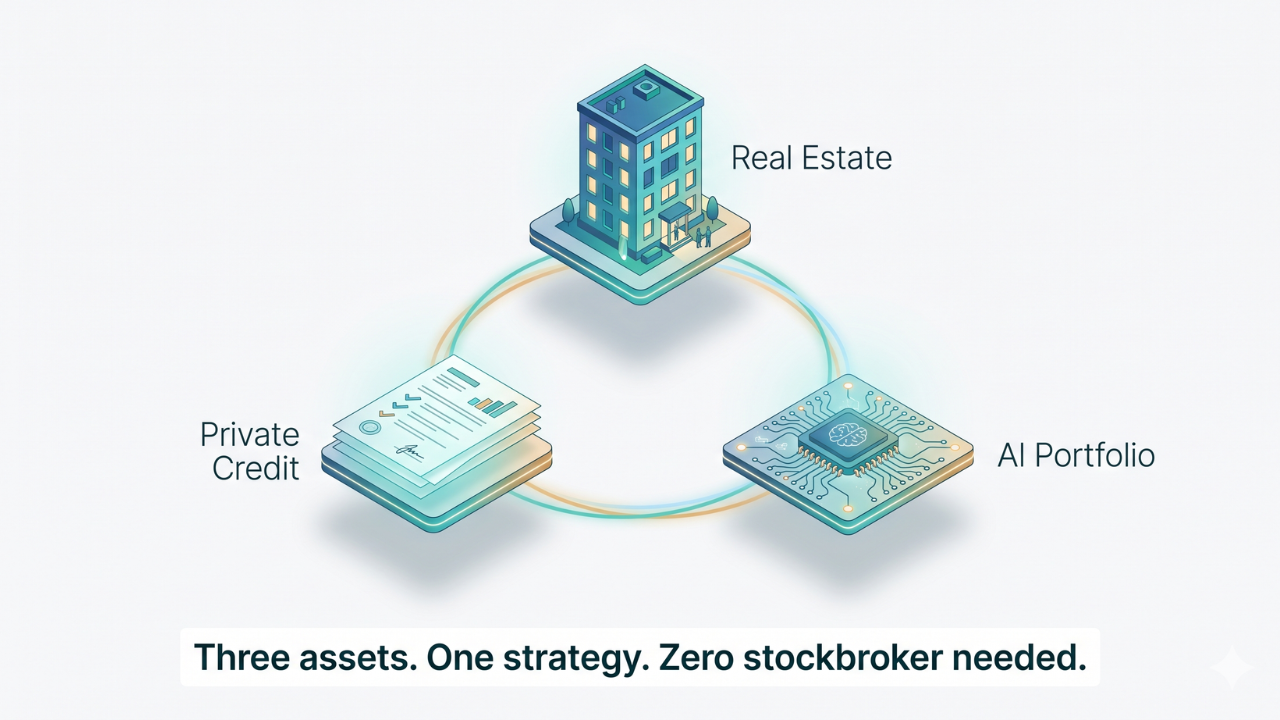
“Three assets. One strategy. Zero stockbroker needed.” — dannywrites.us
When Mia started her Sunday-night research session, she discovered that the new wealth playbook has three core pillars — each one previously locked behind a door that required either a fortune or a connection to open. Let’s break each one down.
Pillar One: Private Credit — Becoming the Bank
When a mid-sized manufacturing company needs $50 million in operating capital and traditional banks won’t move fast enough, they turn to private credit funds. These are pools of investor capital lent directly to businesses at premium interest rates — often 10% to 14% annually. Historically, participating in these funds required a minimum check of $500,000 and an accredited investor status.
Platforms like Percent, Yieldstreet, and Cadence have broken that wall. Today, you can participate in private credit deals with as little as $500 to $1,000. The mechanics are straightforward: you lend capital, the borrower pays interest, and you receive monthly or quarterly distributions. The yields are significantly higher than any savings account, CD, or investment-grade bond — and the returns are largely uncorrelated with the stock market.
Real Numbers from 2025:
The private credit market in the US surpassed $1.7 trillion in assets under management in 2025, according to Preqin data. Institutional investors have allocated an average of 12% of their total portfolios to private credit. Retail investors currently hold less than 2%. That gap is the opportunity.
Pillar Two: Fractional Real Estate — Own Property Without a Mortgage
Real estate has built more generational wealth in America than any other asset class. But the barriers — 20% down payments, property management, geographic limitations, credit requirements — have kept millions of Americans on the sidelines. Fractional real estate investing removes every one of those barriers.
Platforms like Arrived Homes, Fundrise, and Roofstock One allow you to purchase fractional shares of single-family rental homes, commercial properties, and multi-family units for as little as $10 per share. You receive proportional rental income deposited monthly, and your investment appreciates as the property value increases. There’s no tenant communication, no repair calls at 2am, and no property management fees eating your returns.
- No geographic limitation: Invest in high-yield rental markets like Memphis, Tennessee or Birmingham, Alabama without living there.
- Instant diversification: Spread $1,000 across 10 different properties instead of being concentrated in one.
- Tax advantages preserved: Many platforms pass through depreciation benefits to investors, reducing your taxable income.
- Liquidity options: Secondary markets on some platforms allow you to sell your shares before the property is sold.
Pillar Three: AI-Powered Portfolio Management — Your Personal CFO
The third pillar is perhaps the most transformative. Until 2020, having a personal financial advisor who could actively manage your portfolio, optimize for taxes, rebalance based on market conditions, and coordinate across multiple asset classes required either $1 million in investable assets or $500 per hour in advisory fees. Most Americans had neither.
The 2025-2026 generation of AI wealth tools has changed this equation completely. These platforms analyze your complete financial picture — income, spending, tax bracket, existing investments, risk tolerance, time horizon — in real time, then construct and actively manage a personalized portfolio across stocks, bonds, alternative assets, and even cryptocurrency.
The feature that makes the biggest practical difference is tax-loss harvesting — automatically selling positions that are temporarily down to realize a tax loss, then immediately replacing them with similar (but not identical) investments. This single feature can recover 1.5% to 2% of annual returns that most self-directed investors leave on the table every year. On a $50,000 portfolio, that’s $750 to $1,000 of pure tax savings annually — essentially free money.
Mia’s Story: Six Months After That Sunday Night

“Her money now works the morning shift.” — dannywrites.us
Remember Mia? Let’s check back in. She didn’t quit her job. She didn’t take out a loan. She didn’t gamble on cryptocurrency. She spent three Sunday afternoons reading, asking questions in Reddit communities, and watching explainer videos. Then she made three small, deliberate moves:
Move 1: $200/month to fractional real estate
Diversified across 4 single-family rental homes in Tennessee and Georgia. Monthly rental income: $18.
Move 2: $100/month to private credit
Spread across 3 short-term business loans at 11.5% average yield. Monthly interest income: $9.50.
Move 3: AI portfolio for her existing savings
Moved her $4,200 savings into an AI-managed account. First tax-loss harvest: $47 in tax savings.
Six months later, Mia’s money is working three jobs simultaneously. She still has her marketing salary. But now she also has rental income, interest income, and compound portfolio growth — all running on autopilot while she focuses on the work she actually enjoys.
“My AI finance app sent me a notification last Thursday: ‘Your portfolio rebalanced automatically. You saved $47 in taxes through tax-loss harvesting.’ I didn’t do anything. I was at lunch with a friend. My money just… worked.”
— Mia, Austin TX (composite profile)
She still works 9-to-5. But the 9-to-5 no longer works her. That distinction — subtle as it sounds — is the entire point of this article.
Sponsored
Protect Your Financial Data Online
When you’re managing investments across multiple platforms, your financial data is only as safe as your internet connection. NordVPN encrypts your connection on every device — so your portfolio activity, bank logins, and personal data stay private, even on public Wi-Fi.
Secure Your Connection with NordVPN →Your Practical Starter Guide: How to Begin in 2026
Enough theory. Let’s talk about how you actually start. The biggest mistake most people make is waiting until they have “enough” money to begin. The second biggest mistake is trying to do everything at once. Here’s a step-by-step framework designed for someone starting with $500 to $1,000.
Step 1: Audit Your Current Money Situation (30 minutes)
Before you invest a single dollar in alternatives, understand your baseline. List every account you have: checking, savings, 401(k), IRAs, brokerage accounts. Calculate your true monthly cash flow — income minus all fixed expenses. The money you invest in alternative assets should come entirely from surplus — never from emergency funds or money you might need in the next 12 months.
Step 2: Set Up Your AI Portfolio Layer First
The AI portfolio layer is your foundation. Move your existing savings into an AI-managed account before you start allocating to alternatives. This ensures your liquid capital is already working harder while you build your alternative investment knowledge. Look for platforms with these three non-negotiable features: automatic tax-loss harvesting, automatic rebalancing, and transparent fee structures below 0.5% annually.
Step 3: Add Fractional Real Estate as Your Second Layer
Once your AI portfolio is running, allocate a fixed monthly amount to fractional real estate — treat it like a bill you pay yourself. Start with $50 to $100 per month. Prioritize platforms that are SEC-regulated, show audited historical returns (not projected returns), and offer clear information about the specific properties underlying your investment.
What to Watch Out For:
Fractional real estate is illiquid by nature. Unlike a stock, you cannot sell your shares instantly. Most platforms have holding periods of 3 to 7 years. Never invest money you might need access to within that time frame.
Step 4: Layer in Private Credit After 90 Days
Give yourself 90 days to understand how your first two layers work before adding private credit. When you’re ready, apply the 10-15% rule: no more than 10-15% of your total investable portfolio should be in any single illiquid alternative asset. Diversify across at least 3-5 different credit deals — different industries, different borrower profiles, different maturity dates.
Step 5: Automate and Review Quarterly
The goal is to build a system that requires minimal ongoing attention. Set up automatic monthly contributions to each platform. Schedule a quarterly 30-minute review to check performance, reinvest any distributions, and adjust your allocation based on changes in your financial situation. Once automated, this entire system should require no more than 2 hours per quarter of your time.
What They Don’t Tell You: Real Risks to Understand
Every investment carries risk, and alternative investments are no exception. Being honest about these risks is what separates informed wealth building from naive speculation. Here are the risks you need to understand before you start:
- Illiquidity risk: Unlike stocks, you cannot sell most alternative investments on demand. If a financial emergency arises, you may not be able to access these funds quickly. Maintain a separate 3-6 month emergency fund in liquid cash before investing in alternatives.
- Platform risk: You’re trusting a fintech company to operate honestly and competently. Research the platform’s regulatory status, leadership team, investor reviews, and financial backing. Stick to SEC-regulated offerings.
- Default risk in private credit: Businesses can and do fail to repay loans. Diversification across multiple deals mitigates this risk, but does not eliminate it. Historical default rates on reputable platforms have ranged from 2% to 5% annually.
- Real estate market risk: Property values can decline. Rental occupancy is not guaranteed. Economic recessions typically reduce both property values and rental demand simultaneously.
- AI model risk: Robo-advisors and AI portfolio managers are only as good as their underlying algorithms. In highly unusual market conditions — like March 2020 or the SVB collapse — automated systems can behave unexpectedly.
⚠️ Important Disclaimer: This article is for educational and informational purposes only and does not constitute financial, investment, or legal advice. All investment involves risk, including the potential loss of principal. Past performance is not indicative of future results. Always consult a registered financial advisor and conduct your own due diligence before making investment decisions.
The Future of Wealth Is Already Here — The Question Is Whether You’re In It

“Which side are you building on?” — dannywrites.us
The financial industry is in the middle of a once-in-a-generation transformation. The convergence of AI, regulatory reform, and fintech innovation is dismantling barriers that have stood for nearly a century. Private credit, fractional real estate, and AI-managed portfolios are not fringe experiments — they are mainstream financial products being used by millions of Americans right now.
The question is no longer whether these tools are legitimate or whether they work. The question is whether you’re using them. Because while you wait for the perfect moment or the perfect amount of money, inflation is silently taxing your savings and the wealth gap continues to widen.
Mia figured that out on a Sunday night in Austin. She didn’t have a finance degree. She didn’t have a wealthy mentor. She had curiosity, a few hours, and the willingness to start small. The rest followed naturally.
Your money doesn’t have to clock out when you do.
The tools exist. The platforms are regulated. The minimum to start is $10.
The only variable left is you.
Recommended Resources
Build Your Smart Wealth Library
From personal finance books to investment tracking tools — shop our curated Smart Wealth picks on Amazon.
Shop Smart Wealth Resources on Amazon →💡 Frequently Asked Questions
Tags
🌿 Weekly wellness, health & beauty insights — straight to your inbox
Free subscription · Cancel anytime