Disclosure: This article contains sponsored and affiliate links. If you click and make a purchase, Dannywrites may earn a small commission at no extra cost to you. We only feature resources that fit the topic, and our analysis is never for sale. Nothing here is personalized financial, legal or tax advice.
Work & Money · Deep Dive · 35-Minute Read
The job-for-life promise has quietly expired. Here is a sober, data-driven and surprisingly hopeful guide to building a second income stream in the middle of your career, without quitting, without burning out and without falling for the internet’s favorite lies.

It usually starts at the kitchen table, somewhere around 10:40 on a weeknight.
The dishes are done. The kids, if there are kids, are finally quiet. The laptop is open to a banking app, or a retirement account statement, or a LinkedIn post announcing that another “restructuring” has claimed a few hundred people at a company that used to feel permanent. You are somewhere past forty. You are good at your job. And for the first time in your career, you are doing the math on what would happen if that job simply disappeared.
If that scene feels familiar, you are not alone, and you are not being paranoid. It is exactly why searches for side hustles for people over 40 keep climbing. Living in California, I’ve watched this exact moment play out among friends, neighbors and former colleagues for years now: the engineer in San Jose who survived three rounds of layoffs and stopped unpacking his desk, the hospital administrator in Sacramento who started teaching spreadsheets online “just in case,” the marketing director who discovered at 52 that her decades of experience translated into a surprisingly profitable consulting practice on weekends.
None of them quit their jobs. None of them became overnight internet millionaires. What they did was quieter and, I would argue, far more powerful. They built a second door. A small, steady, independent stream of income that belongs to them, not to an org chart.
This guide is about building that door. Not the fantasy version sold in rented-Lamborghini videos, but the realistic version: side hustles for people over 40 that actually fit around a demanding full-time job, a family, aging parents and a body that no longer appreciates all-nighters.
What you will get from this guide
- The real numbers behind job security, age bias and side income in the US today
- Why your age is a competitive advantage, not a handicap
- A practical “one hour a day” system that respects your energy
- Five proven side hustles, each with first steps, realistic income ranges and honest drawbacks
- The scams that specifically target mid-career adults, and how to spot them in seconds
- A 30-day action plan to earn your first dollar online
One quick note on method. The statistics in this article come from public sources such as the US Bureau of Labor Statistics, the Federal Trade Commission, AARP Research, Bankrate and the Upwork Research Institute. The people you will meet along the way, like Mark, Linda and Robert, are composite characters. Each one is drawn from patterns that show up again and again in real stories of mid-career side hustlers, and they are here to make the strategies feel human, not to stand in for data.
Pour yourself something warm. Let’s do the math together.
The Quiet Collapse of the Job-for-Life

Our parents were sold a simple contract. Show up, work hard, stay loyal, and the company would take care of you: a pension, a gold watch, maybe a cake in the break room on your last day. For a generation of Americans, that contract was mostly honored.
That contract has been torn up, and the paperwork proves it.
What the numbers actually say
According to the Bureau of Labor Statistics, the median American wage and salary worker had been with their current employer for just 3.9 years as of January 2024. That is down from 4.1 years in 2022 and the lowest reading since 2002. Older workers still tend to stay longer, with a median of 9.6 years for people aged 55 to 64, but the direction of travel is clear: tenure is shrinking for every age group over 25.
Now layer age bias on top of that. In AARP’s January 2025 survey of Americans 50 and older, 74 percent said they believe their age would be a barrier to getting hired. AARP research has consistently found that about 64 percent of workers 50-plus have seen or experienced age discrimination at work. And a newer AARP survey published in January 2026 found that nearly a quarter of workers 50 and older feel they are being pushed out of their jobs.
Put those two facts side by side and you get the real source of mid-career anxiety. It is not just “What if I lose my job?” It is “What if I lose my job and the market decides I am too old to get another one at the same level?”
The side hustle paradox
Here is the twist that most “make money online” articles skip. Fewer Americans, not more, reported having a side hustle recently. Bankrate’s 2025 Side Hustle Survey found that 27 percent of US adults had one, down from 36 percent the year before and the lowest share since 2017. Among generations, Gen Z led at 34 percent, while just 23 percent of Gen X and 22 percent of baby boomers reported side income.
At first glance, that sounds like a reason to relax. Look closer, and it is actually an opportunity. Bankrate’s analysts attributed the decline largely to a strong job market and cooling inflation, while warning that weakening employment trends could push side hustling back up. In other words, many people only start building a second income when they are already in trouble. Starting now, while you still have a paycheck, is the single biggest strategic advantage you can give yourself.
There is another number worth sitting with. In the same Bankrate survey, 63 percent of Gen X side hustlers reported earning more than $100 a month from their side work, a higher share than any other generation, compared with just 45 percent of Gen Z. Older side hustlers may be outnumbered, but they tend to earn more per person. Experience, it turns out, has a price tag.
By the numbers
- 3.9 years: median US employee tenure, January 2024 (BLS)
- 74%: of Americans 50+ believe age would be a hiring barrier (AARP, 2025)
- 27%: of US adults had a side hustle in 2025 (Bankrate)
- 63%: of Gen X side hustlers earn $100+ per month (Bankrate)
- 16%: of 50+ workers planning a job change want to start their own business, up from 9% (AARP, 2025)
Reframing the goal: not escape, but insurance
Most side hustle content is built around a single fantasy: quit your job and live on your laptop from a beach. For most people over 40, that is the wrong goal. You may have a mortgage, a health plan your family depends on and retirement contributions you are not willing to pause.
A better frame is income insurance. Think of a side hustle the way you think of an emergency fund or a good roof. Its job is not to make you rich. Its job is to make you less fragile. Even a modest $500 a month in independent income changes your psychology in profound ways:
- You negotiate with your employer from a position of calm rather than fear.
- A layoff becomes a painful event instead of a catastrophic one.
- You build skills and a public reputation that exist outside any single company.
- You test a possible “second act” career with real customers before betting everything on it.
Bankrate’s survey found that about 3 in 10 side hustlers believe they will always need a side hustle to make ends meet, while only 16 percent want their side work to become their main income. That is a healthy dose of realism. For most of us, the side hustle is not the destination. It is the safety net that lets us walk the tightrope with our heads up.
So let’s talk about why you, specifically, are better positioned for this than you think.
Sponsored
Ready to Build Your Plan B?
Explore a hand-picked resource for people starting a second income stream in the middle of their careers.
See the Resource →Why Side Hustles for People Over 40 Come With a Hidden Advantage

There is a story the internet likes to tell about side hustles. It stars a 23-year-old with a ring light, a viral video and a dropshipping store that somehow made six figures in a month. If you are 46 and tired, that story can make you feel like you missed the train.
You didn’t. You are standing on a different platform, and your train is arguably better.
The four assets younger hustlers cannot buy
1. Domain expertise. You know how a hospital billing department actually works, why a warehouse loses money in the fourth quarter, what an auditor looks for, how to calm down an angry client or how to get a permit through a city office. That knowledge took you two decades to earn. To someone five years into their career, it is gold, and they will pay to borrow it.
2. A network. Former bosses, colleagues who moved to other companies, vendors, clients, people from your church, your kids’ soccer league or your neighborhood association. Most first side-hustle customers do not come from algorithms. They come from people who already trust you.
3. Judgment. You have seen projects fail. You know the difference between a client who is demanding and a client who will never be satisfied. You can smell a bad deal. That judgment saves you from the expensive mistakes that sink many first-time entrepreneurs.
4. Credibility by default. Fair or not, many buyers associate gray hair with reliability. A 45-year-old accountant offering bookkeeping help, or a 52-year-old nurse writing about caregiving, starts with a level of trust that a younger creator has to work hard to earn.
“Age is a disadvantage when you are asking an employer for permission. It becomes an advantage the moment you start offering your experience directly to the people who need it.”
Meet Mark: the “boring” expert
Mark is 47 and manages logistics for a regional food distributor outside Sacramento. For years he believed he had “no marketable skills” outside his job. He did not code. He did not design. He was not interested in dancing on camera.
Then a friend who ran a small coffee roastery asked him to look at her shipping costs. In two evenings, Mark spotted carrier contracts she was overpaying on and a packaging change that cut damaged shipments. She saved thousands of dollars in a year. She also told three other small business owners.
Within six months, Mark had a simple one-page offer, “Shipping Cost Audit for Small E-commerce Brands,” and was doing two or three audits a month on weekends. He was not famous. He was useful. That is the whole game.
An exercise: your experience inventory
Before you read about specific hustles, take fifteen minutes with a notebook. Answer these questions honestly:
- What do colleagues or friends regularly ask you for help with?
- What problem at work do you solve faster than almost anyone else?
- What did you have to learn the hard way that you wish someone had taught you at 30?
- What tools, software or systems do you know deeply?
- What hobbies or personal experiences have made you unusually knowledgeable, such as caregiving, home renovation, gardening, fitness after 40 or navigating a health condition?
Circle the two or three answers that make you lean forward. Those are the seeds of your side hustle. Everything that follows is about choosing the right container for them.
The One-Hour Rule: Fitting a Side Hustle Into a Full Life

The most common objection I hear from people over 40 is not “I don’t know what to do.” It is “I don’t have the time.” And honestly, that objection deserves respect. Many mid-career adults are part of the sandwich generation, raising kids while helping aging parents, all while holding down demanding jobs.
So let’s do some honest time math.
The math of small hours
One focused hour a day, five days a week, equals about 260 hours a year. That is the equivalent of six and a half full-time work weeks. Add a single three-hour block on Saturday mornings and you are past 400 hours a year.
What can 400 focused hours build? Enough to launch a consulting offer and serve a dozen clients. Enough to write and publish a digital guide plus a set of templates. Enough to publish around 80 blog posts or 50 YouTube videos. Enough to change your financial life.
The secret is not finding more time. It is protecting a small amount of time with ruthless consistency.
Designing your hour for a 40-something brain
Energy, not time, is the scarce resource after 40. A 9 p.m. hour after a brutal workday is not the same as a 6 a.m. hour after a good night’s sleep. Design around that reality:
- Match tasks to energy. Do creative work, like writing, recording or building an offer, when you are freshest. Save low-energy tasks, like answering emails, uploading files or formatting, for tired evenings.
- Use a “next action” note. End every session by writing the very first thing you will do next time. This eliminates the 15 minutes many of us waste deciding where to start.
- Batch on weekends. If weekday evenings are unpredictable, plan to do 70 percent of the work in one Saturday or Sunday block and use weekday minutes only for maintenance.
- Guard your sleep. A side hustle that costs you sleep will eventually cost you your health, your main job performance or both. If you want a deeper look at sustainable energy and stress after 40, the team at WellbeingPrime covers it well.
The “moonlighting” checklist before you start
One unglamorous step that protects everything else: read your employment agreement and employee handbook before you launch. Look specifically for:
- Conflict of interest clauses. Most employers do not mind side work, but they do mind side work that competes with them or serves their clients.
- Intellectual property clauses. Some agreements claim ownership of anything you create using company time, equipment or confidential information. Never use your work laptop, work hours or proprietary data for your side hustle.
- Disclosure requirements. Some industries, such as finance, government and healthcare, require you to report outside income or activities.
Rules vary by state and employer, and California, for example, has specific protections around employee inventions created on your own time. If anything looks unclear, a short consultation with an employment attorney is far cheaper than a dispute later.
How to Choose Among Side Hustles for People Over 40
There are hundreds of possible side hustles. Most lists simply throw 50 ideas at you and hope something sticks. That approach creates paralysis, especially when your time is precious.
Instead, run every idea through four filters:
- Leverage: Does it use experience you already have, or does it require starting from zero?
- Flexibility: Can it be done in evenings and weekends, without live calls during your work hours?
- Startup cost: Can you test it for under $200?
- Compounding: Does the work you do this month keep paying you next year, or do you have to start over every time?
Based on those filters, five categories consistently rise to the top for people over 40. They also line up with what Americans actually do: Bankrate found that online sales (15 percent) and professional services (14 percent) were the two most common side hustle categories in 2025. Here is how the five compare at a glance:
| Side Hustle | Startup Cost | Time to First Dollar | Income Style | Best For |
|---|---|---|---|---|
| Freelance consulting | Very low | 2–6 weeks | Active, high hourly | Deep professional expertise |
| Digital products | Low | 1–3 months | Semi-passive, scalable | Organizers and explainers |
| Online teaching | Low | 2–8 weeks | Active or recorded | Patient communicators |
| Blog and YouTube | Low | 6–12 months | Compounding, long-term | Storytellers, consistent creators |
| Reselling online | Low to moderate | 1–2 weeks | Active, inventory-based | Bargain hunters, hands-on people |
You do not need all five. In fact, please don’t try. Pick one primary hustle, give it six months of honest effort and only then consider adding a second that complements it. Let’s walk through each one in depth.
Side Hustle #1: Turn Your Career Into Consulting Income

If you only read one section of this guide, read this one. Of all the side hustles for people over 40, consulting is usually the fastest to pay. For most professionals over 40, freelance consulting is the fastest path from “I know things” to “I get paid for knowing things.”
Why consulting works so well after 40
The market for independent expertise is enormous. Upwork’s Future Workforce Index, released in April 2025, estimated that 28 percent of US skilled knowledge workers, more than 20 million people, now freelance or work independently, and that together they generated about $1.5 trillion in earnings in 2024. The same research found that skilled freelancers who worked alongside a full-time job reported a median of around $40,000 in freelance income on top of their salaries.
That number will not describe everyone’s first year, and you should not expect it to. But it shows how much room exists for people who package their expertise well.
“Consulting” sounds intimidating, but it simply means solving a specific problem for someone who will pay to have it solved. Common mid-career examples include:
- An HR manager who reviews résumés and runs mock interviews
- A finance professional who sets up bookkeeping systems for small businesses
- A project manager who rescues stalled projects for startups
- A nurse who helps families navigate Medicare paperwork and care decisions
- A sales leader who writes outreach scripts for small agencies
- A teacher who coaches parents through college applications
The productized offer: consulting that fits a full-time job
The biggest mistake new consultants make is selling open-ended hours. “I’ll help with whatever you need” invites endless calls during your workday and scope creep that eats your weekends.
Instead, build a productized offer: a clearly defined service with a fixed scope, a fixed price and a fixed delivery time. Mark’s “Shipping Cost Audit” is a perfect example. The client sends data, Mark reviews it over a weekend, and he delivers a written report with a 30-minute call scheduled on a Saturday morning or a weekday evening.
A strong productized offer answers five questions in one sentence each:
- Who is it for? “Small e-commerce brands shipping 200 to 2,000 orders a month.”
- What problem does it solve? “Overpaying on shipping and losing margin to damaged packages.”
- What do they get? “A written audit with five prioritized savings opportunities.”
- How long does it take? “Delivered within 10 days.”
- What does it cost? “A flat fee, paid up front.”
Your first five clients: a practical playbook
Forget paid ads. Your first clients are almost always within two degrees of you.
- Update your LinkedIn headline to describe the problem you solve, not just your job title.
- Write a short, honest post announcing that you are taking on a small number of projects outside your main role.
- Message 20 people personally: former colleagues, past clients, small business owners you know. Ask for introductions, not sales.
- Offer two discounted “case study” projects in exchange for detailed testimonials.
- List your offer on a freelance marketplace to reach buyers outside your network.
That last step deserves a closer look. Freelance marketplaces handle the parts of freelancing that are hardest to fit around a day job: finding buyers, processing payments and protecting both sides when a project goes sideways. For many mid-career professionals, a well-written marketplace profile is the easiest way to test demand without building a website first.
Sponsored
Sell Your Expertise on Fiverr
Package your experience into a fixed-price service and reach buyers worldwide, on your own schedule.
Start Selling on Fiverr →Pricing: stop charging like an intern
Mid-career professionals chronically underprice. A simple starting point: take your current salary, divide it by 2,000 to estimate your hourly wage, and then multiply by 1.5 to 2 to account for the fact that freelance work comes with no benefits, no paid time off and self-employment taxes. Then convert that into a flat project price based on the hours you expect to spend.
If your first three clients say yes instantly, your price is too low. Raise it for client number four.
The honest drawbacks
- Income stops when you stop. Consulting is active income. No hours, no pay.
- Conflict-of-interest risk. Never consult for your employer’s competitors or clients without written approval.
- Client communication can bleed into work hours. Set clear boundaries in writing, such as “replies within 24 hours on weekdays, calls on Saturdays.”
The good news is that consulting is also the perfect launchpad for the next hustle on our list. Once you have explained the same thing to ten clients, you have the raw material for a product that can sell while you sleep.
Side Hustle #2: Create Once, Sell Forever With Digital Products

Consulting trades hours for dollars. Digital products break that link, which is why they rank among the most scalable side hustles for people over 40. You do the work once, and the product can be sold again and again with almost no additional effort. For people with limited time, that is the closest thing to magic the internet offers.
Let me be clear about one thing first: “passive income” is a slightly dishonest phrase. Digital products require real work up front and steady marketing afterward. But the ratio of effort to income improves dramatically over time, which is exactly what a busy 40-something needs.
What counts as a digital product?
- Templates: spreadsheets, budgets, project trackers, contract templates, meal planners, wedding planners
- Guides and e-books: practical how-to manuals that solve one narrow problem
- Checklists and toolkits: “The New Manager’s First 90 Days Toolkit,” “The Caregiver’s Hospital Discharge Checklist”
- Printables: planners, worksheets, educational materials for teachers and homeschool families
- Swipe files: email scripts, interview answers, sales templates
Meet Linda: the spreadsheet that paid for a vacation
Linda is 51 and works as an operations coordinator for a school district in the Central Valley. For years, she maintained a color-coded spreadsheet to manage her mother’s medications, doctor appointments and insurance claims. When friends in similar situations kept asking for a copy, she cleaned it up, added instructions and a few extra tabs, and listed it online for a modest price.
The first month, she sold four copies. By the end of the year, after writing a few blog posts and answering questions in caregiver forums, she was selling a steady trickle every week. It never replaced her salary. It did pay for a family trip she had postponed for five years, and it gave her something that mattered even more: proof that she could build something of her own.
The five-step digital product launch
- Find a painful, specific problem. The best products solve one narrow problem for one specific group. “Budget template” is crowded. “Budget template for couples paying for a parent’s assisted living” is a niche with urgency.
- Validate before you build. Search the problem on Reddit, Facebook groups and Pinterest. Are people asking for help? Are similar products selling? Competition is actually a good sign; it proves demand exists.
- Build the minimum version. Your first version should take a weekend, not a year. You can improve it based on buyer feedback.
- Choose a platform. Marketplaces such as Etsy offer built-in traffic, while storefront tools like Gumroad, Payhip or your own website give you more control and better margins. Many sellers start on a marketplace and add their own store later.
- Create a simple traffic engine. Pinterest pins, a blog post, a short YouTube walkthrough or an email to your network. One reliable channel is better than five half-hearted ones.
Pro tip: the consulting-to-product pipeline
If you are also consulting, keep a running document of every question clients ask more than twice. After ten clients, those repeated answers become the outline of your first guide or toolkit. You get paid to research your product before you ever build it.
Realistic income expectations
This is where honesty matters. Bankrate’s 2025 survey found that the median side hustler earned about $200 a month, while the average was closer to $885, pulled upward by a smaller group of high earners. Digital products follow a similar curve. Many sellers make a few dollars in their first months; a meaningful minority build reliable monthly income over one to two years by adding products and improving their marketing.
The key insight is compounding. Product number one may sell slowly. Product number five, sold to an audience that already trusts you, often sells on launch day.
The honest drawbacks
- Slow start. Without an audience, early sales are often small.
- Copycats exist. Your template may be imitated. Your defense is quality, updates and your personal story.
- Platform dependence. Marketplace rules and fees can change. Building an email list protects you.
Sponsored
Tools to Launch Your First Digital Product
Discover a resource that helps you turn what you know into something you can sell, even on a tight schedule.
Learn More →Side Hustle #3: Teach What You Already Know

There is a particular kind of joy that many people discover in their forties and fifties: the satisfaction of teaching. After decades of doing, explaining becomes its own reward. And the internet has made it possible to get paid for that joy from your living room. Teaching is one of the most rewarding side hustles for people over 40 because it turns decades of experience directly into value.
Three ways to teach online
1. Live tutoring. One-on-one sessions in academic subjects, test prep, languages, music or professional skills. Platforms connect you with students, or you can find clients through your network. Evening and weekend demand is high, which fits a full-time schedule well.
2. Small-group workshops. A two-hour Saturday workshop on “Excel for Small Business Owners” or “Navigating Medicare for the First Time” can serve ten or twenty people at once. You multiply your hourly value without multiplying your hours.
3. Recorded courses. Record once, sell repeatedly. This is the teaching version of a digital product. Course marketplaces offer built-in audiences, while hosting your own course gives you higher margins.
Meet Robert: the accidental instructor
Robert is 56, a civil engineer in Fresno who has reviewed construction plans for nearly thirty years. When a younger colleague struggled to prepare for a professional licensing exam, Robert spent a few evenings coaching him. The colleague passed and told everyone.
Robert started tutoring two exam candidates on Tuesday and Thursday evenings over video calls. A year later, he recorded his most common explanations into a short course and now runs a monthly Saturday review session for small groups. He describes it as “the most meaningful work I’ve done in a decade,” and it creates a meaningful supplement to his retirement savings.
Getting started without fancy equipment
You do not need a studio. A decent starter setup looks like this:
- A laptop with a built-in or inexpensive external webcam
- A USB microphone, because clear audio matters more than sharp video
- A window facing you for natural light, or an affordable ring light
- A quiet room and a tidy background
- Free video-call software and a simple scheduling link
Total cost: often under $150 if you already own a computer.
What sells best for mid-career teachers
- Professional exam prep: licensing, certifications, industry credentials
- Career skills: interviewing, public speaking, management, negotiation
- Software skills: Excel, QuickBooks, project management tools, AI productivity tools
- Life transitions: retirement planning basics, caregiving, financial literacy for young adults
- Languages and culture: especially if you are bilingual or have lived abroad
If your teaching ideas lean toward later-life transitions, such as retirement, caregiving or reinvention after 50, you will find a wealth of inspiration at Senior Journey Blog, which focuses on exactly those chapters of life.
The honest drawbacks
- Live tutoring is still trading time for money. It does not scale unless you add groups or courses.
- Platform fees can be steep. Some marketplaces take a significant share of each sale.
- Courses need marketing. A course nobody knows about earns nothing. That is why many teachers pair this hustle with a blog or YouTube channel.
Sponsored
Turn Your Knowledge Into Lessons
Check out a recommended resource for professionals who want to teach, tutor or build their first course.
Explore Now →Side Hustle #4: It’s Not Too Late to Start a Blog or YouTube Channel

Among all side hustles for people over 40, content is the long game. I will admit a bias here: I believe in this one deeply, because it is the engine behind everything you are reading right now. Content creation, whether through a blog, a YouTube channel or both, is the slowest side hustle on this list to produce income. It is also the one with the highest long-term ceiling, and the one that makes every other hustle easier.
Why content is different
A consulting client pays you once. A blog post that ranks on Google or a YouTube video that keeps getting recommended can bring you visitors, subscribers and income for years. Each piece of content is a small digital asset. Publish enough of them, and you have a portfolio that works around the clock.
Content also acts as a magnet for your other hustles. Your blog post about shipping costs brings Mark new audit clients. Linda’s YouTube walkthrough of her caregiver spreadsheet sells more templates. Robert’s free exam tips video fills his Saturday workshops.
Why being over 40 is an advantage online
Google has been explicit for years that it rewards content demonstrating experience, expertise, authoritativeness and trustworthiness, often called E-E-A-T. The first “E,” experience, means first-hand knowledge. A 48-year-old writing about managing diabetes while working full time, or a 55-year-old explaining how to plan a career change, brings exactly the lived experience search engines and readers value.
Audiences over 40 are also large, loyal and underserved. Many creators chase younger viewers, leaving huge gaps in topics like midlife career changes, caregiving, health after 50, empty-nest travel and practical personal finance for people closer to retirement than to college.
How content actually makes money
- Display advertising: ad networks pay based on traffic. Modest at first, meaningful at scale.
- YouTube Partner Program: YouTube publishes the eligibility requirements, which include thresholds for subscribers and watch hours, so check its official help pages for the current numbers.
- Affiliate marketing: earning commissions by recommending products you genuinely use, with clear disclosure.
- Your own products and services: consulting, templates, courses. This is usually where the real money is.
- Sponsorships: brands paying to reach your specific audience, which becomes possible even with a modest but focused following.
A sustainable content system for full-time workers
- Pick a narrow niche. “Personal finance” is too broad. “Personal finance for people starting over after 45” is a real lane.
- Use long-tail keywords. Instead of fighting for “make money online,” target specific phrases like “side hustles for people over 40.” Lower competition, higher intent.
- Create one pillar piece per week. One substantial blog post or one well-produced video weekly is enough. Consistency beats volume.
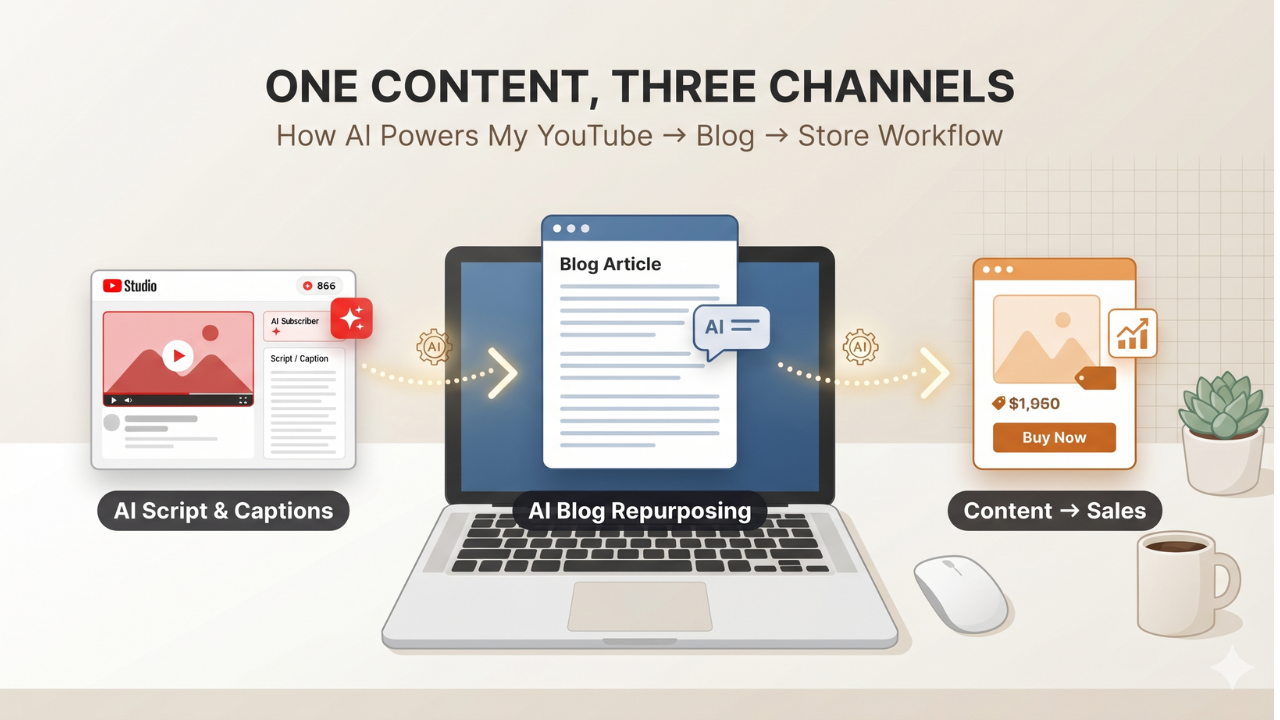
- Repurpose everything. Turn each blog post into a video script, three short clips and five Pinterest pins. One idea, many formats.
- Connect your channels. Embed videos in blog posts, link blog posts in video descriptions and point both toward your products or services.
Reality check
Most new blogs and channels earn little or nothing in their first six months. That is normal, not failure. Think of the first year as planting an orchard. You are not harvesting yet; you are building roots. Creators who quit at month four never see the trees bear fruit at month eighteen.
The honest drawbacks
- Slow money. This is a long game, measured in years.
- Algorithm risk. Search and platform updates can shift traffic overnight. An email list and multiple channels reduce that risk.
- Public exposure. Some people are uncomfortable being visible online. You can build a faceless channel or a blog under your name without showing your face.
Sponsored
Start Your Blog or Channel the Smart Way
A recommended resource for first-time creators who want to build content that keeps working for years.
Get Started →Side Hustle #5: Turn Clutter Into Cash by Reselling Online

Not all side hustles for people over 40 involve a laptop and a ring light. Reselling, buying items at a low price and selling them online for more, is one of the most tangible, fast-feedback side hustles available. It is also one of the most popular: online sales topped Bankrate’s list of side hustle categories in 2025.
For people over 40, reselling has a unique advantage. You remember what things used to cost, which brands were built to last and which vintage items people your age are now nostalgic for. That knowledge is an edge.
Start with what you already own
The best first inventory is free: the things already sitting in your closets, garage and storage unit. Many households in their forties and fifties have accumulated decades of items, from kids’ outgrown gear and sports equipment to kitchen appliances, tools, books, collectibles and clothing.
Selling your own clutter first lets you learn the platforms, photography, shipping and customer service with zero financial risk. And it often funds your first round of sourcing.
Where to source once you are ready
- Thrift stores: brand-name clothing, kitchenware, books and small electronics
- Estate sales and garage sales: tools, vintage items and collectibles, often priced to move
- Clearance aisles: retail markdowns that can be resold online at full or near-full price
- Local marketplace listings: people moving or downsizing who want items gone quickly
Choosing your selling platform
Each major platform has its own personality. eBay is strong for collectibles, tools, electronics and parts. Poshmark and similar apps focus on clothing and accessories. Facebook Marketplace works well for large local items like furniture, where shipping is impractical. Etsy is a fit for vintage and handmade goods. Start with one platform, learn its rhythm and expand later.
A weekend reselling system
- Saturday morning: source for two hours at estate sales or thrift stores.
- Saturday afternoon: clean, photograph and research prices by checking “sold” listings, not asking prices.
- Sunday: write and publish listings in a batch.
- Weekday evenings: 20 minutes to answer messages and pack orders.
- Two mornings a week: drop packages off on your commute.
The golden rule of reselling
You make your money when you buy, not when you sell. Before buying anything, check recently sold prices on your platform and subtract fees, shipping and your time. If the math does not clearly work, walk away.
The honest drawbacks
- Physical space. Inventory takes up room. Set firm limits before your garage becomes a warehouse.
- Physical effort. Sourcing, lifting and shipping can be tiring, so be realistic about your energy.
- Fees and returns. Platform fees and occasional returns can eat margins if you do not price carefully.
Reselling also teaches something valuable for every other hustle: the discipline of tracking real profit. Now let’s talk about the people who would love to take that profit from you.
Avoid These Traps Targeting Side Hustles for People Over 40

Here is an uncomfortable truth: the same anxiety that pushes people toward side hustles for people over 40 makes them prime targets for scammers. Fraudsters know that someone worried about job security, with savings in the bank and limited time to research, is the perfect victim.
The scale of the problem
The Federal Trade Commission’s data is sobering. Americans reported losing $750.6 million to business and job opportunity scams in 2024, up nearly $250 million from the year before. Within that category, losses to job and employment agency scams jumped from about $90 million in 2020 to $501 million in 2024, while the number of reports tripled. And in congressional testimony in March 2026, the FTC said consumers reported a record $15.9 billion in total fraud losses in 2025.
These are only reported losses. The real numbers are almost certainly higher, because many victims never report out of embarrassment.
The seven most common traps
- Task scams. You are “hired” to like videos, rate products or complete simple online tasks. Early on you see small earnings, then you are asked to deposit money, often in cryptocurrency, to unlock bigger tasks. The money never comes back.
- Fake remote job offers. A recruiter contacts you by text or messaging app with a high-paying, low-effort job. Soon they ask you to buy equipment, pay for training or share banking information.
- Overpayment and reshipping schemes. You receive a check for more than you are owed and are asked to wire back the difference, or you are asked to reship packages, which may be stolen goods.
- Expensive “business coaching” programs. High-pressure webinars that promise a proven system for thousands of dollars, often pushing you to use credit cards or retirement funds.
- Pyramid-style recruiting. Opportunities where income depends mainly on recruiting others rather than selling real products to real customers.
- “Done-for-you” stores. Pay a large fee and someone builds you a profitable online store. Usually you receive a generic website and no customers.
- Investment “side hustles.” Crypto or trading schemes disguised as income opportunities. The FTC reports that investment scams caused the largest losses of any category in 2025.
The 10-second red flag test
Before you respond to any opportunity, ask yourself:
- Do I have to pay money to start earning money?
- Did they contact me first, out of nowhere?
- Is the pay wildly out of proportion to the work?
- Are they pushing urgency, like “only three spots left” or “offer expires tonight”?
- Do they want payment in crypto, gift cards or wire transfers?
- Are they vague about what I will actually do?
If you answered yes to even one of these, stop. Every legitimate hustle in this guide can be started for little money, and none requires you to pay a stranger for permission to work.
Protect your digital life, too
Running a side business online means more logins, more payments and more personal data moving across the internet. Basic digital hygiene goes a long way:
- Use a password manager and unique passwords for every platform.
- Turn on two-factor authentication for email, banking and selling accounts.
- Open a separate bank account and email address for your side hustle.
- Avoid logging in to financial accounts on public Wi-Fi at coffee shops or airports without protection.
- Report suspected fraud at ReportFraud.ftc.gov.
Sponsored
Work Online Safely With a VPN
Encrypt your connection when you manage clients, payments and accounts from home, cafés or the road.
Protect Your Connection →The Boring Stuff That Protects Your Money: Taxes, Records and Retirement
Nobody starts a side hustle because they love bookkeeping. But every one of the side hustles for people over 40 in this guide creates taxable income, and a little structure at the beginning prevents painful surprises in April.
Side income is taxable income
In the US, income from a side hustle is generally taxable, whether or not you receive a tax form for it. If your net earnings from self-employment reach $400 or more in a year, the IRS generally requires you to file and pay self-employment tax, which covers Social Security and Medicare. Reporting thresholds for payment app and marketplace forms have changed several times in recent years, so check IRS.gov for the current rules rather than relying on old articles.
Five habits that save headaches
- Separate your money. A dedicated checking account for your side hustle makes tracking simple.
- Save a tax buffer. Many side hustlers set aside a portion of every payment, often in the range of 25 to 30 percent, for taxes. Your situation may differ.
- Track expenses. Software, equipment, platform fees and a portion of home office costs may be deductible when they are ordinary and necessary for the business.
- Understand estimated taxes. If your side income grows, you may need to make quarterly estimated tax payments.
- Talk to a tax professional once your side income becomes meaningful. A single consultation can pay for itself.
The retirement bonus most people miss
Here is a hidden benefit for people over 40: self-employment income may allow you to contribute to additional retirement accounts, such as a Solo 401(k) or a SEP IRA, on top of your workplace plan, subject to IRS limits. For someone in their late forties or fifties trying to catch up on retirement savings, that can be powerful. A financial or tax professional can help you understand what applies to you.
Matching Side Hustles for People Over 40 to Your Life Stage
A 42-year-old with toddlers and a 58-year-old empty nester are both “over 40,” but their calendars, energy levels and financial goals look nothing alike. The right side hustle is not the one with the biggest income screenshot online. It is the one that fits the shape of your actual week.
Early forties: the time-starved builder
If you are juggling young children, a demanding career and maybe a mortgage that still feels new, your scarcest resource is unbroken time. Favor hustles that can be done in short, interruptible bursts: digital products, written content and asynchronous consulting delivered as reports rather than live calls. Your goal at this stage is to plant seeds that compound, so that by your late forties you have assets working for you.
Late forties to mid-fifties: the peak-expertise earner
This is often the window when your professional knowledge is at its deepest and your network is at its widest. Many people in this stage also have slightly more evening freedom as children grow older. It is the ideal moment for high-value consulting, small-group workshops and professional exam coaching. Charge for your expertise accordingly. You are not a beginner, so do not price like one.
Late fifties and beyond: the bridge builder
As retirement comes into view, a side hustle can become a bridge between full-time work and whatever comes next. Teaching, mentoring and content creation tend to shine here, because they reward wisdom and storytelling and can scale down gracefully as you choose to work less. For many people, a well-built side business becomes a semi-retirement income stream that keeps them engaged, connected and purposeful.
Special situations worth planning around
- Caregivers: Choose work with flexible deadlines and no fixed live hours. Digital products and reselling from home are strong fits.
- Recently laid off: Consulting can generate income fastest while you job hunt, and it keeps your skills visible to potential employers.
- Health limitations: Prioritize low-physical, schedule-flexible options like writing, tutoring or template design, and build in rest from day one.
- Couples: Many of the most durable side businesses are run by two people who split the work, for example one creates while the other handles listings, customer emails and bookkeeping.
Five mistakes that quietly kill mid-career side hustles
- Starting three things at once. Focus wins. Split attention produces three half-finished projects.
- Buying courses instead of taking action. One good free resource and a real customer will teach you more than five expensive programs.
- Waiting until it feels perfect. Version one is supposed to be a little embarrassing. Ship it.
- Underpricing out of insecurity. Your experience is the product. Price it like it matters.
- Quitting in month three. Most side hustles look like failures right before they start working. Commit to six months before judging the results.
Keep this section in mind as you start the plan below. The best 30 days are the ones designed around your real life, not an imaginary version of yourself with unlimited energy.
Your 30-Day Action Plan to Your First Side Income
Information without action is just entertainment. Reading about side hustles for people over 40 changes nothing until you start one. So here is a simple, realistic plan designed for someone with a full-time job and about one hour a day. The goal is not to get rich in 30 days. The goal is to earn your first dollar, because the first dollar changes everything.
Week 1: Clarity (Days 1–7)
- Day 1: Complete the experience inventory exercise from earlier in this guide.
- Day 2: Review your employment agreement for moonlighting, IP and conflict-of-interest rules.
- Day 3: Choose one primary hustle from the five in this guide.
- Day 4: Research ten people already doing it successfully. Note what they offer and charge.
- Day 5: Define your first offer in one sentence: who, what problem, what result.
- Day 6: Block your protected side hustle hours on your calendar for the next 30 days.
- Day 7: Rest. Seriously. Sustainability starts now.
Week 2: Build (Days 8–14)
- Open a separate bank account and email for your side hustle.
- Create the minimum version of your offer: a one-page service description, a first template, a lesson outline, a starter blog post or ten listings of items from your home.
- Set up your profile on one platform, whether a freelance marketplace, Etsy, a tutoring site, a blog or eBay.
- Ask two trusted friends to review your offer and give blunt feedback.
Week 3: Launch (Days 15–21)
- Publish your offer, product or listings.
- Share it with your network through a LinkedIn post, personal emails or a community group.
- Personally message 20 people who might need it or know someone who does.
- Offer a small “founding customer” discount in exchange for feedback.
Week 4: Learn and Improve (Days 22–30)
- Deliver excellent work to your first customer, even if it is just one.
- Ask for a testimonial or review.
- Write down what worked, what did not and what customers asked about.
- Adjust your price, description or platform based on what you learned.
- Set one goal for the next 30 days, such as three clients, ten sales or eight blog posts.
Remember
If you earn $20 in your first month, you have not failed. You have proven that someone, somewhere, will pay you directly for your value without an employer in the middle. That proof is worth more than the money.
Sponsored
Take the First Step Today
Explore a featured resource to help you turn your 30-day plan into real progress.
Check It Out →Your Second Act Starts Today
Let’s go back to that kitchen table at 10:40 on a weeknight.
The laptop is still open. The anxiety is still real. The headlines about layoffs and shrinking job tenure have not gone anywhere. But something has shifted. You now know that your age is not a liability in the independent economy; it is leverage. You know that one protected hour a day adds up to hundreds of hours a year. You know five realistic ways to turn experience into income, and you know exactly which traps to avoid.
Most importantly, you know that the goal is not to escape your life. It is to strengthen it. Side hustles for people over 40 are not about chasing a fantasy. They are about building a small, sturdy structure of independence that no restructuring memo can take away.
Mark did not become a famous consultant. Linda did not become a template millionaire. Robert did not quit engineering. Each of them simply built a second door. And every one of them will tell you the same thing: the hardest part was the first hour.
Yours can start tonight.
If you are navigating life, work and money in the US as a newcomer or between cultures, you may also enjoy the practical guides at SeoulCast. And if this guide helped, share it with one friend over 40 who has been doing the same late-night math. Sometimes the best gift is permission to begin.
💡 Frequently Asked Questions (FAQ)
Q1. Is it too late to start a side hustle after 40 if I have no online experience?
No. Online skills can be learned in weeks, but the professional judgment, domain expertise and network you have built over 20 years cannot be rushed. Data backs this up: Bankrate’s 2025 survey found that 63 percent of Gen X side hustlers earn more than $100 a month, a higher share than any other generation. Start with a hustle that leverages what you already know, such as consulting or teaching, and learn the technical pieces as you go.
Q2. How much can I realistically earn from a side hustle while working full time?
It varies widely. Bankrate found the median side hustler earned about $200 a month in 2025, while the average was about $885, pulled up by high earners. At the upper end, Upwork research found skilled professionals freelancing alongside a full-time job reported a median of around $40,000 a year in freelance income. Expertise-based hustles tend to pay more per hour, while content and digital products start slowly but compound over time.
Q3. How can I tell a legitimate side hustle from a scam?
The clearest warning sign is being asked to pay money before you can earn money, especially through crypto, gift cards or wire transfers. Unsolicited job offers, pay that is wildly out of proportion to the work and high-pressure deadlines are other red flags. The FTC reported $750.6 million in losses to business and job opportunity scams in 2024, so skepticism is a strength. Legitimate hustles like consulting, digital products, teaching, content and reselling can all be started for little money.
Sources: US Bureau of Labor Statistics, Employee Tenure in 2024; AARP Research surveys of workers 50+ (January 2025 and January 2026); Bankrate 2025 Side Hustle Survey; Upwork Research Institute, Future Workforce Index 2025; Federal Trade Commission Consumer Sentinel data (March 2025) and FTC testimony to the Joint Economic Committee (March 2026). This article is for educational purposes and is not financial, legal or tax advice.
🌿 Weekly wellness, health & beauty insights — straight to your inbox
Free subscription · Cancel anytime